
Ga onbeperkt met Magzter GOLD
Krijg onbeperkte toegang tot meer dan 9000 tijdschriften, kranten en Premium-verhalen voor slechts
Indian Tea Industry Needs Comprehensive Reform
BUSINESS ECONOMICS
|April 16-30, 2019
The Indian Tea association has been playing a multi-dimensional role towards formulating policies for the growth of the Indian tea industry since 1881. Arijit Raha, Secretary General of Indian Tea Association, spoke to BE's Ellora De.
-

Q) Unremunerative prices seem to eat into the margins of the tea companies. How can prices be increased?
A. It is true that tea prices in India have been stagnating for the last five years. The erosion of margins is primarily attributed to the impact of rising costs in the backdrop of stagnating prices. While input costs have witnessed a compound annual growth rate (CAGR) of more than 10% over the last decade, the CAGR of tea prices have been around 5%. The auctions being a prime channel of sale, serve as a benchmark for tea prices and are indicative of the market trends. In recent years, auction buying patterns suggest a higher preference for teas in the mid and lower end of the pyramid.
Tea production in India has grown significantly from a level of 980 million kg in 2008 to 1312 million kg in 2018. The spurt in production has been largely contributed by the small tea grower (STG) segment. In fact, during the period 2014-18, the STG production has increased by 223 million kg – an increase of 56%. During this period, the estate sector crop has declined by 13%. The last decade has seen the emergence of a dual cost paradigm. The STG sector’s tea harvest is primarily sourced by the Bought Leaf Factories (BLFs), which has the advantage of manufacturing teas at a substantially lower cost than the estate sector where high fixed overheads burden the cost of production. The large variance in the cost of production gives the BLF sector a competitive edge to offload teas at a lower price which is often below the cost of production of the estate sector.
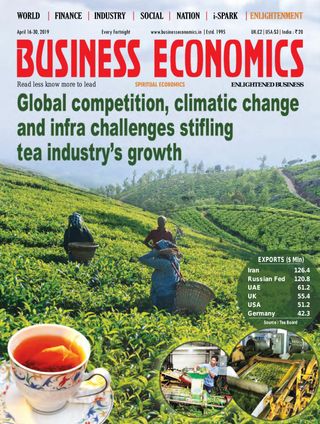

Dit verhaal komt uit de April 16-30, 2019-editie van BUSINESS ECONOMICS.
Abonneer u op Magzter GOLD voor toegang tot duizenden zorgvuldig samengestelde premiumverhalen en meer dan 9000 tijdschriften en kranten.
Bent u al abonnee? Aanmelden
MEER VERHALEN VAN BUSINESS ECONOMICS

BUSINESS ECONOMICS
Rupee has weakened
The rupee has weakened significantly over the past year, falling from 84.7 to 89.7 against the US dollar. Its depreciation has been even sharper against the euro (9.4 per cent) and the British pound (14.3 per cent). It has also lost value against the Japanese yen and the Chinese yuan. In nominal terms, therefore, the rupee has depreciated against all major global currencies.

1 mins
December 1 - 31, 2025

BUSINESS ECONOMICS
Foundations of Indian Yoga Philosophy
Yoga, in very simple terms, means union.
4 mins
December 1 - 31, 2025

BUSINESS ECONOMICS
The New Indian Professional: Work, Wealth & Wellness in 2026 Changing aspirations, consumption patterns, and lifestyle expectations
As 2025 draws to a close, a new archetype is emerging across India's corporate and entrepreneurial landscape.
4 mins
December 1 - 31, 2025
BUSINESS ECONOMICS
Where Rhythm Meets Divinity: A Three-Day Odyssey of Indian Classical Art
An Artistic Journey Through Dance, Melody & Tradition (27-29 November 2025)
3 mins
December 1 - 31, 2025
BUSINESS ECONOMICS
Bharat Electronics Ltd
BEL is a public sector undertaking (PSU) under the Indian government's Ministry of Defence.
2 mins
December 1 - 31, 2025

BUSINESS ECONOMICS
A New Crisis: Impact of US Tariff hikes on UP's Industries
Long-established industrial centres such as Kanpur, Moradabad, Bhadohi and Firozabad are currently facing severe disruptions due to the imposition of steep US tariffs.
2 mins
December 1 - 31, 2025

BUSINESS ECONOMICS
Nobel Prize in Physiology or Medicine 2025 Significance of the Laureates' Work in the Medical World
Mary E. Brunkow, Fred Ramsdell, and Shimon Sakaguchi have been awarded the 2025 Nobel Prize in Physiology or Medicine for their pioneering discoveries on peripheral immune tolerance—the mechanisms that prevent the immune system from attacking the body’s own tissues.
2 mins
December 1 - 31, 2025

BUSINESS ECONOMICS
The RBI's Balancing Act: Strategy and Execution in 2025
In 2025, the Reserve Bank of India (RBI) has adopted a cautious yet steady monetary policy, distinguishing itself from the more aggressive actions of several global central banks.
3 mins
December 1 - 31, 2025

BUSINESS ECONOMICS
From stagnation to surge: 10 reasons the Indian market rallied hard
The Indian stock market spent most of 2025 moving sideways in a narrow and frustrating band.
5 mins
December 1 - 31, 2025

BUSINESS ECONOMICS
Uttar Pradesh witnesses renovations of pilgrimage sites propelling multi-dimensional growth
Last month, Prime Minister Narendra Modi ceremonially hoisted the saffron flag, the Dharma Dhwaj, atop the Ram Temple in Ayodhya, marking the completion of the temple's construction.
3 mins
December 1 - 31, 2025
Translate
Change font size