
Ga onbeperkt met Magzter GOLD
Krijg onbeperkte toegang tot meer dan 9000 tijdschriften, kranten en Premium-verhalen voor slechts
The Mezger effect
Racecar Engineering
|August 2020
Porsche’s legendary engine designer died in June at the age of 90, but leaves behind a wonderful legacy both on the road and track

Shortly before the 50th anniversary of Porsche’s first win at Le Mans, the German company reported the death of Hans Mezger, the man who designed the engine for that Porsche 917, and who was instrumental in the development of many significant Porsche racing and road car engines. Mezger was also responsible for the engine that powers what’s commonly known as the Porsche 911 and was so highly regarded that those are known today as the Mezger engines.
Hans Mezger was born on November 18, 1929, in Ottmarsheim, a small village near Ludwigsburg on the outskirts of Stuttgart. At the age of 15, just three weeks before the end of the war, he escaped being enlisted into the German army by a stroke of luck and a faked medical certificate from a German commander. A year later, while continuing his grammar school studies, he attended his first race at Hockenheim.
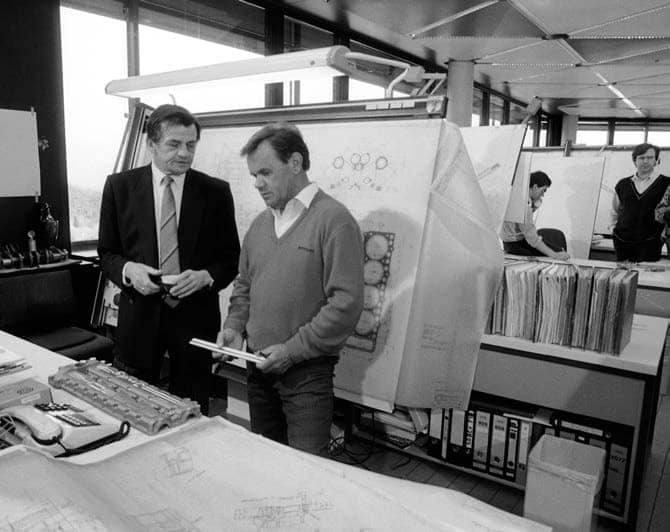
Having taken his A-levels in Ludwigsburg, Mezger decided to study mechanical engineering at the Technical University, now the University of Stuttgart. However, at this time the German universities were very crowded because the young men who had returned from the war were given preferential treatment for admission.
When he reached the required age, he used the university requirement for a 12-month internship to gain valuable experience in machining, welding and model making and spent a few weeks in the grey cast iron and aluminium foundry.


Dit verhaal komt uit de August 2020-editie van Racecar Engineering.
Abonneer u op Magzter GOLD voor toegang tot duizenden zorgvuldig samengestelde premiumverhalen en meer dan 9000 tijdschriften en kranten.
Bent u al abonnee? Aanmelden
MEER VERHALEN VAN Racecar Engineering

Racecar Engineering
Talk the torque
More thoughts on in-wheel motors and their effects on twisting force

6 mins
December 2021

Racecar Engineering
Rolling about
An explanation of the limitations of a previous load transfer article, bringing jacking forces into the mix
5 mins
December 2021

Racecar Engineering
F1 breaks schedule records
The FIA has confirmed no fewer than 23 races on the 2022 Formula 1 World Championship schedule, the highest number of grands prix ever to be held in a single season, and that has led to criticism from some teams that will be on the road for eight months.
1 mins
December 2021

Racecar Engineering
Under pressure
Toyota may have finished first and second at Le Mans this year, but the effort required to overcome a fuel delivery problem and finish with both cars was Herculean
12 mins
December 2021

Racecar Engineering
Physics at work
Dutch company, Intrax, offers Racecar Engineering an insight into the technologies it employs to optimise its suspension products
4 mins
December 2021

Racecar Engineering
Williams' 2030 ambition
Williams Racing has committed to becoming climate positive by 2030 as part of an all-new sustainability strategy.
1 min
December 2021

Racecar Engineering
Diff'rent strokes
Racecar looks at the different types of mechanical differential, their benefits and limitations
14 mins
December 2021

Racecar Engineering
Das Boot
A curious Twitter exchange fired up a unique, hydrogen-powered, cross-country project that will contest the Baja 1000 in November 2022
8 mins
December 2021

Racecar Engineering
Air born
Every racecar engineer's dream is a blank sheet of paper design. When Hoonigan and Subaru approached Vermont Sportscars about building the next generation of Gymkhana racer, that's just what the company was given
8 mins
December 2021

Racecar Engineering
Remote control
Called variously ‘virtual garages’, ‘mission control’ or ‘race support rooms’ is the future of race engineering sitting in the warm back at HQ?
14 mins
December 2021
Translate
Change font size