
Ga onbeperkt met Magzter GOLD
Krijg onbeperkte toegang tot meer dan 9000 tijdschriften, kranten en Premium-verhalen voor slechts
Poging GOUD - Vrij
New Production Trend Hits South Africa
Farmer's Weekly
|May 24, 2019
The implementation of regenerative agriculture principles is allowing a growing number of farmers to reduce their inputs while producing similar or even better yields than they would have produced if they used conventional farming practices. Glenneis Kriel reports.

Regenerative agriculture is the latest buzz in responsible agricultural management. It is similar to conservation farming in that it combines the use of stubble retention, crop rotation and the minimum disturbance of the soil to promote soil health, but is on a higher level as it also incorporates the use of cover crops, compost teas, compost and manure (to avoid using synthetic fertilisers), pesticides and genetically modified organisms (GMOs).
While having the same aims, it moves beyond the simple definition of ‘organic’ and ‘biological’ production, aiming not only to replace chemical inputs with so-called natural inputs, or to improve microbiological diversity, but to adapt farming practices to what is happening in and around the plant, and to essentially mimic rather than work against nature.
The first thing to change when switching to regenerative farming is your mindset, says Prof Buz Kloot from the University of South Carolina in the US. Kloot, a proponent of regenerative farming, has been documenting regenerative farming practices in the US since 2011.
During a recent regenerative farming conference in Cape Town, he explained that farmers are often led to look for quick fixes to improve production outcomes. Regenerative agriculture, in contrast, is built on a “soil health mindset”, which is “more about thinking through what you are doing and where you are going with your production practices”.
It is based on the understanding that soil is a living, dynamic ecosystem and not just a growth medium. “Soil health, in effect, should be seen as a journey and not a destination, with production strategies continuously being adapted to accommodate changes in the system.”
It is also not about equipment, but about understanding how systems work.
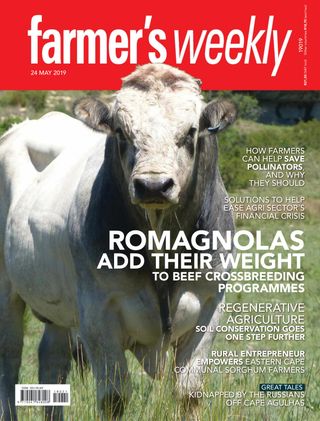

Dit verhaal komt uit de May 24, 2019-editie van Farmer's Weekly.
Abonneer u op Magzter GOLD voor toegang tot duizenden zorgvuldig samengestelde premiumverhalen en meer dan 9000 tijdschriften en kranten.
Bent u al abonnee? Aanmelden
MEER VERHALEN VAN Farmer's Weekly

Farmer's Weekly
More about growing vegetable seedlings in trays
By considering various factors and tailoring care to specific vegetable needs, you can produce healthy, robust seedlings ready for transplanting into the garden, writes Shane Brody.

2 mins
March 27 - April 3, 2026

Farmer's Weekly
Prodigy of agriculture and land is now a presidential envoy
Wandile Sihlobo will be armed by state powers to accelerate any decision-making that the Presidency deems crucial to grow the sectors of agriculture and land
2 mins
March 27 - April 3, 2026

Farmer's Weekly
Notes from the Western Cape agricultural roadshow
We spent time last week engaging with agribusinesses and farmers in the Western Cape. The primary agricultural focus of the province is various fruits, citrus, table grapes, wine, wheat, barley, livestock, and aquaculture, among many value chains.
3 mins
March 27 - April 3, 2026

Farmer's Weekly
AGOA's promise fades under new US tariffs
Although the African Growth and Opportunity Act has been extended for another year, new US reciprocal tariffs have largely erased its duty-free benefits. Recent modelling shows sharp declines in African exports to the US, particularly in apparel-dependent economies such as Lesotho and Madagascar.
4 mins
March 27 - April 3, 2026
Farmer's Weekly
Egon Zunckel: a lifetime of learning from the soil
The Zunckel name is synonymous with no-till farming in South Africa. Egon Zunckel, a pioneer in the field and a passionate advocate for soil health, shared with Lindi Botha the lessons he has learnt over the years about building resilient soils and sustainable farming systems.
10 mins
March 27 - April 3, 2026
Farmer's Weekly
Researchers explore new tools to combat herbicide resistance
Research by students from Stellenbosch University aimed at combatting herbicide resistance was highlighted during a recent technical trial information day hosted by the Western Cape Department of Agriculture.
6 mins
March 27 - April 3, 2026

Farmer's Weekly
Lepas leaps into South Africa as the latest Chery-owned brand
Lepas has become Chinese carmaker Chery's latest local subbrand with the introduction of the L4 compact SUV. The Citizen's Charl Bosch reports.
2 mins
March 27 - April 3, 2026
Farmer's Weekly
La Rhone Limousins: a small mixed herd turned renowned stud
The Western Cape is not typically known for cattle farming, particularly in its fruit-growing regions. Yet nestled among the orchards below the mountains of Tulbagh is a Limousin stud that has made a name for itself. AJ du Toit of La Rhone Limousins spoke to Henning Naudé about producing high-quality genetics now found on farms in all nine provinces.
6 mins
March 27 - April 3, 2026
Farmer's Weekly
Nitrogen: no easy fix
Products that claim to herald a nitrogen revolution that will boost global food production are nothing more than snake oil, say scientists.
4 mins
March 27 - April 3, 2026

Farmer's Weekly
Potato soup
Rich, creamy, and indulgent, this soup is the ultimate in comfort food.
1 mins
March 27 - April 3, 2026
Translate
Change font size