Poging GOUD - Vrij
Light And Its Effects On Plant Growth
Farmer's Weekly
|24 February 2017
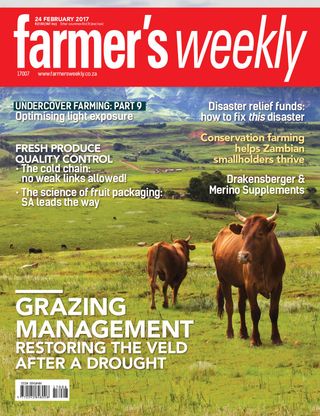
The most important variable affecting plant growth is light exposure, and it is therefore important to measure the amount of light your plants receive. Prof Gert Venter explains how this is done.

The most important concept to understand when growing plants is the rule of limiting factors, which determines plant quality. Hydroponics cannot compensate for poor growing conditions, such as improper temperature, insufficient irrigation, nutrient deficiencies, pest and disease problems, or poor light.
Light is the most important variable influencing plant growth.
If plants do not receive enough light, they will not grow at their maximum rate or reach their maximum potential, regardless of how much of any other variable – water, growth medium or fertiliser – they receive.
INCREASING LIGHT INCREASES YIELD
Light is the driving force for photosynthesis, a plant process that changes sunlight into chemical energy. During photosynthesis, water is split in a chemical reaction in which it is separated into oxygen and hydrogen, and carbon dioxide (CO 2) is converted into sugar. A general rule of thumb is that 1% more light will give you a similar percentage increase in plant growth, resulting in a 1% higher yield.
All plants require light and CO 2 for photosynthesis. Adequate spacing between plants will ensure that each plant receives sufficient light in the greenhouse. Tomato plants pruned to a single stem are spaced at 2,7 plants/ m 2 to three plants/m 2 . Seedless cucumbers, with their larger leaves, require almost double this spacing. Hydroponic lettuce spacing varies from 2,5cm 2 for first-stage seedlings to 15cm 2 for final spacing.

Dit verhaal komt uit de 24 February 2017-editie van Farmer's Weekly.
Abonneer u op Magzter GOLD voor toegang tot duizenden zorgvuldig samengestelde premiumverhalen en meer dan 9000 tijdschriften en kranten.
Bent u al abonnee? Aanmelden
MEER VERHALEN VAN Farmer's Weekly
Farmer's Weekly
How AFGRI uses technology to unlock farm finance from asset to market
As modern farming becomes more capital-intensive and digitally driven, AFGRI is reinventing agricultural finance by linking technology directly to lending decisions.

5 mins
January 16-23, 2026

Farmer's Weekly
Adele's Mohair: a living tapestry of craft, colour and rural heritage
Octavia Avesca Spandiel spoke to Adele Cutten, founder of Adele's Mohair, to explore how a small spinning experiment grew into a thriving rural craft enterprise rooted in South Africa's rich mohair heritage.
6 mins
January 16-23, 2026
Farmer's Weekly
How Merino farmers are battling predation, disease and rising costs
Whether you are a stud breeder or commercial Merino farmer, environmental, operational, and infrastructural challenges have an equal impact on a farming operation. The aim of any livestock farmer, whether stud or commercial, is to keep losses at a minimum, and although farmers are facing many challenges, they implement various strategies to ensure both the survival and financial security or profitability of farming operations.
9 mins
January 16-23, 2026
Farmer's Weekly
The future of SA wool: refined infrastructure and wool traceability
As the agriculture sector starts to adapt to the fast-paced development of technology, producers and processors need to decide what to implement and what to avoid. Henning Naudé spoke to Izak Klopper, manager of shearer training at the National Wool Growers' Association, about how shearing has changed, and what the industry can expect from new research and development from international markets.
5 mins
January 16-23, 2026
Farmer's Weekly
Cannabis and marketing in South Africa
The path from cultivation to commercial success remains complicated by regulatory ambiguity. Cultivators who master compliant marketing while delivering verifiable quality will build sustainable businesses, says Thomas Walker.
2 mins
January 16-23, 2026
Farmer's Weekly
Foot-and-mouth disease project targets waste reduction and regulatory reform
A groundbreaking research collaboration between Red Meat Industry Services, the University of Pretoria, and global animal health leader Zoetis is aiming to transform South Africa's approach to foot-and-mouth disease.
3 mins
January 16-23, 2026
Farmer's Weekly
What to expect in 2026
The world faces a complex interplay of economic, geopolitical, environmental, technological, and social pressures.
3 mins
January 16-23, 2026

Farmer's Weekly
How drones are revolutionising pest and disease detection in agriculture
Drones are reshaping modern crop protection by giving farmers a powerful new vantage point: the sky. With advanced sensors, high-resolution imaging, and artificial intelligence-driven analytics, these unmanned aerial vehicles can detect early signs of disease, water stress, and pest damage long before the human eye can. Jedrie Harmse spoke to agricultural drone specialist Monique Heydenrych.
7 mins
January 16-23, 2026
Farmer's Weekly
Generic advertising in perspective
Dr Koos Coetzee explains how industry organisations and the agriculture sector actually have the ability to prudently manage the negative perceptions surrounding generic advertising campaigns.
2 mins
January 16-23, 2026
Farmer's Weekly
The modern Merino: the benchmark breed
The Merino breed has transformed dramatically over the past seven decades-from the skin-folded wool specialists of the 1950s to today's plain-bodied, fertile, well-balanced sheep prized for their dual-purpose productivity. Yet, despite its versatility, myths persist. Willie van Heerden, manager at Merino South Africa, dispels some of these myths.
2 mins
January 16-23, 2026
Translate
Change font size