Poging GOUD - Vrij
Keep Accurate Records for Maximum Economic Impact
Farmer's Weekly
|24 March 2017
Derick le Roux and his father, Carl, own the only 5-Star Breedplan accredited stud in South Africa. Derick explains to Gerhard Uys how record-keeping can optimise profit in any production environment.

Whereas South Africa’s crop farmers are among the most efficient in the world, there is certainly room for improvement in beef production. And at the heart of this lies better record-keeping.
This is according to stud breeder Derick le Roux (25), who, with his father, Carl, owns Xourel Limousins near Lichtenburg in North West, the country’s only 5-Star Breedplan Completeness of Performance Data stud.
Once a beef producer has defined his goals and his production system, he can use information about pedigree, health, feed and marketing to improve the system and increase profits, says Derick.
“If you have 1 000 commercial cattle, say, and, through recordkeeping, manage to increase your calving rate from 80% to 90% (900 calves instead of 800 calves annually), you can earn an extra R450 000/year without additional costs.
“Even if you have to employ someone to keep the records and push up the calving percentage, or pay a cattle consultant R4 000/ day, it remains profitable.”
He points out that South Africa has about 14 million head of cattle, of which between five and six million are owned by smallholders, and the average intercalving period is 700 days. Reducing this to 400 days would therefore make an immense difference.
“It would mean going from 14 million head of cattle to perhaps 17 million on the same amount of grazing, because a cow without a calf still eats roughly the same amount of grass. Livestock farmers outside the economy could become players. It all starts with keeping records.”
There is a proviso, he stresses. In order to keep ‘economically efficient’ records, a fixed breeding and calving season is necessary.
“Without a calving season, you cannot compare average weaning weights, as these will differ every three months or according to seasonal changes and nutritional state of the veld or pasture,” he explains.
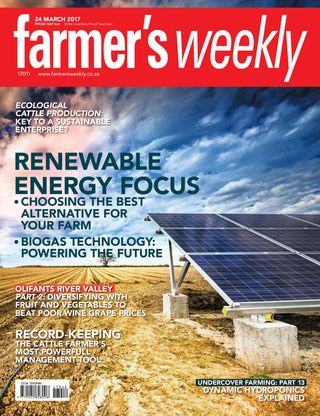

Dit verhaal komt uit de 24 March 2017-editie van Farmer's Weekly.
Abonneer u op Magzter GOLD voor toegang tot duizenden zorgvuldig samengestelde premiumverhalen en meer dan 9000 tijdschriften en kranten.
Bent u al abonnee? Aanmelden
MEER VERHALEN VAN Farmer's Weekly
Farmer's Weekly
Cannabis and marketing in South Africa
The path from cultivation to commercial success remains complicated by regulatory ambiguity. Cultivators who master compliant marketing while delivering verifiable quality will build sustainable businesses, says Thomas Walker.

2 mins
January 16-23, 2026
Farmer's Weekly
Foot-and-mouth disease project targets waste reduction and regulatory reform
A groundbreaking research collaboration between Red Meat Industry Services, the University of Pretoria, and global animal health leader Zoetis is aiming to transform South Africa's approach to foot-and-mouth disease.
3 mins
January 16-23, 2026
Farmer's Weekly
What to expect in 2026
The world faces a complex interplay of economic, geopolitical, environmental, technological, and social pressures.
3 mins
January 16-23, 2026
Farmer's Weekly
Generic advertising in perspective
Dr Koos Coetzee explains how industry organisations and the agriculture sector actually have the ability to prudently manage the negative perceptions surrounding generic advertising campaigns.
2 mins
January 16-23, 2026

Farmer's Weekly
Elsenburg Agricultural Training Institute celebrates excellence
The Elsenburg Agricultural Training Institute marked a major milestone in December 2025, conferring over 200 agricultural qualifications, including bachelor's degrees and various national certificates.
2 mins
January 16-23, 2026
Farmer's Weekly
Grain SA issues guidelines as poor-quality agri inputs threaten farmers livelihoods
Grain SA has urged South African grain and oilseed farmers to act fast when seeds, fertilisers, or agrochemicals underperform, providing clear guidelines to protect crops.
2 mins
January 16-23, 2026
Farmer's Weekly
Vegetable price trends as we enter the new year
This analysis by Zama Sangweni explores how five key vegetable commodities, cabbages, carrots, onions, potatoes, and tomatoes, performed, considering recent supply volumes and consumer demand patterns.
2 mins
January 16-23, 2026

Farmer's Weekly
Joburg Fresh Produce Market needs a 'refresh'
South Africa's fresh produce markets are vital to food security, supplying up to half of the nation's fruit and vegetables. Protecting and modernising these markets is essential for a resilient, equitable food system writes Marc Wegerif, senior lecturer in Development Studies at the University of Pretoria.
4 mins
January 16-23, 2026
Farmer's Weekly
Infrastructure, policy, and finance will be the African continent's growth drivers
Africa's agricultural potential is vast, but inefficiencies in infrastructure, trade policy, and finance limit growth. Investments in transport, cold storage, irrigation, and digital trade systems, among others, are key to unlocking faster, cheaper, and more efficient agricultural trade.
3 mins
January 2-9, 2026

Farmer's Weekly
SAPPO Academy showcases skills development and small business success
The South African Pork Producers' Organisation (SAPPO) Academy, a training organisation that promotes animal, environmental, and public health in the pig industry through knowledge transfer, recently hosted a mini development symposium in Pretoria. The event included an afternoon of meaningful dialogue, strategic learning, and leadership exchange, effectively bridging academic insight with real-world industry innovation.
3 mins
January 2-9, 2026
Translate
Change font size