Prøve GULL - Gratis
PS Audio Aspen FR5 - LOUDSPEAKER
Stereophile
|December 2024
I remember the first PS Audio product: a simple phono stage. It was so simple - a passive RIAA eq filter flanked by a pair of primitive op-amps - that when the schematic was made public, I built one myself; I was in the midst of my DIY years. I thought it was, to use a word from that time, nifty.

Paul McGowan went on to other things and other companies, eventually reviving PS Audio and building it into its present form with a wide range of interesting and substantive products. Most recently, PS Audio added a line of loudspeakers inspired by Paul's erstwhile partner in other ventures, the late Arnie Nudell.
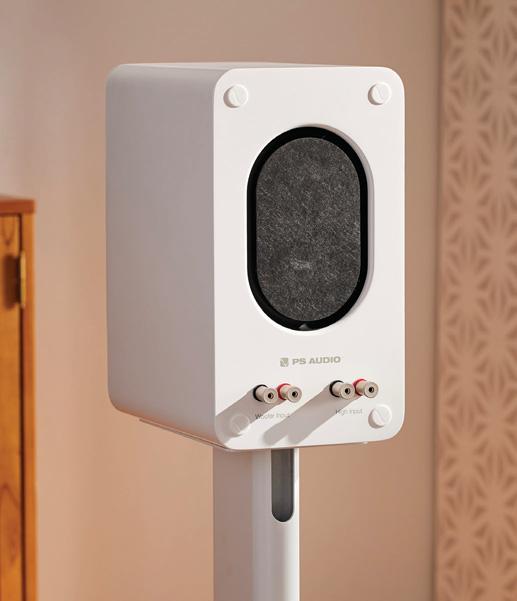
The PS Audio Aspen speaker line has four models, three 3-way floorstanders (FR30, FR20, FR10) and a single two-way standmount (the FR5, $3499/pair). All the Aspen speakers share the same 2.5" planar magnetic tweeter, but the three-ways differ in the number of tweeters, the size of their planar magnetic midrange drivers, and the number and size of woofers and passive radiators. The FR5 eschews a midrange but retains the same 2.5" tweeter mated to a 6.5" polypropylene-cone midwoofer and a 6x9" passive radiator. The FR5, then, is the outlier in the Aspen range, not only in being a standmount but also in lacking the planar magnetic midrange driver that's the defining feature in the rest of the Aspen range. Because a midrange driver was excluded, the midwoofer operates higher in frequency (up to 1750Hz) than the similar cone drivers in the larger designs.
I chose to review the FR5 because I think making a successful small speaker is harder than making a successful large speaker. Once I received them, I liked them right away because of their clean, no-nonsense design and their common-sense engineering-modern lines shaped by modern ideas.

Denne historien er fra December 2024-utgaven av Stereophile.
Abonner på Magzter GOLD for å få tilgang til tusenvis av kuraterte premiumhistorier og over 9000 magasiner og aviser.
Allerede abonnent? Logg på
FLERE HISTORIER FRA Stereophile
Stereophile
Wattson Emerson Digital
My story with Wattson Audio began about three years ago. It was my first encounter with a network bridge, at least within the context of our hobby.

12 mins
April 2026
Stereophile
Magico S2
When I was about 12 years old, my mother and I watched a movie on TV in which a ship closed in on a swimmer.
12 mins
April 2026

Stereophile
Current events
Hi-fi dealerships need to find creative new ways to get customers into their stores—to stoke their interest and to help new people feel welcome.
3 mins
April 2026

Stereophile
You can never have too much Trane on vinyl
As I listened to the newly remastered edition of John Coltrane's Complete 1961 Village Vanguard Recordings, I read through some critics' takes, which make it apparent just how far critics tend to trail the musicians they cover, the great ones at least.
3 mins
April 2026
Stereophile
HiFi Rose RD160
Lord knows I try to keep an open mind, but those good-measuring delta-sigma chip DACs rub me the wrong way.
13 mins
April 2026

Stereophile
MANUFACTURERS' COMMENTS
We extend our sincere thanks to Stereophile and to Jason Victor Serinus for their deeply engaged and perceptive evaluation of the M10. It is especially meaningful to see the amplifier’s core principles—control, stability, dynamic authority, and system matching through precise feedback and bias management—so clearly experienced and conveyed in listening.
2 mins
April 2026

Stereophile
LAiV Audio's Harmony GaNM monoblock
The first thing I noticed about the LAiV Audio GaNM monoblock amplifier¹ is its unusual shape and size; it occupies space differently than the other, more basic amplifiers on my rack.
11 mins
April 2026

Stereophile
RECORD REVIEWS
There are times when songwriters, particularly those who have been at it for a while, need a jolt, a shock to the system that gets their creative juices flowing again.
3 mins
April 2026
Stereophile
The Nighthawk soars
When people ask me what I do for a living, I reply that I'm a turntable setter upper.
11 mins
April 2026

Stereophile
Engagement vs sound quality
The more I listen to gear I'm reviewing as well as other people's hi-fis-the more I believe in intangibles. One of these intangibles is the art of system building.
12 mins
April 2026
Listen
Translate
Change font size