Prøve GULL - Gratis
BRILLIANT CORNERS
Stereophile
|August 2024
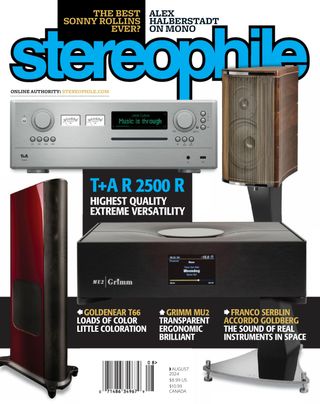
Stereo is the most successful audio gimmick of all time. While dashboard record players, quadraphonic LPs, and MQA have gone the way of Ron Popeil's hair-in-aspray-can infomercials, stereo remains king. And I am guilty of loving it.

That old expression "men love with their eyes" applies to listening, too. Enabled by the advent of a second channel, the fanning out of musicians across a soundstage fills the room and gives the eyes-and not only the ears-something to do. And I happen to enjoy the soundstage. It may be an utterly artificial delight, but who doesn't love hearing a tambourine coming from 10' to the left of the left speaker? So when I came across an article in which someone likened mono to listening to music through a hole in a wall, the metaphor made sense. Why would anyone want their music congealed in a blob directly in front of them when they could hear it separated out in space?
As always, though, it turns out that things aren't quite so simple. A number of listeners I respect-often the very same folks who enjoy low-powered tube amplifiers, vinyl, vintage gear, and horn speakers-consider the soundstage a distraction, or at least a compromise whereby we trade some of the music's life force for a visual spectacle created not by the artist but by the engineer.
I've often wondered what these listeners were going on about. For me, their conviction simply wasn't borne out through personal experience and seemed like one of those perversely contrary hipster positions, like preferring a foot-pedaloperated sewing machine to an electric one. When listening to stereo and mono versions of the same record, I've consistently preferred the stereo mixes (here I'm talking about stereo-era records, not "electronically rechanneled" records from the mono era, which are the sonic equivalent of a bad hairpiece). For me, even early stereo Beatles LPs, and other examples of awkward hard-panned left-right mixes, were preferable to music emerging from a single point between the speakers. So for years I scoffed at mono records from the stereo era as something anachronistic and embarrassing, a sop for Luddites who desperately clung to the past.

Denne historien er fra August 2024-utgaven av Stereophile.
Abonner på Magzter GOLD for å få tilgang til tusenvis av kuraterte premiumhistorier og over 9000 magasiner og aviser.
Allerede abonnent? Logg på
FLERE HISTORIER FRA Stereophile
Stereophile
Wattson Emerson Digital
My story with Wattson Audio began about three years ago. It was my first encounter with a network bridge, at least within the context of our hobby.

12 mins
April 2026
Stereophile
Magico S2
When I was about 12 years old, my mother and I watched a movie on TV in which a ship closed in on a swimmer.
12 mins
April 2026

Stereophile
Current events
Hi-fi dealerships need to find creative new ways to get customers into their stores—to stoke their interest and to help new people feel welcome.
3 mins
April 2026

Stereophile
You can never have too much Trane on vinyl
As I listened to the newly remastered edition of John Coltrane's Complete 1961 Village Vanguard Recordings, I read through some critics' takes, which make it apparent just how far critics tend to trail the musicians they cover, the great ones at least.
3 mins
April 2026
Stereophile
HiFi Rose RD160
Lord knows I try to keep an open mind, but those good-measuring delta-sigma chip DACs rub me the wrong way.
13 mins
April 2026

Stereophile
MANUFACTURERS' COMMENTS
We extend our sincere thanks to Stereophile and to Jason Victor Serinus for their deeply engaged and perceptive evaluation of the M10. It is especially meaningful to see the amplifier’s core principles—control, stability, dynamic authority, and system matching through precise feedback and bias management—so clearly experienced and conveyed in listening.
2 mins
April 2026

Stereophile
LAiV Audio's Harmony GaNM monoblock
The first thing I noticed about the LAiV Audio GaNM monoblock amplifier¹ is its unusual shape and size; it occupies space differently than the other, more basic amplifiers on my rack.
11 mins
April 2026

Stereophile
RECORD REVIEWS
There are times when songwriters, particularly those who have been at it for a while, need a jolt, a shock to the system that gets their creative juices flowing again.
3 mins
April 2026
Stereophile
The Nighthawk soars
When people ask me what I do for a living, I reply that I'm a turntable setter upper.
11 mins
April 2026

Stereophile
Engagement vs sound quality
The more I listen to gear I'm reviewing as well as other people's hi-fis-the more I believe in intangibles. One of these intangibles is the art of system building.
12 mins
April 2026
Listen
Translate
Change font size