Prøve GULL - Gratis
FROM WATER TO FLAME: The Evolution Of Hydrogen Cooking
Electronics For You
|July 2026
Imagine cooking with a stove that uses nothing more than water and electricity to generate fuel on demand. With no need for cylinders or pipelines, it challenges conventional ideas about how energy reaches the kitchen. This is not ‘burning water,’ but a fundamentally different approach to fuel generation. Could it eventually rival LPG and induction cooking in India?
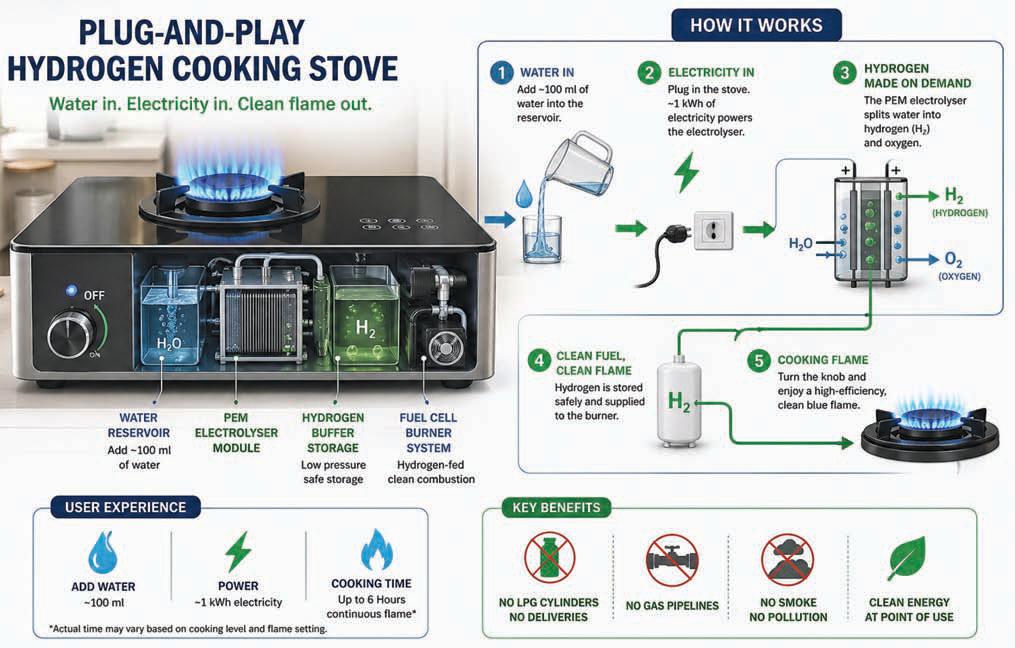
According to the International Energy Agency, almost 2.3 billion people continue to rely on environmentally damaging fuels. As countries move towards sustainable energy sources, there is growing interest in hydrogen as an energy carrier. Hydrogen cookers are now emerging whose primary function is to produce hydrogen fuel from water and electricity, eliminating the need for LPG cylinders or hydrogen pipelines.
In collaboration with India’s oil and natural gas industry, Greenvize, a cleantech startup, has developed a portable hydrogen stove for domestic and commercial applications. At the heart of the device is a proton exchange membrane (PEM) electrolyser integrated into a stove-like appliance.
Water is not the fuel source; it is the feedstock used to produce hydrogen. Electricity is used to split water molecules and generate hydrogen, which is then combusted. This process introduces energy losses that make the overall system less efficient than LPG and induction cooking. However, a major advantage is that hydrogen is produced continuously on demand, eliminating the need for fuel replenishment, storage tanks, and distribution infrastructure. The device requires only 100 millilitres of water and approximately 1kWh electricity to operate.
From water to flame: The science at the core
The operating principle of a hydrogen stove is straightforward. It relies on electrolysis, in which electricity splits water into hydrogen and oxygen. This reaction occurs in a PEM electrolyser, where hydrogen is generated at the cathode and oxygen is released at the anode.
Unlike older systems that depended on high-pressure hydrogen storage, these stoves generate hydrogen only when required. As a result, dedicated fuel storage and transportation systems may no longer be necessary.

Denne historien er fra July 2026-utgaven av Electronics For You.
Abonner på Magzter GOLD for å få tilgang til tusenvis av kuraterte premiumhistorier og over 9000 magasiner og aviser.
Allerede abonnent? Logg på
FLERE HISTORIER FRA Electronics For You

Electronics For You
FM RADIO RECEIVER Using TDA7000
This FM radio receiver demonstrates the practical application of RF engineering and analogue signal-processing techniques.

4 mins
July 2026

Electronics For You
Latest 3D chip stacking method could extend Moore's Law
Engineered by a team at the University of Illinois Grainger College of Engineering in Urbana-Champaign, the process uses ultrathin single-crystalline silicon nanomembranes transferred at temperatures below 200°C, avoiding heat damage to underlying circuits.
1 min
July 2026

Electronics For You
Stretchable patch detects heart failure risks
Researchers at the University of Chicago's Pritzker School of Molecular Engineering in Chicago have developed an AI-powered stretchable computing patch capable of processing health data directly on the body in milliseconds, eliminating the need for external servers or wireless connections.
1 min
July 2026

Electronics For You
Simple 12V To 24V VOLTAGE DOUBLER
Many electronic circuits require a voltage higher than that available from the power supply.
3 mins
July 2026
Electronics For You
Crystal stress method reshapes nanochip manufacturing techniques
Research conducted at Rice University in Houston, Texas, demonstrated that alpha-molybdenum trioxide crystals can deform under an electron beam, generating highly ordered nanoscale wrinkles that function as optical gratings for guiding and manipulating light on chips.
1 min
July 2026

Electronics For You
Hidden Costs In IoT PRODUCT DEVELOPMENT
Hardware mistakes do not show up early in development. The most expensive hardware mistakes are rarely the obvious ones. Decisions made during design, testing, and architecture shape costs for years.
7 mins
July 2026

Electronics For You
Temperature-Based DUAL SAFETY SYSTEM For Smart Homes
A temperature-based dual safety system addresses common household risks through intelligent control.
4 mins
July 2026

Electronics For You
Smart material developed to fight counterfeiting
Engineered by a team at the Indian Institute of Technology Guwahati, the technology uses perovskite nanocrystals with a double-layer protective coating that improves resistance to heat and chemicals while maintaining optical performance.
1 min
July 2026

Electronics For You
President Murmu inaugurates semiconductor training fab at IISc
On June 3, 2026, President Droupadi Murmu inaugurated IISc Bengaluru’s Semiconductor Training Fab at CeNSE, established with support from the Ministry of Tribal Affairs.
4 mins
July 2026

Electronics For You
Quantum Li-Fi secures networks
Research conducted in Germany by a consortium led by KEEQuant and supported by Fraunhofer IPMS highlights a pathway toward flexible, high-security next-generation wireless networks.
1 min
July 2026
Listen
Translate
Change font size