Prøve GULL - Gratis
State of American Science
Scientific American
|July/August 2026
A decades-old compact between science and society is broken
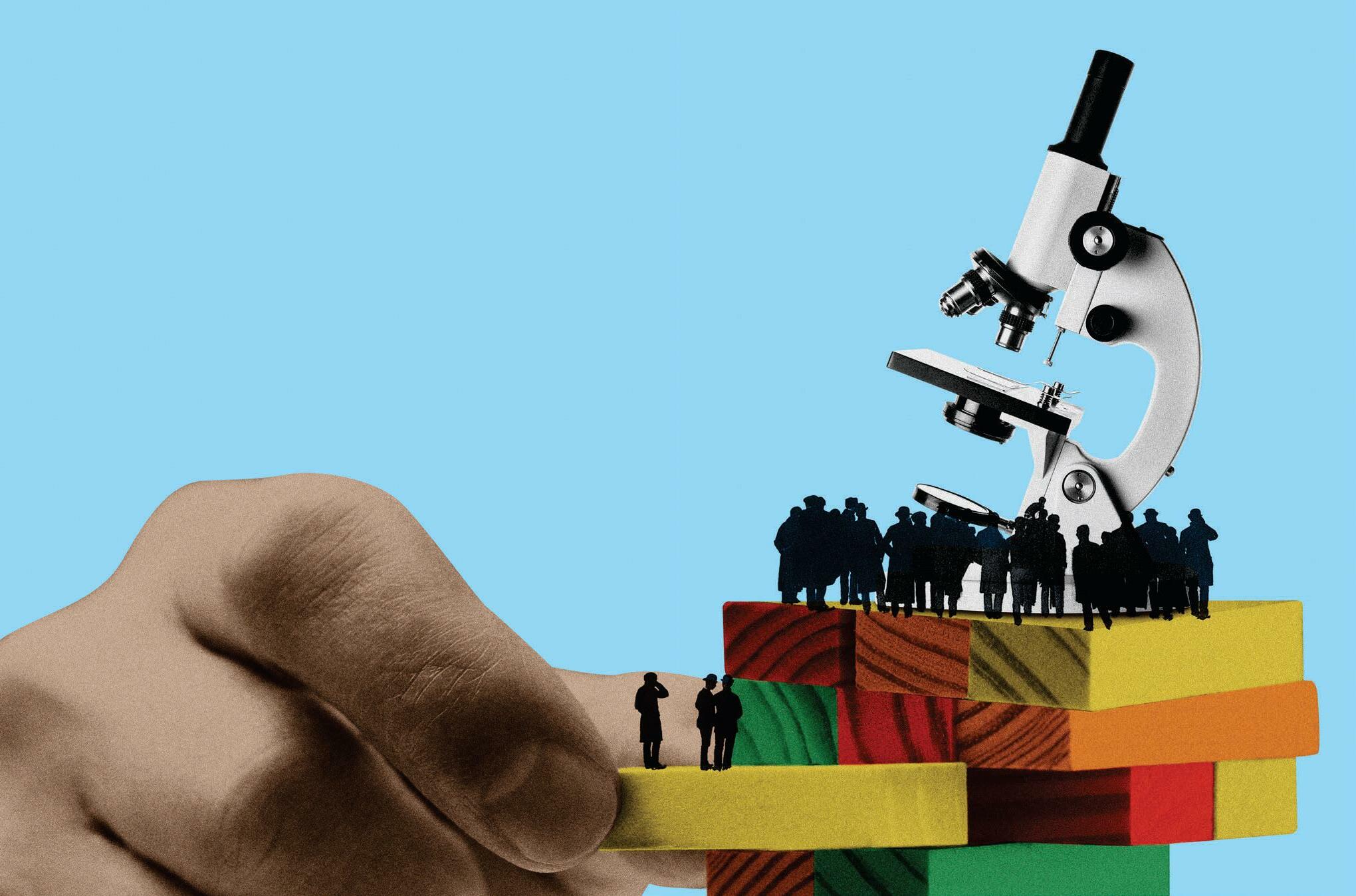
LAST YEAR CHRISTOPHER REYNOLDS started to worry that his space telescope was going to be killed. The mission had started taking shape nine years earlier, a billion-dollar orbiting observatory that would look back in time into the early universe to study the first black holes, the formation of galaxies, and more. Eight teams of researchers pitched NASA their ideas; Reynolds, an astronomer at the University of Maryland, was part of a group that wanted to deploy a new technology: x-ray mirrors made of single-crystal silicon. It sounded promising enough that in October 2024 Reynolds’s group got a $5-million grant from the agency to refine the idea—the Advanced X-ray Imaging Satellite, or AXIS. The scientists teamed up with spacecraft builders at the NASA Goddard Space Flight Center. “Everything seemed to be going pretty well,” Reynolds says. “And then we started to get hit by programmatic chaos.”
Last June the budget hawks in the Department of Government Efficiency (DOGE) pushed NASA into offering a broad package of buyouts, paid leave and early retirement. Over the next few weeks nearly 4,000 NASA employees—about a fifth of the workforce—took the deal. Reynolds’s AXIS team lost 20 people. The engineer designing the heaters to keep the x-ray mirror at a constant temperature: gone. The lead project manager: gone. William Zhang, the astrophysicist who invented the telescope’s mirror technology: gone. “We were literally left with their PowerPoints, trying to figure out what they’d done and where we were with aspects of the design,” Reynolds says.

Denne historien er fra July/August 2026-utgaven av Scientific American.
Abonner på Magzter GOLD for å få tilgang til tusenvis av kuraterte premiumhistorier og over 9000 magasiner og aviser.
Allerede abonnent? Logg på
FLERE HISTORIER FRA Scientific American
Scientific American
Let There Be Weapons
The Department of Energy’s new Genesis Mission promises AI-accelerated discovery. Seven of its first 26 challenges focus on nuclear weapons and national security

4 mins
July/August 2026

Scientific American
How to Fix Science
The federal funding system for scientific research in the U.S. needs reform
9 mins
July/August 2026
Scientific American
Robots Can Now Fold Your Laundry
Home-helper tasks are becoming easier for robotic assistants
4 mins
July/August 2026
Scientific American
50, 100 & 150 Years
NATURAL FISSION REACTOR
3 mins
July/August 2026

Scientific American
Anna Ho
Describing the characteristics of short-lived astrophysical events
1 mins
July/August 2026
Scientific American
THE SOLILOQUY OF SCHRÖDINGER'S CAT
A MEDITATION ON LIFE AND THE VON NEUMANN–WIGNER INTERPRETATION OF QUANTUM MECHANICS
1 min
July/August 2026

Scientific American
Mikhail Kolmogorov
Developing software to reveal large genetic changes that lead to cancer
1 mins
July/August 2026

Scientific American
Jaye Gardiner
Learning how the matrix around cells and tissues impacts cancers
1 mins
July/August 2026

Scientific American
Timnit Gebru
On safeguarding independent research in the age of big tech
3 mins
July/August 2026

Scientific American
A Youthful Illusion Sharpens Memory
By making people feel as if their face is a younger version of itself, researchers can bring childhood memories into sharper focus
4 mins
July/August 2026
Listen
Translate
Change font size