Prøve GULL - Gratis
Sheepdog Strategy
Scientific American
|July/August 2026
Herding a small group of “noisy” sheep holds hints for computer algorithms
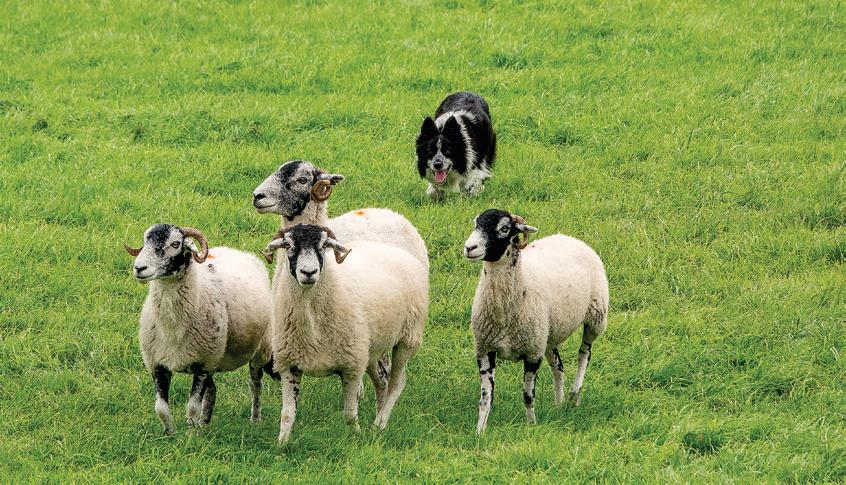
Sheepdog trials put trained dogs to work herding small groups of sheep.
WATCHING HOURS of “sheepdog YouTube”—competitions where trained dogs shepherd a small number of unpredictable sheep—gave scientists a key insight into how to control chaotic swarms. The trick, they write in Science Advances, is to exploit the sheep’s indecisiveness.
Sheepdogs routinely steer and split groups of 50 or more sheep. But in the century-old tradition of sheepdog trials, dogs display their skills by controlling only four or five. Such a small flock is inherently “noisier”—less predictable—and harder to manage than a large herd. Without the safety of numbers, their individual personalities can drive them to frequently switch between “Flee the dog!” and “Keep calm and follow the others.” How do sheepdogs successfully steer small groups of erratic sheep?

Denne historien er fra July/August 2026-utgaven av Scientific American.
Abonner på Magzter GOLD for å få tilgang til tusenvis av kuraterte premiumhistorier og over 9000 magasiner og aviser.
Allerede abonnent? Logg på
FLERE HISTORIER FRA Scientific American

Scientific American
Let There Be Weapons
The Department of Energy’s new Genesis Mission promises AI-accelerated discovery. Seven of its first 26 challenges focus on nuclear weapons and national security

4 mins
July/August 2026

Scientific American
How to Fix Science
The federal funding system for scientific research in the U.S. needs reform
9 mins
July/August 2026

Scientific American
Robots Can Now Fold Your Laundry
Home-helper tasks are becoming easier for robotic assistants
4 mins
July/August 2026

Scientific American
50, 100 & 150 Years
NATURAL FISSION REACTOR
3 mins
July/August 2026

Scientific American
Anna Ho
Describing the characteristics of short-lived astrophysical events
1 mins
July/August 2026
Scientific American
THE SOLILOQUY OF SCHRÖDINGER'S CAT
A MEDITATION ON LIFE AND THE VON NEUMANN–WIGNER INTERPRETATION OF QUANTUM MECHANICS
1 min
July/August 2026

Scientific American
Mikhail Kolmogorov
Developing software to reveal large genetic changes that lead to cancer
1 mins
July/August 2026

Scientific American
Jaye Gardiner
Learning how the matrix around cells and tissues impacts cancers
1 mins
July/August 2026

Scientific American
Timnit Gebru
On safeguarding independent research in the age of big tech
3 mins
July/August 2026

Scientific American
A Youthful Illusion Sharpens Memory
By making people feel as if their face is a younger version of itself, researchers can bring childhood memories into sharper focus
4 mins
July/August 2026
Listen
Translate
Change font size