Prøve GULL - Gratis
City Flitters
Scientific American
|July/August 2026
Spotted lanternflies’ love of cities may be the secret to their invasive success
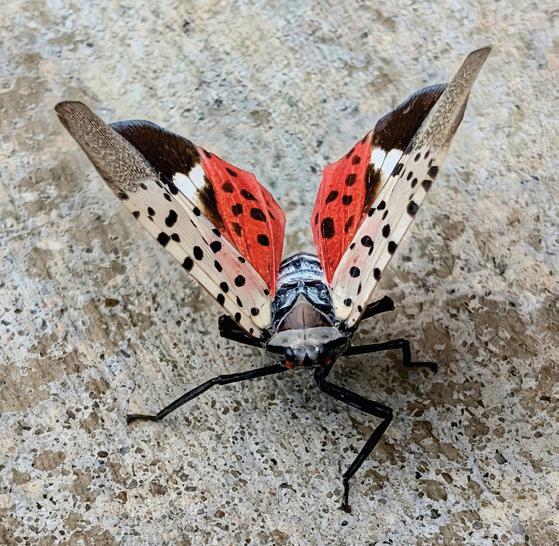
CITIES BY THEIR NATURE are hotspots for invasive species: all the coming and going means that countless newbie plants and animals regularly face the gamble of natural selection.
Most newcomers fade out or establish only a small population, but every so often a species explodes on the scene and becomes problematic.
Perhaps no species has made quite as splashy an entrance as the spotted lanternfly (Lycorma delicatula), which in the past decade has stormed mid-Atlantic cities in massive flurries of polka-dotted wings. Although they’re more of an economic threat in the countryside, where they’re particularly damaging to grapevines, new research shows it’s likely not a coincidence they’re succeeding at city life, too.
For Kristin Winchell, an evolutionary ecologist at New York University, the spotted lanternfly’s arrival in New York City in July 2020 was serendipitous. She wanted to test a hypothesis called anthropogenically induced adaptation to invade: the idea that landscapes that humans have reshaped worldwide—cities being the most extreme examples—are ecologically more like one another than natural ecosystems are. So species adapted to local urban areas may more easily invade a distant one.
Spotted lanternflies seemed a plausible example; in the U.S., they were first detected about an hour’s drive from downtown Philadelphia in 2014, and today their spread tracks the web of cities from Greensboro, N.C., to as far north as Boston and as far west as Detroit, with sightings scattered as far as Chicago, Cincinnati, Nashville and Atlanta.

Denne historien er fra July/August 2026-utgaven av Scientific American.
Abonner på Magzter GOLD for å få tilgang til tusenvis av kuraterte premiumhistorier og over 9000 magasiner og aviser.
Allerede abonnent? Logg på
FLERE HISTORIER FRA Scientific American

Scientific American
Let There Be Weapons
The Department of Energy’s new Genesis Mission promises AI-accelerated discovery. Seven of its first 26 challenges focus on nuclear weapons and national security

4 mins
July/August 2026

Scientific American
How to Fix Science
The federal funding system for scientific research in the U.S. needs reform
9 mins
July/August 2026

Scientific American
Robots Can Now Fold Your Laundry
Home-helper tasks are becoming easier for robotic assistants
4 mins
July/August 2026

Scientific American
50, 100 & 150 Years
NATURAL FISSION REACTOR
3 mins
July/August 2026

Scientific American
Anna Ho
Describing the characteristics of short-lived astrophysical events
1 mins
July/August 2026

Scientific American
THE SOLILOQUY OF SCHRÖDINGER'S CAT
A MEDITATION ON LIFE AND THE VON NEUMANN–WIGNER INTERPRETATION OF QUANTUM MECHANICS
1 min
July/August 2026

Scientific American
Mikhail Kolmogorov
Developing software to reveal large genetic changes that lead to cancer
1 mins
July/August 2026

Scientific American
Jaye Gardiner
Learning how the matrix around cells and tissues impacts cancers
1 mins
July/August 2026

Scientific American
Timnit Gebru
On safeguarding independent research in the age of big tech
3 mins
July/August 2026

Scientific American
A Youthful Illusion Sharpens Memory
By making people feel as if their face is a younger version of itself, researchers can bring childhood memories into sharper focus
4 mins
July/August 2026
Listen
Translate
Change font size