Prøve GULL - Gratis
Excessive groundwater extraction can cause subsidence
Down To Earth
|November 16, 2025
Subsidence is a global phenomenon seen not just in coastal regions, but also in inland areas. Natural subsidence progresses slowly, but anthropogenic activities, like excessive groundwater extraction, can significantly accelerate the rate, says LEONARD OHENHEN, assistant professor, department of earth system science, University of California, Irvine, US. In an interview with SUSHMITA SENGUPTA, Ohenhen says that climate change intensifies the problem through multiple pathways.
-

Which cities in the world are prone to subsidence?
Most coastal cities are prone to subsidence because coastal areas naturally sink over time due to natural compaction of sediments. However, in some cities where intensive groundwater extraction occurs, the rates are dramatically accelerated. Notable examples include cities like Jakarta, Mexico City, Tehran, Bangkok, Tokyo, Ho Chi Minh City, Dhaka and Lagos. In the US, subsidence has been documented in cities including Houston, New Orleans, Norfolk and Los Angeles. The common thread is the combination of natural coastal vulnerability or intense groundwater pumping, often in areas with clay-rich sediments.
Will climate change make these cities more vulnerable to land subsidence?
Absolutely. Climate change intensifies the problem through multiple pathways. Increased drought frequency drives greater groundwater demand, while rising temperatures increase water consumption. This creates a dangerous feedback loop where climate adaptation efforts often increase groundwater dependence, accelerating subsidence that makes communities more vulnerable.
What are the natural and anthropogenic reasons for such land subsidence?
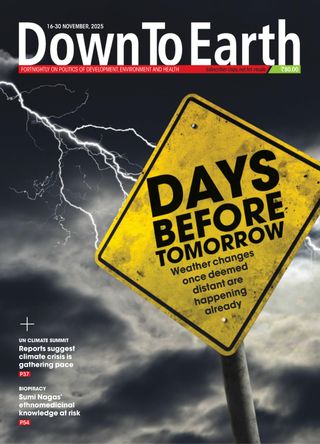

Denne historien er fra November 16, 2025-utgaven av Down To Earth.
Abonner på Magzter GOLD for å få tilgang til tusenvis av kuraterte premiumhistorier og over 9000 magasiner og aviser.
Allerede abonnent? Logg på
FLERE HISTORIER FRA Down To Earth

Down To Earth
JINALI MODY - ENTREPRENEUR
In September 2025, UN Environment Programme announced Mumbai-based Jinali Mody, founder of material-science startup Banofi Leather, as a Young Champion of the Earth.

2 mins
January 01, 2026

Down To Earth
IT'S AN ENDLESS BATTLE
A decade spent tackling waste still feels vanishingly small
2 mins
January 01, 2026

Down To Earth
'NUMB, AND UNABLE TO ACT
As disasters grow more frequent, I find myself wondering how long I can continue living here, waiting for the next storm
2 mins
January 01, 2026

Down To Earth
SAJANA SAJEEVAN - CRICKETER
In April 2024, Sajana Sajeevan got her maiden call up to the national women's cricket team on the back of a 12-year domestic career that began in the paddy fields of Wayanad, Kerala.
4 mins
January 01, 2026

Down To Earth
NILA MADHAB PANDA - FILMMAKER
Few storytellers bring dramatic despair of ecological loss to the big screen like Nila Madhab Panda. The national-award winning filmmaker often makes nature his central character, be it in his 2017 film Kadvi Hawa or in the 2023 web series The Jengaburu Curse.
4 mins
January 01, 2026

Down To Earth
CHETAN SINGH SOLANKI: SCIENTIST | SOCIAL ENTREPRENEUR
For the past five years, Chetan Singh Solanki has been on a singular journey.
2 mins
January 01, 2026

Down To Earth
ʻLIVING SLOWLY, RELUCTANTLY
The pleasures and burdens of attempting a sustainable life in a fast-moving world
2 mins
January 01, 2026

Down To Earth
KIRAN RAO
Filmmaker and producer Kiran Rao has mastered the art of mainstreaming social commentary, as seen in her early films like Dhobi Ghat and more recently in Laapataa Ladies and Humans in the Loop.
4 mins
January 01, 2026

Down To Earth
I SEE THE RISE OF DEFENDERS
When a species disappears from a land, the loss extends far beyond the species itself.
2 mins
January 01, 2026

Down To Earth
MANISH MEHROTRA - CHEF | RESTAURATEUR
Manish Mehrotra is globally recognised for his innovative approach to preserving India's culinary heritage.
4 mins
January 01, 2026
Listen
Translate
Change font size