Prøve GULL - Gratis
A job not done
Down To Earth
|July 16, 2023
As multiple states launch urban employment guarantee schemes, the need for a Central Act similar to MGNREGA becomes stronger

TILL THE middle of last year, Sarju Devi's family lived a comfortable life by selling milk from her 10 cows. But things turned for the worse in September 2022, when six of her cows died within a week due to an outbreak of lumpy skin disease, a highly contagious viral infection that killed over 76,000 cattle in the state alone, as per government estimates released in March 2023. Currently, only two of her cows are giving milk, which, coupled with the ever-rising fodder prices, means that the family in Rajasthan's Ajmer city is not earning enough from their traditional work. "Still, our income has not dipped by much," says Devi. This has been possible because of a recent state government scheme that promises 100 days of assured unskilled employment to all urban dwellers who demand work, similar to the Mahatma Gandhi National Rural Employment Guarantee Act (MGNREGA).
Launched in September 2022, the Indira Gandhi Shahari Rozgar Yojana (IGRY) is implemented by urban local bodies, such as municipal corporations, councils and nagar panchayats, who in turn hire educated youngsters as rozgar sahayaks (employment assistants) to sensitise people about the scheme and mates to oversee worksites. By enrolling under it, Devi now works as a caretaker at a stray cattle shed run by the Ajmer Municipal Corporation in the city's Panchsheel area. There are at least four other women working at the centre who lost their cattle to lumpy skin disease.
Rajasthan is the most recent state to launch an urban employment guarantee scheme, on the lines of MGNREGA. Two other states, Jharkhand and Odisha, started a similar programme in 2020 after the first wave of the coVID-19 pandemic, which saw mass-scale reverse migration from urban to rural areas due to the unavailability of jobs. Kerala was the first state to launch an urban employment guarantee scheme in 2011 to arrest unemployment. It was followed by Himachal Pradesh in 2019.
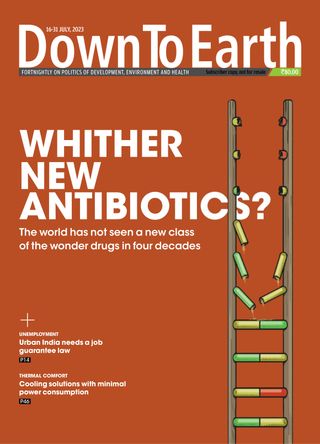

Denne historien er fra July 16, 2023-utgaven av Down To Earth.
Abonner på Magzter GOLD for å få tilgang til tusenvis av kuraterte premiumhistorier og over 9000 magasiner og aviser.
Allerede abonnent? Logg på
FLERE HISTORIER FRA Down To Earth

Down To Earth
BEYOND COLLATERAL DAMAGE
Recent geopolitical conflicts are urging a reconsideration of what constitutes environmental harm in war and the limits of existing legal frameworks

3 mins
April 01, 2026

Down To Earth
Masterstroke
Residents of a small Kerala town reject an inadequate state-led development blueprint and create their own master plan that prioritises protection of historic water systems and urban commons
4 mins
April 01, 2026

Down To Earth
Rethinking E20
It is pertinent to explore potential of ethanol as high-value industrial feedstock
4 mins
April 01, 2026
Down To Earth
Food in the age of climate change
WHEN WE eat, we contribute to climate change. But food is also about livelihoods, about nutrition and about nature.
3 mins
April 01, 2026

Down To Earth
FADING WINTER
India's winters are warming, becoming shorter, shifting and spilling beyond their traditional bounds. The consequences are already evident in meltwater availability, forest-fire intensity and changes in flowering cycles and insect behaviour.
20 mins
April 01, 2026

Down To Earth
War on Iran strikes India's pharmaceuticals sector
Shortages of critical raw materials and rising input costs for the drug industry will have global consequences
4 mins
April 01, 2026

Down To Earth
POWER IN AN AGE OF INSECURITY
Energy transition is no longer solely about emission reduction but also about energy security
3 mins
April 01, 2026
Down To Earth
Re-discovery of fuelwood
THE WEST Asia conflict has made visible a multi-billion dollar energy market in India.
2 mins
April 01, 2026

Down To Earth
A CASE THAT RESHAPED INDIA'S ENVIRONMENT
The case of MC Mehta v Union of India stands as proof that a proactive judiciary can accelerate action even when the executive drags its feet
4 mins
April 01, 2026
Down To Earth
FOREVER DEPENDENT
India depends on global fertiliser supply chains for 70 per cent of its needs, leaving its food security exposed to geopolitical disruptions
6 mins
April 01, 2026
Translate
Change font size