
Gå ubegrenset med Magzter GOLD
Få ubegrenset tilgang til over 9000 magasiner, aviser og premiumhistorier for bare
ZWO ASI585MM Pro USB 3.0 cooled mono camera
BBC Sky at Night Magazine
|August 2025
Fast for planets, cooled for deep sky - and all at an affordable price
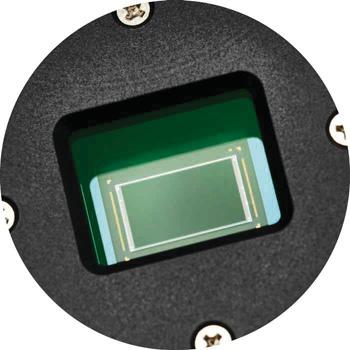
ZWO's original non-cooled mono and colour versions of the ASI585, aimed at planetary imagers, were very well received for their fast frame rates and extremely low noise. So when ZWO announced it was adding the very same Sony STARVIS IMX585 sensor to its deep-sky camera range, complete with two-stage cooling systems, we couldn't wait to get our hands on one to try it.
This 'active cooling' ability allows you to set the temperature of the sensor to as low as 35° below ambient and further reduce noise in what was already a proven low-noise sensor.
Opening the box, we found the ZWO ASI585MM Pro, with familiar bright-red camera body, nestled in a padded zip-up compact case. Included with the camera were three USB cables and a range of adaptors and spacers - a nice touch from ZWO that will help users avoid having to buy extras (often an unforeseen additional expense). Making the most of these, we easily attached our non-ZWO filter wheel and correctly spaced our field flattener.
As with all ZWO's Pro series cameras that feature two-stage cooling, we did note that no power cable was included. You'll therefore need a suitable 12V 2.1mm power supply for the ASI585MM Pro.
After a quick look on the ZWO website, we located the Downloads section and were pleased to see a single driver file covering all their cameras, meaning we didn't need to hunt for the correct one. Adding our own power supply and the supplied USB 3.0 cable, we got the camera connected and it was instantly recognised by our capture software.
Utilising the USB hub on the back of the camera, we connected the filter wheel and motorised focuser, both of which were discovered by our PC instantly and worked flawlessly, proving this to be a great addition. With everything now connected, we started the camera cooling.


Denne historien er fra August 2025-utgaven av BBC Sky at Night Magazine.
Abonner på Magzter GOLD for å få tilgang til tusenvis av kuraterte premiumhistorier og over 9000 magasiner og aviser.
Allerede abonnent? Logg på
FLERE HISTORIER FRA BBC Sky at Night Magazine
BBC Sky at Night Magazine
MOONWATCH
January's top lunar feature to observe

2 mins
January 2026

BBC Sky at Night Magazine
Speed up your processing workflow
How to use Photoshop's Actions tool to drastically cut your processing time
3 mins
January 2026

BBC Sky at Night Magazine
Chasing Canada's polar lights
With solar maximum peaking and a new Moon promising dark skies, Jamie Carter travels to Churchill, Manitoba to hunt the Northern Lights - and dodge polar bears – in Canada's far north
7 mins
January 2026

BBC Sky at Night Magazine
Beyond Pluto: The search for the hidden planets
Could one – or even two - undiscovered planets lurk at the edges of our Solar System? Nicky Jenner explores how close we are to finding the elusive 'Planet 9'
6 mins
January 2026
BBC Sky at Night Magazine
Jupiter moon events
Jupiter is a magnificent planet to observe.
2 mins
January 2026

BBC Sky at Night Magazine
What samples from space have taught us
Alastair Gunn explains what scientists have learnt in the 20 years since the first unmanned mission brought materials back from alien worlds
3 mins
January 2026

BBC Sky at Night Magazine
The Milky Way as you've never seen it before
This is the largest low-frequency radio colour image of our Galaxy ever assembled
1 min
January 2026

BBC Sky at Night Magazine
Merger of ‘impossibly' massive black holes explained
Scientists discover how enormous, fast-spinning black holes can exist after all
1 mins
January 2026
BBC Sky at Night Magazine
Lunar occultation of the Pleiades
BEST TIME TO SEE: 27 January from 20:30 UT
1 min
January 2026

BBC Sky at Night Magazine
The Universe's expansion may be slowing down
New study suggests current theories of dark energy could be wrong
1 mins
January 2026
Listen
Translate
Change font size