Prøve GULL - Gratis
ARTEMIS BEGINS
BBC Sky at Night Magazine
|October 2022
As Artemis I takes the first step in NASA's plan to return humans to the Moon, Shaoni Bhattacharya talks to the people behind the wider series of missions
-

This year heralds the first crucial stage in NASA's ambitious plans to put 'boots back on the Moon', as Artemis I gets ready for launch.
Artemis I is an uncrewed flight test of two new space systems: the world's most powerful rocket - the Space Launch System - and the Orion crew spacecraft. It will travel to the Moon, skimming 100km above its surface before entering a retrograde orbit that takes it 70,000km beyond the lunar far side and returns to Earth 4-6 weeks later. Though it will have no human crew this time around, it will deploy multiple CubeSats to perform a range of science experiments.
Should all go well, Artemis II will take a four-person crew to lunar orbit and back no earlier than 2024. Finally, Artemis III aims to send astronauts to the lunar surface in 2025, with NASA vowing to put the first woman on the Moon and the first person of colour. Beyond this are plans for building the Lunar Gateway, a staging post in lunar orbit that will enable humans to stay at the Moon for months at a time. To learn more about the programme, we spoke to key figures across the Artemis project.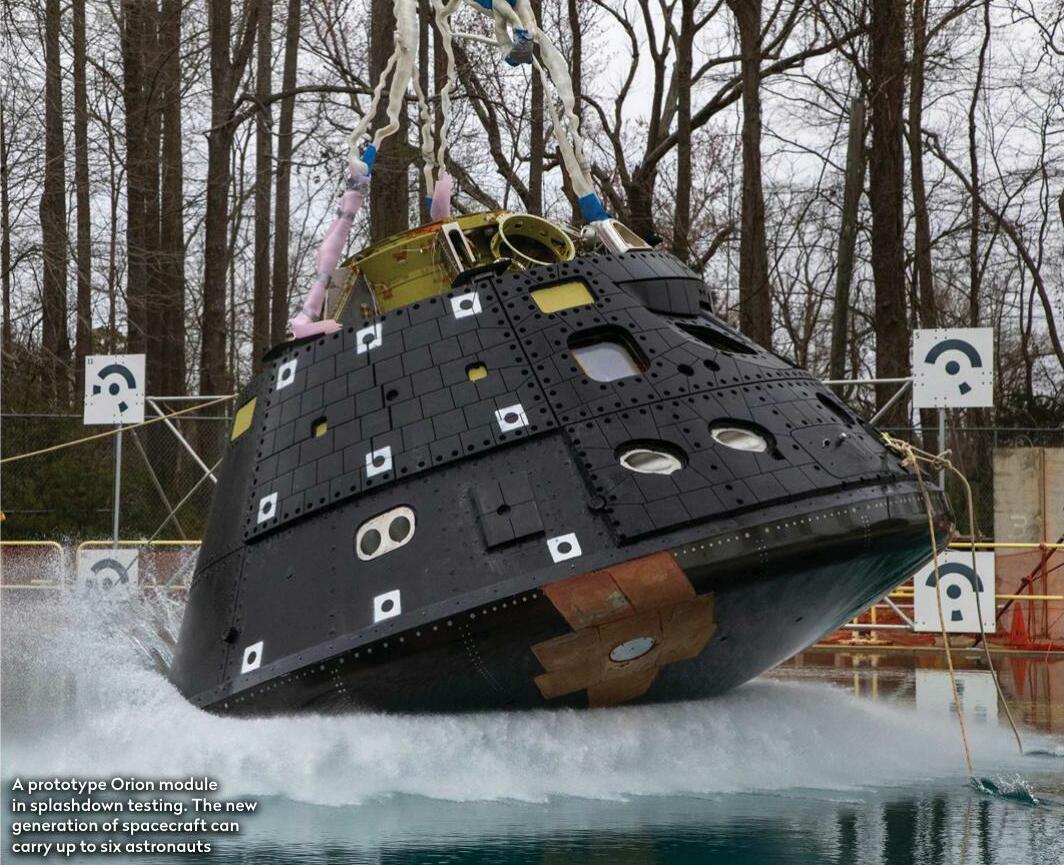
Orion's first flight
The Orion module will house future crews bound for the Moon and for deep space beyond. Its manager Debbie Korth reveals how Artemis I will put the new spacecraft through its paces
How will Artemis I test the Orion crew and service module before it carries humans in Artemis II?
There are several big systems that we want to check out. The Orion capsule has a 4.9m diameter heat shield - we need to see how that performs. Orion will come back from the Moon at about 40,000km/h and the heat shield will get to about 2,750°C.


Denne historien er fra October 2022-utgaven av BBC Sky at Night Magazine.
Abonner på Magzter GOLD for å få tilgang til tusenvis av kuraterte premiumhistorier og over 9000 magasiner og aviser.
Allerede abonnent? Logg på
FLERE HISTORIER FRA BBC Sky at Night Magazine
BBC Sky at Night Magazine
The Giant Leap: Why Space is the Next Frontier in the Evolution of Life
“Earth is the cradle of humanity, but one cannot live in the cradle forever,” wrote Konstantin Tsiolkovsky in 1911.

1 mins
February 2026
BBC Sky at Night Magazine
Tele Vue Nagler Type-7 series eyepieces
These premium optics were inspired by Apollo - and deliver a giant leap to your views
4 mins
February 2026
BBC Sky at Night Magazine
Once Upon a Time in Space
While the Space Race of the Cold War years was ultimately a geopolitical contest between the USA and the Soviet Union, the rivalry sparked rapid innovation and inspired multiple generations to look skyward.
1 mins
February 2026
BBC Sky at Night Magazine
The Multiverse: When One Universe Isn't Enough
The concept of a 'multiverse' – the idea that our Universe may be just one of many – is widespread in science fiction and a common thread of online discussions.
1 mins
February 2026
BBC Sky at Night Magazine
Q&A WITH A GAMMA RAY SPECIALIST
In 2025, astronomers detected a blast from space that lasted seven hours. Now they're uncovering the strange processes behind the exceptional outburst
3 mins
February 2026
BBC Sky at Night Magazine
Astronomy Photographer of the Year
The world-leading astrophotography competition returns. Could your image take the top prize of £10,000?
2 mins
February 2026
BBC Sky at Night Magazine
MOONWATCH
February's top lunar feature to observe
2 mins
February 2026
BBC Sky at Night Magazine
NOVAStar Scarlet A62Q 62mm f/8.4 quadruplet achromatic refractor
Well-built and capable, this beginner scope punches well above its bargain price
4 mins
February 2026
BBC Sky at Night Magazine
STAR OF THE MONTH
Rasalas, Leo the Lion's metal-rich crown
1 min
February 2026
BBC Sky at Night Magazine
Comet 24P/Schaumasse
Having reached perihelion on 8 January, comet 24P/ Schaumasse is now fading. Starting the month at a small-telescope-friendly mag. +10.5, it dims throughout February to below 12th magnitude.
1 min
February 2026
Translate
Change font size