Prøve GULL - Gratis
A December GRAND TOUR
BBC Sky at Night Magazine
|December 2023
Just like the epic journeys of the Voyager probes to our Solar System's outer planets, this tour takes you to the gas and ice giants as they line up in the night sky this month. Stuart Atkinson is your guide

One of the greatest achievements in the history of space exploration was the Grand Tour, NASA's ambitious mission of the late 1970s and '80s to visit the Solar System's outer planets using the twin Voyager space probes. They flew from world to world in a series of fascinating fly-bys, sending back incredible images of the planets which are still iconic today.
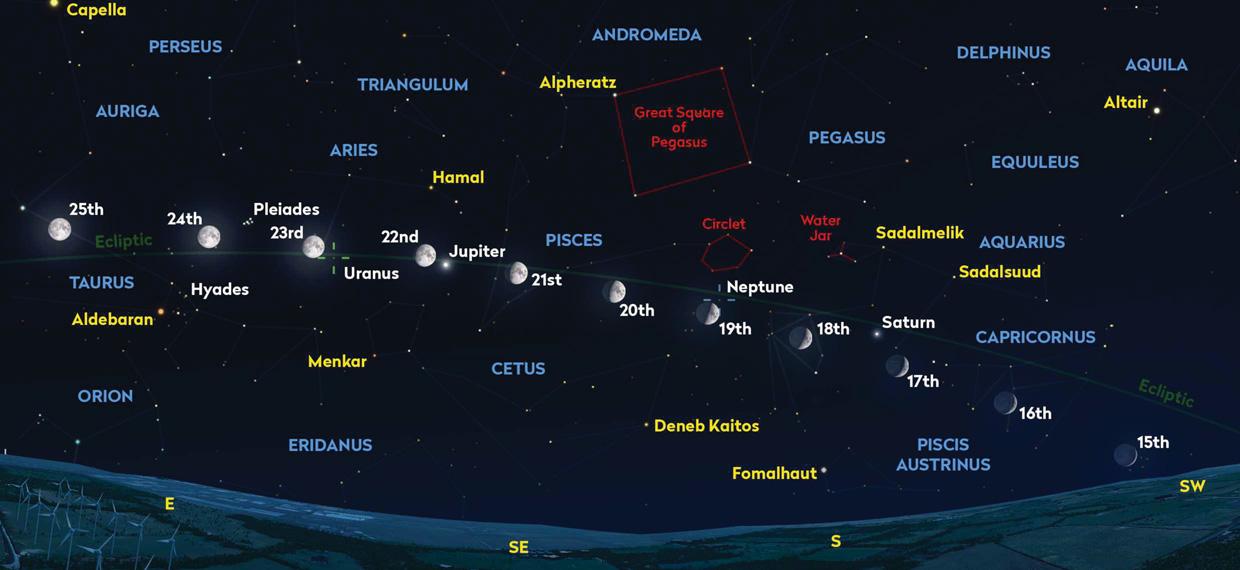
There will never be another Grand Tour, but this month we will be able to go on our own 'Grand Tour' of Jupiter, Saturn, Uranus and Neptune as the four planets will be stretched out across the heavens in a long line. Observers with Go-To telescopes will be able to navigate from one world to another just by pressing a few buttons, but less experienced observers will find they have help from the Moon, which will hopscotch along the planetary parade over the course of a week in December.
The big picture
Go out on any clear night, or morning, and the chances are that there will be at least one planet in the sky for you to enjoy looking at with just your eyes or through binoculars or a telescope. Sometimes a couple of Earth's distant sister worlds come together in the same part of the sky - a grouping astronomers call a conjunction - which can be a lovely sight and very photogenic too.
Occasionally, if they align just the right way, we're treated to a veritable parade of planets spread out across the sky in a cosmic daisy chain. This is exactly what's going to happen this month: all of the outer planets will be on view in the sky after sunset, conveniently arranged in a line stretching from the southeast to the southwest.

Denne historien er fra December 2023-utgaven av BBC Sky at Night Magazine.
Abonner på Magzter GOLD for å få tilgang til tusenvis av kuraterte premiumhistorier og over 9000 magasiner og aviser.
Allerede abonnent? Logg på
FLERE HISTORIER FRA BBC Sky at Night Magazine

BBC Sky at Night Magazine
Crush: Close Encounters with Gravity
Gravity is something that we're all innately familiar with. It keeps our feet on the ground, fights against a rocket trying to leave Earth and governs the movement of the planets and stars.

1 mins
April 2026

BBC Sky at Night Magazine
Exploring the Universe
There's no shortage of children's books about astronomy.
2 mins
April 2026
BBC Sky at Night Magazine
Make your Milky Way images pop
Simple, free processing techniques using FastStone Image Viewer
3 mins
April 2026

BBC Sky at Night Magazine
Nightfaring: In Search of the Disappearing Darkness
This book is a manifesto for dark skies, written as a travel memoir.
1 mins
April 2026

BBC Sky at Night Magazine
Flying saucers- The making of a modern myth
Our obsession with UFOs goes back further than you might think. Robert Pateman traces how early science fiction, dubious sightings and an alien-mad media led to the 1950s saucer fever
9 mins
April 2026

BBC Sky at Night Magazine
STAR OF THE MONTH
Alphecca, the brightest jewel in the Crown
1 min
April 2026

BBC Sky at Night Magazine
How to use a planisphere
Navigate the sky with the original stargazer's tool. No batteries, apps or Wi-Fi required!
3 mins
April 2026
BBC Sky at Night Magazine
Why rockets don't launch straight up
For a rocket to get its payload into space, it has to follow a curved path. But what would happen if it didn't?
2 mins
April 2026

BBC Sky at Night Magazine
Q&A WITH A DARK MATTER SPECIALIST
Dark matter makes up 27 per cent of all matter in the Universe. So why is it so hard to find? Meet one of the people making a map that leads us to it
3 mins
April 2026

BBC Sky at Night Magazine
Why I want to put a hotel on the Moon
Bored of the beach? Sick of city breaks? Step this way. Space entrepreneur Skyler Chan explains how he'll build a holiday destination on the Moon by 2030
2 mins
April 2026
Translate
Change font size