
Gå ubegrenset med Magzter GOLD
Få ubegrenset tilgang til over 9000 magasiner, aviser og premiumhistorier for bare
WE TRULY ARE ALL CONNECTED
Heartfulness eMagazine
|June 2023
DR. ROLLIN MCCRATY, Director of Research at the HeartMath Institute, gave an online presentation to the Heartfulness international conference, "An Integrative Approach to Health and Well-being," at Kanha Shanti Vanam in December 2022. In part 2, he shares more about coherence at the individual, group, and global levels.
-

Heart to Brain to Body
It took many years for us to sort out why our heart rhythms have such a profound influence on brain function, but at the end of the day it’s pretty simple.
As I mentioned in “The Science of Heart Coherence,” we have neural traffic coming up through the afferent or ascending pathways to the brain, and once it comes to the brainstem there are strong direct neural connections to every major brain center. The one I’m going to focus on is the thalamus, which is at the very core of our brain.
The thalamus has many roles and functions, but one key function is to globally synchronize the electrical activity of the neural systems in the entire brain. In fact, it’s the brain’s ability to synchronize its own electrical activity that allows us to be awake and conscious. These neural loops between the thalamus and cortex, called the thalamocortical loops, are critical to be awake and conscious. If those loops are damaged, like in a head injury, and they get severed, those people are in a coma. They can’t wake up because the brain can’t organize and synchronize its electrical activity.
When we’re in an emotional state that desynchronizes our system, like when we feel frustration or anger, that neural pattern of activity goes directly to the thalamus. It interferes with and inhibits the thalamus’ ability to globally synchronize the activity in the entire brain. It’s easy to measure in things like reaction times, coordination tasks, visual fields, etc.
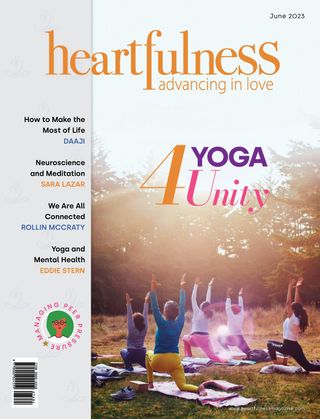

Denne historien er fra June 2023-utgaven av Heartfulness eMagazine.
Abonner på Magzter GOLD for å få tilgang til tusenvis av kuraterte premiumhistorier og over 9000 magasiner og aviser.
Allerede abonnent? Logg på
FLERE HISTORIER FRA Heartfulness eMagazine

Heartfulness eMagazine
A Touch of Heaven
Irish singer and teacher, EILISH BUTLER, combines the mystical chant of Saint Hildegard von Bingen (1098-1176) with the evolutionary path of Uncovering the Voice, satisfying her passion for mystical spirituality and music.

2 mins
November 2025

Heartfulness eMagazine
FROM INNER STILLNESS TO OUTER AGENCY:
How Heartfulness Builds an Internal Locus of Control and Workplace Success
3 mins
November 2025

Heartfulness eMagazine
Virtual Intelligence
Author and cultural commentator CHARLES EISENSTEIN extends last month's argument about virtual substitutes hollowing out reality-this time to Al's imitation of intimacy-and points to what only embodied relationships can restore.
10 mins
November 2025

Heartfulness eMagazine
Grace Is the Creative Spark
Do you sometimes feel that life is blessed and things are unfolding effortlessly, without force or struggle? Some people say it is because of “grace” or “God’s grace.
5 mins
November 2025

Heartfulness eMagazine
Zuri's Guiding Light
A luminous fable from LIAA KUMAR on self-trust, belonging, and inner guidance.
3 mins
November 2025

Heartfulness eMagazine
I AM
In a quiet meditation on desire, stillness, and the witnessing Self, JARNA KHIMANI traces the shift from seeking to being.
3 mins
November 2025

Heartfulness eMagazine
Courage: From Relief to Presence
JASON NUTTING on why relief is temporary-and how courage, rooted in the heart, endures.
3 mins
November 2025

Heartfulness eMagazine
Embracing The Value Within
DR. ROXANNE M. ST. CLAIR on seeing the value in you—and in others—and making it a daily practice.
4 mins
November 2025
Heartfulness eMagazine
Gratitude's Gift
A Creston woman recently recounted her experience in a checkout line.
2 mins
November 2025

Heartfulness eMagazine
HAPPINESS and Gut Health
Q: How does gut health influence mental well-being, and can practices like meditation actively support a healthier digestive system? The gut is often called the second brain because it has over 500 million neurons that constantly talk to the brain through the vagus nerve.
2 mins
November 2025
Translate
Change font size