Prøve GULL - Gratis
International Cities of Peace
Heartfulness eMagazine
|September 2024
J. FREDERICK ARMENT is in conversation with CHRISTINE JONES about his organization, International Cities of Peace, as well as other ways he promotes peace in the world. The foundation of it all is the importance of relationship, community, and love. This is the first of a series of conversations.

Q: Fred, you are the founding director of the organization, International Cities of Peace, which was established fifteen years ago. You are stewarding its growth with the goal of 1,000 cities by 2030. Currently there are 414. You're one of the co-founders of the Dayton International Peace Museum, and you see yourself as a facilitator of peace. You have dedicated your life to peace efforts.
The idea of facilitator is very important to me. I used to be called a director, and I dropped that because everything is collaboration, just as the trainers at Heartfulness Centers are facilitators, and there is a relationship based on the facilitating of peace. Rather than telling people how to find peace, directing them, or coordinating them, I consider myself a lead facilitator. I run a team called ICP Central, which we’re keeping very small, because the cities of peace themselves are what should be given accolades. They are the people. They are the leaders. They are the teams that work in their community, not because of money (although money is always useful) but because of love of community and love of place. We facilitate that love, and that is what creates cities of peace.
Q: What inspired your inclination toward peace initiatives? Was there an event that happened when you were young that moved you in this direction?
Maybe playing basketball at 11 years old, and wondering what the heck was going on, and how an 11-year-old could contribute to the world. I became a writer, not because I knew a lot but because I had so many questions. Questioning is what drove me to the idea that we need peace in this world.

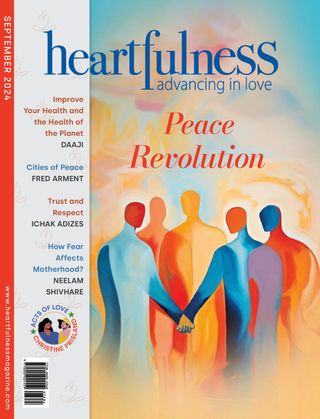

Denne historien er fra September 2024-utgaven av Heartfulness eMagazine.
Abonner på Magzter GOLD for å få tilgang til tusenvis av kuraterte premiumhistorier og over 9000 magasiner og aviser.
Allerede abonnent? Logg på
FLERE HISTORIER FRA Heartfulness eMagazine

Heartfulness eMagazine
A Touch of Heaven
Irish singer and teacher, EILISH BUTLER, combines the mystical chant of Saint Hildegard von Bingen (1098-1176) with the evolutionary path of Uncovering the Voice, satisfying her passion for mystical spirituality and music.

2 mins
November 2025

Heartfulness eMagazine
FROM INNER STILLNESS TO OUTER AGENCY:
How Heartfulness Builds an Internal Locus of Control and Workplace Success
3 mins
November 2025

Heartfulness eMagazine
Virtual Intelligence
Author and cultural commentator CHARLES EISENSTEIN extends last month's argument about virtual substitutes hollowing out reality-this time to Al's imitation of intimacy-and points to what only embodied relationships can restore.
10 mins
November 2025

Heartfulness eMagazine
Grace Is the Creative Spark
Do you sometimes feel that life is blessed and things are unfolding effortlessly, without force or struggle? Some people say it is because of “grace” or “God’s grace.
5 mins
November 2025

Heartfulness eMagazine
Zuri's Guiding Light
A luminous fable from LIAA KUMAR on self-trust, belonging, and inner guidance.
3 mins
November 2025

Heartfulness eMagazine
I AM
In a quiet meditation on desire, stillness, and the witnessing Self, JARNA KHIMANI traces the shift from seeking to being.
3 mins
November 2025

Heartfulness eMagazine
Courage: From Relief to Presence
JASON NUTTING on why relief is temporary-and how courage, rooted in the heart, endures.
3 mins
November 2025

Heartfulness eMagazine
Embracing The Value Within
DR. ROXANNE M. ST. CLAIR on seeing the value in you—and in others—and making it a daily practice.
4 mins
November 2025
Heartfulness eMagazine
Gratitude's Gift
A Creston woman recently recounted her experience in a checkout line.
2 mins
November 2025

Heartfulness eMagazine
HAPPINESS and Gut Health
Q: How does gut health influence mental well-being, and can practices like meditation actively support a healthier digestive system? The gut is often called the second brain because it has over 500 million neurons that constantly talk to the brain through the vagus nerve.
2 mins
November 2025
Listen
Translate
Change font size