Prøve GULL - Gratis
Standing Up to Trump
The Sunday Guardian
|August 03, 2025
India and the US are natural allies, but can America learn to accept that India will always retain its strategic independence?
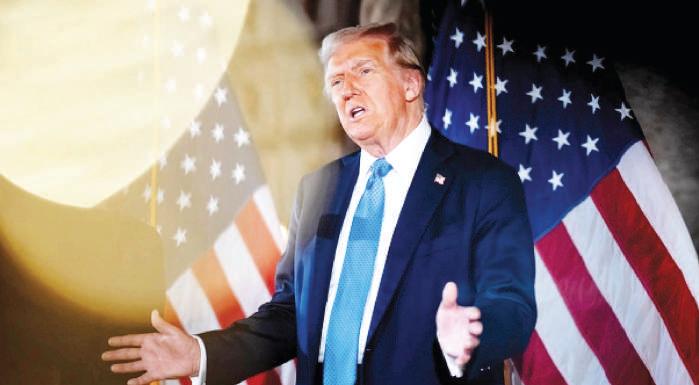
Depending on who you are reading, the 25% tariffs announced by US President Donald Trump on India, and the flurry of his petulant tweets, have not provoked the Indian government to respond. For once, there is benefit in the ponderous nature of Indian bureaucracy. A slanging match with Trump is beneath India and it would only encourage more petulant behaviour. If the world's biggest democracy cannot show propriety, at least the world's oldest needs to display dignity.
This controversy has many layers which are worth unpacking. First, to take America's point, a re-adjustment of tariffs is not necessarily a bad thing, and it may even have been required. Overdependence on American largesse was never going to be sustainable in the long-run, and its national debt of $36 trillion is at dystopian levels. There is a case to be made for more equitable levels of trade.
But the manner and tonality in which the Trump administration has gone about rolling out these tariffs, while at the same time wrecking the existing international trade system, will be remembered long after the Trump presidency ends.
As far as economic damage is concerned, in the mid-to-long term, to the Indian economy, it is unlikely to be extremely significant. Though some immediate-term pain is inevitable. It is important to note that Trump's actions may well prove to be detrimental to his own constituency in America as prices of goods—especially things like pharmaceuticals and electronics—rise. In the end, the price of this tariff rise will be paid by the Indian consumer, especially since India's exports to the US are less than 2% of its GDP. In comparison, Vietnam and Indonesia, at 20% and 19% tariff-levels, get 30% and 10% of their GDP from exports to the US. Contrary to popular belief, negotiations between the US and India are still on and the final tariff level will most probably be lower than 25%.

Denne historien er fra August 03, 2025-utgaven av The Sunday Guardian.
Abonner på Magzter GOLD for å få tilgang til tusenvis av kuraterte premiumhistorier og over 9000 magasiner og aviser.
Allerede abonnent? Logg på
FLERE HISTORIER FRA The Sunday Guardian

The Sunday Guardian
Suboptimal diets linked to 4 million heart deaths
What we eat on a daily basis may be affecting our hearts more than we realise, as even small, routine dietary choices can gradually raise blood pressure, cholesterol, and long-term heart disease risk, say researchers.

2 mins
April 05, 2026
The Sunday Guardian
DELHI ROLLS OUT AI-DRIVEN SUMMER WATER STRATEGY
Capital targets higher output, tech integration to combat summer shortages.
2 mins
April 05, 2026
The Sunday Guardian
UP SETTLES DISPLACED FAMILIES IN KHERI
State allocates land, extends welfare support to rehabilitated families.
2 mins
April 05, 2026

The Sunday Guardian
Historian reframes Malabar: Hindu ruler led Muslim communities
In an intellectual landscape often shaped by binaries, historian Dr. Abbas Panakkal offers a strikingly different lens.
3 mins
April 05, 2026

The Sunday Guardian
Hostage horror in Mothabari exposes Bengal lawlessness
Photos and videos show Trinamool’s Mothabari MLA and minister in Mamata Banerjee’s Cabinet, Sabina Yeasmin sitting among the protesters and even cooking food for them.
4 mins
April 05, 2026
The Sunday Guardian
He is ever-present for his loved ones
‘The great apostle was walking through the city, when hecame upona group of people, who were otherwise well clad and looked prosperous, but seemed full of sadness.
1 mins
April 05, 2026
The Sunday Guardian
IN 12 YEARS: HOW NAXAL, KASHMIR CHALLENGES COLLAPSED IN INDIA
What followed after May 2014 was not a single intervention but a layered restructuring of state response, built around continuous presence, infrastructure penetration, intelligence integration, financial disruption, technological expansion.
6 mins
April 05, 2026

The Sunday Guardian
Why India cannot afford to lose technological sovereignty
Sharma defines technological sovereignty as the ‘the ability [of a nation] to access, control and weaponize critical technologies without necessarily owning them.’
3 mins
April 05, 2026
The Sunday Guardian
DELHI EATERIES SWITCH TO COAL AMID GAS SHORTAGE
Fuel scarcity compels eateries to trim menus and costs.
2 mins
April 05, 2026
The Sunday Guardian
EC SUSPENDS POLICE OFFICERS FOR LETTING TMC CADRE TARGET AMIT SHAH'S ROADSHOW
The move signals the Commission's intent to enforce strict accountability and prevent any breakdown of law and order.
1 mins
April 05, 2026
Listen
Translate
Change font size