
Gå ubegrenset med Magzter GOLD
Få ubegrenset tilgang til over 9000 magasiner, aviser og premiumhistorier for bare
SHANTI and the evolution of India's regulatory philosophy
The Sunday Guardian
|December 21, 2025
SHANTI's significance lies less in its immediate impact on reactor capacity and more in how it redefines the relationship between the state, markets, and high-consequence technological risk.
Regulatory systems are ultimately theories of risk. They encode assumptions about who may bear it, how it should be priced, and which institutions can be trusted to manage it.
For much of independent India's history, nuclear governance rested on a single premise: catastrophic risk must be contained through state monopoly and legal exceptionalism. The Sustainable Harnessing of Nuclear Energy for Transforming India (SHANTI) Act, 2025 marks a deliberate departure from this premise. Its significance lies less in its immediate impact on reactor capacity and more in how it redefines the relationship between the state, markets, and high-consequence technological risk.
The Statement of Objects and Reasons (SOR) makes this shift explicit when it acknowledges that India's legacy legal framework had become a constraint on clean-energy expansion, private participation, and timely capacity addition. That acknowledgement is philosophically important. It recognises that the problem was not ambition or capability, but institutional design.
The Atomic Energy Act of 1962 reflected a distinctly postwar regulatory philosophy in which sovereignty was equated with ownership and centralised command. Safety, secrecy, and strategic autonomy were pursued by concentrating all operational, financial, and technological responsibility within a single public entity, leaving little room for institutional pluralism or external oversight. This framework assumed that dispersing activity across multiple actors would inevitably weaken control, increase security risks, and dilute accountability. As a result, monopoly was treated not merely as an administrative choice, but as an essential condition for governing a technology perceived to be uniquely dangerous and politically sensitive.
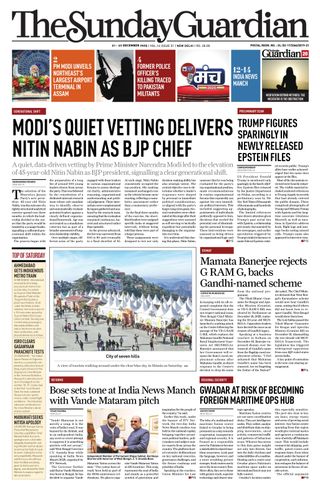

Denne historien er fra December 21, 2025-utgaven av The Sunday Guardian.
Abonner på Magzter GOLD for å få tilgang til tusenvis av kuraterte premiumhistorier og over 9000 magasiner og aviser.
Allerede abonnent? Logg på
FLERE HISTORIER FRA The Sunday Guardian

The Sunday Guardian
RS data exposes reality of AAP’s ‘education revolution’: Ashish Sood
Delhi Education Minister Ashish Sood mounted a strong attack on the former Aam Aadmi Party (AAP) government, asserting that data presented in the Rajya Sabha has exposed the true reality behind its widely promoted \"education revolution\".

2 mins
December 14, 2025
The Sunday Guardian
The President we never had
Shivraj Patil, former Union Minister, Governor and Speaker, who passed away on Friday, was an exceptional politician, perhaps the only one from his state to have been elected to the Lok Sabha seven consecutive times.
3 mins
December 14, 2025
The Sunday Guardian
TALENT TRUMPS TECH: HOW INDIA VAULTED T0 #3 IN THE Al WORLD
Diplomatically, occupying the third spot changes the nature of India’s engagement with the world. When global leaders gather to discuss AI safety, India is no longer justa participant; itis a heavyweight. We can now shape rules of the road rather than just follow them.
5 mins
December 14, 2025
The Sunday Guardian
Time to call out the hypocrisy of the woke ecosystem
Tragedy is that loudest champions of tolerance have become intolerant. Those who claim to defend inclusion now practise exclusion.
5 mins
December 14, 2025

The Sunday Guardian
GST reforms may reduce retail inflation by 35 basis points
The decline in Consumer Price Index (CPI) or retail inflation due to massive GST rate rationalisation has been around 25 bps so far in the September-November 2025 period, according to estimates put forth by SBI Research.
1 min
December 14, 2025
The Sunday Guardian
INDIA'S FOREX RESERVES UP BY $1.03 BILLION
India's foreign exchange reserves rose marginally, by USD 1.033 billion in the week that ended December 5 to USD 687.260 billion, driven by a jump in gold reserves, the Reserve Bank of India's latest 'Weekly Statistical Supplement' data showed.
1 mins
December 14, 2025
The Sunday Guardian
CBDCs more superior to Stablecoins as they satisfy all attributes of money
Central Bank Digital Currencies (CBDCs) are digital tokens like Stablecoins, but they are inherently superior since they satisfy all the attributes that money should have, RBI Deputy Governor T Rabi Sankar argued.
2 mins
December 14, 2025

The Sunday Guardian
NEW DIGITAL TOOLS TRANSFORM INDIA'S LAW ENFORCEMENT MATRIX
Officials familiar with global policing trends say the tools now used in India place the country within the same broad class of investigative capability of Western nations such as the United States and the United Kingdom.
4 mins
December 14, 2025

The Sunday Guardian
What media and experts got wrong about Vladimir Putin’s India visit
On the eve of Putin's visit, a majority of national dailies and prime time TV debates were projecting big ticket announcements.
4 mins
December 14, 2025
The Sunday Guardian
PRESIDENT TRUMP, A CAUTIONARY TALE
Rising US joblessness and higher rates of inflation is the perfect cocktail for the disaster of any government.
3 mins
December 14, 2025
Listen
Translate
Change font size