Prøve GULL - Gratis
Life in the grey Zone
The Guardian Weekly
|November 29, 2024
Neonatal care has advanced so far that babies born as early as 21 weeks have survived. But is this type of care always the right thing to do?

ALICE SMITH WAS FIVE MONTHS PREGNANT when she noticed some discharge one evening, and something felt off. She did an online yoga class and went to bed early, but the next day she felt worried enough to phone the maternity triage line. The midwives invited her in for a checkup at Homerton hospital, near her home in east London. Smith emailed her boss to explain she'd be offline for a few hours and then headed to hospital.
Until then, her pregnancy had progressed smoothly. She was 37 years old, healthy and expecting twins: a boy and a girl. A routine ultrasound a few weeks earlier had suggested all was well. Smith and her husband, Jim Clack, had already decided to name their daughter Peggy. For their son they had drawn up a shortlist of names.
In the waiting room at Homerton, Smith began to feel an ache in her lower back. When the registrar examined her, she told Smith that she was in labour and already 3cm dilated. The average pregnancy is about 40 weeks long, but Smith was just 23 weeks and four days pregnant. If the babies died, which was the most likely outcome, their deaths would be classified as a miscarriage rather than stillbirths.
Twenty-three weeks is on the cusp of viability. Every hour that the twins' birth could be delayed would improve their chances. The doctors gave Smith steroids, to strengthen the babies' lungs, and magnesium, which aids brain development. Smith phoned Clack, who rushed to the hospital.
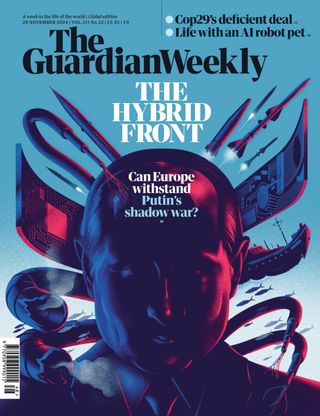

Denne historien er fra November 29, 2024-utgaven av The Guardian Weekly.
Abonner på Magzter GOLD for å få tilgang til tusenvis av kuraterte premiumhistorier og over 9000 magasiner og aviser.
Allerede abonnent? Logg på
FLERE HISTORIER FRA The Guardian Weekly
The Guardian Weekly
Trump has shown there aren't any rules. We'll all regret that
I never thought it possible that you could look back on the Iraq war and feel some measure of nostalgia.

4 mins
January 09, 2026
The Guardian Weekly
The new world order 'according to Trump
With the audacious snatch and grab raid that extracted Nicolás Maduro to face trial in the United States, Washington sent a clear message to its allies and adversaries:
3 mins
January 09, 2026
The Guardian Weekly
The phone is ringing, but is it a scam? I'll ask my assistant
I am staring at my computer when my phone rings.
3 mins
January 09, 2026

The Guardian Weekly
The unlikely genius of Getdown Services
Scatological lyrics, social conscience, a commitment to fun and a shoutout from Walton Goggins - 2026 is going to be the laptop garage band's year
3 mins
January 09, 2026
The Guardian Weekly
Behind the race to get Americans back on the moon
With astronauts set to fly around the moon for the first time in more than half a century when Artemis 2 makes its ascent sometime this spring, 2026 was already destined to become a standout year in space.
3 mins
January 09, 2026
The Guardian Weekly
Striking it rich The US plan for involvement in Venezuela's 'bust' oil sector
The Venezuelan oil industry has been “a total bust” for a long time, according to Donald Trump.
2 mins
January 09, 2026

The Guardian Weekly
Life after extinction Science or science fiction?
A startup's plans for resurrecting lost creatures have caught the public's imagination but many researchers doubt that such a feat is possible
5 mins
January 09, 2026

The Guardian Weekly
It's a ridiculous time to be a man'
A group of male comedians is at the forefront of a new genre of social media comedy poking fun at our ever-shifting notions of modern masculinity
4 mins
January 09, 2026

The Guardian Weekly
Charting the global economy in 2026
With inflation predicted to cool, rising unemployment, weak growth and trade tensions pose fresh risks, while high debt and AI add to uncertainty in the year ahead
4 mins
January 09, 2026
The Guardian Weekly
High stakes for Mamdani as he must now deliver on his promises to New York
The multiple firsts achieved by New York’s new mayor, Zohran Mamdani, have been well chronicled: he is the first Muslim to occupy that role, the first south Asian and the first to be born in Africa.
2 mins
January 09, 2026
Listen
Translate
Change font size