Prøve GULL - Gratis
Four labour codes: A new social compact for a competitive India
Mint Bangalore
|November 24, 2025
Worker security, enterprise agility and investor confidence should deliver faster and fairer growth
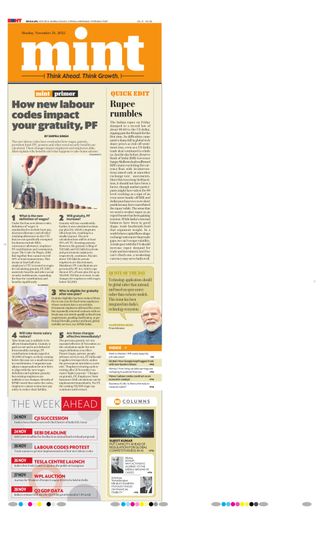
India's long-awaited labour reforms mark a defining moment for our economic and social trajectory. The consolidation of 29 Central labour laws into four Labour Codes represents one of the most forward-looking and inclusive transformations undertaken since Independence. Apart from decades of economic learnings, extensive dialogue with workers, industry and state governments went into these. They reflect a recognition that the world of work has changed and India's labour framework must evolve to match the dynamism of a rapidly modernizing economy.
India is at an inflection point. To become a $5 trillion economy by 2028-29, we need a robust workforce, for which the legal framework must deliver security, opportunity and flexibility for both workers and enterprises. The four Labour Codes—on Wages, Industrial Relations, Social Security and Occupational Safety, Health and Working Conditions—aim to do that by laying a foundation for a more secure workforce and a more competitive industry.

Denne historien er fra November 24, 2025-utgaven av Mint Bangalore.
Abonner på Magzter GOLD for å få tilgang til tusenvis av kuraterte premiumhistorier og over 9000 magasiner og aviser.
Allerede abonnent? Logg på
FLERE HISTORIER FRA Mint Bangalore

Mint Bangalore
Aye Finance defies NBFC IPO logjam
Aye Finance is headed for a public market debut at a valuation below its last funding round, becoming the first non-bank lender to test the appetite after months of sector-wide delays.

2 mins
February 06, 2026

Mint Bangalore
GST cuts, festive rush drive record quarter for Hero MotoCorp, others
Hero MotoCorp
2 mins
February 06, 2026
Mint Bangalore
Wonder Products Group mulls stake sale
The promoters of Wonder Products Group have engaged PwC (PricewaterhouseCoopers) as an adviser to sell a 30-35% stake in the contract manufacturing firm in what will likely be its first round of external funding, two people in the know said.
1 min
February 06, 2026

Mint Bangalore
Al agents: Did markets misread their invasion?
Rattled investors who foresee chunks of the software industry going obsolete aren't wrong. But legacy systems, rules, laws and the true cost of Agentic AI will slow the pace of change
2 mins
February 06, 2026
Mint Bangalore
LIC takes ₹1,400 cr hit from tax credit
Life Insurance Corp. (LIC) has taken a hit of ₹1,400 crore due to the loss of input tax credit after certain life and health plans were exempted from the goods and services tax (GST).
1 min
February 06, 2026
Mint Bangalore
India’s rural job guarantee overhaul needs a trial run
The recent budget marks a shift in India’s approach to short-term state-backed employment support.
3 mins
February 06, 2026

Mint Bangalore
'Branded developers set to buck India's real estate slowdown'
India's top developers, such as Godrej Properties Ltd (GPL), will outpace the pace of the real estate sector's growth, according to a senior company executive.
1 mins
February 06, 2026
Mint Bangalore
US deports 3,800 Indians in 2025
Over 3,800 Indian nationals were deported from the US in 2025, the government informed the Rajya Sabha on Thursday.
1 min
February 06, 2026

Mint Bangalore
After years of excess, a return to essentials
Dressing for the photograph has overtaken dressing for the experience but the pendulum seems to be swinging back again
3 mins
February 06, 2026
Mint Bangalore
RBI should allow a kill-switch for phones of defaulters
After saying that the Reserve Bank of India (RBI) is evaluating whether to bring back the policy of allowing loan-financed phones on which repayments are interrupted to be locked as a method of enforcing credit discipline, the central bank has not moved on the subject.
3 mins
February 06, 2026
Listen
Translate
Change font size