Prøve GULL - Gratis
THE SPECTER OF FAMILY SEPARATION
The Atlantic
|January - February 2024
Almost as soon as Donald Trump took office in 2017, agents from Immigration and Customs Enforcement were dispatched across the country to round up as many undocumented foreigners as possible, and the travel ban put into limbo the livelihoods of thousands of people from majority-Muslim countries who had won the hard-fought right to be here-refugees, tech entrepreneurs, and university professors among them.

The administration drew up plans for erecting a border wall, as well as an approach to stripping away the due-process rights of noncitizens so they could be expelled faster. These changes to American immigration policy took place in the amount of time that it would take the average new hire to figure out how to use the office printer.
Within days of Trump's election, his key immigration adviser, Stephen Miller, was already gathering a group of loyal bureaucrats to start drafting executive orders. Civil servants who were veterans of the George W. Bush administration found the proposals to be so outlandishly impractical, if not also harmful to American interests and perhaps even illegal, that they assumed the ideas could never come to fruition. They were wrong. Over the next four years, lone children were loaded onto planes and sent back to the countries they had fled without so much as a notification to their families. Others were wrenched from their parents' arms as a way of sending a message to other families abroad about what awaited them if they, too, tried to enter the United States.
If given another chance to realize his goals, Miller has essentially boasted in recent interviews that he would move even faster and more forcefully. And Trump, who's been campaigning on the promise to finish the job he started on immigration policy, would fairly assume if he is reelected that harsh restrictions in that arena are precisely what the American people want. "Following the Eisenhower model, we will I carry out the largest domestic deportation operation in American history," he declared during a speech in Iowa in September, referring to 1954's offensively titled Operation Wetback, under which hundreds of thousands of people with Mexican ancestry were deported, including some who were American citizens.
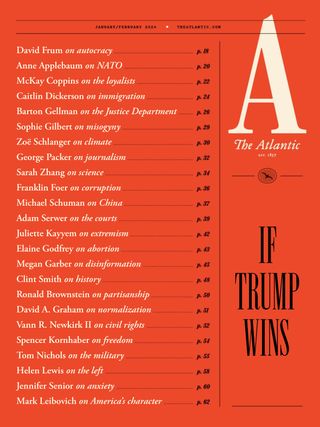

Denne historien er fra January - February 2024-utgaven av The Atlantic.
Abonner på Magzter GOLD for å få tilgang til tusenvis av kuraterte premiumhistorier og over 9000 magasiner og aviser.
Allerede abonnent? Logg på
FLERE HISTORIER FRA The Atlantic

The Atlantic
You Had to Be There
An emerging field of history asks if we can ever really understand how our forebears experienced love, anger, fear, and sorrow.

23 mins
January 2026

The Atlantic
By the Horns
The week before the biggest bullfight of her career, in Cádiz, Spain, this past July, 24-year-old Miriam Cabas posted a carefully produced video on Instagram.
1 mins
January 2026

The Atlantic
The New German War Machine
After World War II, Germany embraced pacifism as a form of atonement. Now the country is arming itself again.
18 mins
January 2026
The Atlantic
The Eloquence
The prime minister was watching a disaster movie when we found him.
4 mins
January 2026

The Atlantic
What's for Dinner, Mom?
The women who want to change the way America eats
12 mins
January 2026

The Atlantic
How Terror Works
A 1947 German novel explores the sometimes corrosive, sometimes energizing nature of fear.
8 mins
January 2026

The Atlantic
Yesterday's Idea of a Modern Man
Sam Shepard, a self-made cowboy, was also a poet of masculine angst.
7 mins
January 2026

The Atlantic
ACCOMMODATION NATION
America's colleges have an extra-time-on-tests problem.
11 mins
January 2026

The Atlantic
Respect the Drummer
A new history of rock, told through its overlooked heroes
5 mins
January 2026

The Atlantic
THE MOST POWERFUL MAN IN SCIENCE
WHY IS ROBERT F. KENNEDY JR. SO CONVINCED HE'S RIGHT?
42 mins
January 2026
Listen
Translate
Change font size