Prøve GULL - Gratis
The End of Us
The Atlantic
|January - February 2023
Is the reign of human beings on Earth nearing its end? A disparate group of thinkers says yes-and that we should welcome our demise.

With this declaration in The Order of Things (1966), the French philosopher Michel Foucault heralded a new way of thinking that would transform the humanities and social sciences. Foucault's central idea was that the ways we understand ourselves as human beings aren't timeless or natural, no matter how much we take them for granted. Rather, the modern concept of "man" was invented in the 18th century, with the emergence of new modes of thinking about biology, society, and language, and eventually it will be replaced in turn.
As Foucault writes in the book's famous last sentence, one day "man would be erased, like a face drawn in the sand at the edge of the sea." The image is eerie, but he claimed to find it "a source of profound relief," because it implies that human ideas and institutions aren't fixed. They can be endlessly reconfigured, maybe even for the better. This was the liberating promise of postmodernism: The face in the sand is swept away, but someone will always come along to draw a new picture in a different style.
But the image of humanity can be redrawn only if there are human beings to do it. Even the most radical 20th-century thinkers stop short at the prospect of the actual extinction of Homo sapiens, which would mean the end of all our projects, values, and meanings. Humanity may be destined to disappear someday, but almost everyone would agree that the day should be postponed as long as possible, just as most individuals generally try to delay the inevitable end of their own life.
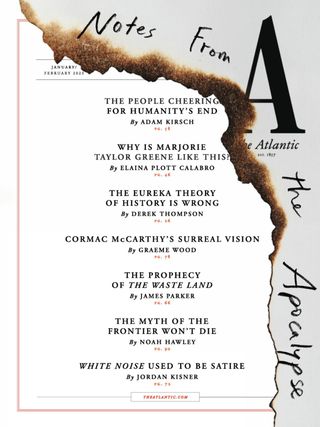

Denne historien er fra January - February 2023-utgaven av The Atlantic.
Abonner på Magzter GOLD for å få tilgang til tusenvis av kuraterte premiumhistorier og over 9000 magasiner og aviser.
Allerede abonnent? Logg på
FLERE HISTORIER FRA The Atlantic
The Atlantic
You Had to Be There
An emerging field of history asks if we can ever really understand how our forebears experienced love, anger, fear, and sorrow.

23 mins
January 2026

The Atlantic
By the Horns
The week before the biggest bullfight of her career, in Cádiz, Spain, this past July, 24-year-old Miriam Cabas posted a carefully produced video on Instagram.
1 mins
January 2026

The Atlantic
The New German War Machine
After World War II, Germany embraced pacifism as a form of atonement. Now the country is arming itself again.
18 mins
January 2026
The Atlantic
The Eloquence
The prime minister was watching a disaster movie when we found him.
4 mins
January 2026

The Atlantic
What's for Dinner, Mom?
The women who want to change the way America eats
12 mins
January 2026

The Atlantic
How Terror Works
A 1947 German novel explores the sometimes corrosive, sometimes energizing nature of fear.
8 mins
January 2026

The Atlantic
Yesterday's Idea of a Modern Man
Sam Shepard, a self-made cowboy, was also a poet of masculine angst.
7 mins
January 2026

The Atlantic
ACCOMMODATION NATION
America's colleges have an extra-time-on-tests problem.
11 mins
January 2026

The Atlantic
Respect the Drummer
A new history of rock, told through its overlooked heroes
5 mins
January 2026

The Atlantic
THE MOST POWERFUL MAN IN SCIENCE
WHY IS ROBERT F. KENNEDY JR. SO CONVINCED HE'S RIGHT?
42 mins
January 2026
Translate
Change font size