Prøve GULL - Gratis
SEEING EARTH FROM SPACE WILL CHANGE YOU
The Atlantic
|January - February 2023
The question is how.

When he first returned from space, William Shatner was overcome with emotion. The actor, then 90 years old, stood in the dusty grass of the West Texas desert, where the spacecraft had landed. It was October 2021. Nearby, Jeff Bezos, the billionaire who had invited Shatner to ride on a Blue Origin rocket, whooped and popped a bottle of champagne, but Shatner hardly seemed to notice. With tears falling down his cheeks, he described what he had witnes his tone hushed. "What you have given me is the most profound experience I can imagine," Shatner told Bezos. "It's extraordinary.
Extraordinary. I hope I never recover from this." The man who had played Captain Kirk was so moved by the journey that his post-touchdown remarks ran longer than the three minutes he'd actually spent in space.
Shatner appeared to be basking in a phenomenon that many professional astronauts have described: the overview effect. These travelers saw Earth as a gleaming planet suspended in inky darkness, an oasis of life in the silent void, and it filled them with awe. "No one could be briefed well enough to be completely prepared for the astonishing view that I got," Alan Shepard, the first American in space, wrote in 1962, after he'd made the same trip that Shatner later took.
Beholding the silky clouds below, the continents and the seas, many astronauts have seen their home planet-and humankind's relationship to it-in a profoundly new light.
"It becomes so small and so fragile, and such a precious little spot in that universe that you can block out with your thumb," Russell "Rusty" Schweickart, who spent 10 days orbiting Earth on the Apollo 9 mission, said in a 1974 speech.
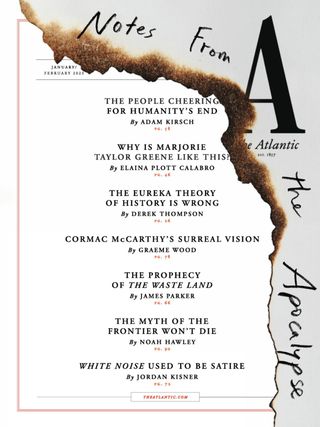

Denne historien er fra January - February 2023-utgaven av The Atlantic.
Abonner på Magzter GOLD for å få tilgang til tusenvis av kuraterte premiumhistorier og over 9000 magasiner og aviser.
Allerede abonnent? Logg på
FLERE HISTORIER FRA The Atlantic
The Atlantic
You Had to Be There
An emerging field of history asks if we can ever really understand how our forebears experienced love, anger, fear, and sorrow.

23 mins
January 2026

The Atlantic
By the Horns
The week before the biggest bullfight of her career, in Cádiz, Spain, this past July, 24-year-old Miriam Cabas posted a carefully produced video on Instagram.
1 mins
January 2026
The Atlantic
The New German War Machine
After World War II, Germany embraced pacifism as a form of atonement. Now the country is arming itself again.
18 mins
January 2026
The Atlantic
The Eloquence
The prime minister was watching a disaster movie when we found him.
4 mins
January 2026

The Atlantic
What's for Dinner, Mom?
The women who want to change the way America eats
12 mins
January 2026

The Atlantic
How Terror Works
A 1947 German novel explores the sometimes corrosive, sometimes energizing nature of fear.
8 mins
January 2026

The Atlantic
Yesterday's Idea of a Modern Man
Sam Shepard, a self-made cowboy, was also a poet of masculine angst.
7 mins
January 2026

The Atlantic
ACCOMMODATION NATION
America's colleges have an extra-time-on-tests problem.
11 mins
January 2026

The Atlantic
Respect the Drummer
A new history of rock, told through its overlooked heroes
5 mins
January 2026

The Atlantic
THE MOST POWERFUL MAN IN SCIENCE
WHY IS ROBERT F. KENNEDY JR. SO CONVINCED HE'S RIGHT?
42 mins
January 2026
Translate
Change font size