Prøve GULL - Gratis
Arrested Development
Outlook
|November 01, 2025
Students rebel because they are most alive to the meaning of freedom
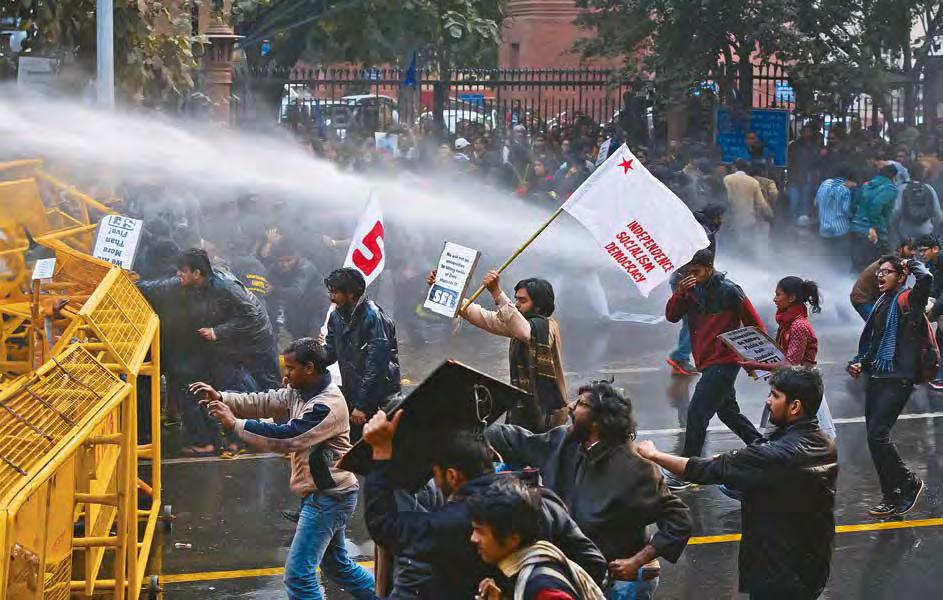
THERE is something in the age of eighteen. It knows no fear; in the fiery eyes of an 18-year-old, storms rise. It breaks all bounds, laughs in the face of death. There cannot be a better description of a student. These words are an English translation of a passage from a poem, Atharo Bochor Boyosh (The Age of Eighteen) written by Sukanta Bhattacharya, the iconic poet from Bengal.
I was reading these lines when the news came: 10 students of the Mumbai-based Tata Institute of Social Sciences (TISS) had been detained and charged.
Their crime? They had gathered in the campus to remember writer and human rights activist, G. N. Saibaba, holding his posters and lighting a few candles.
According to the police, this constituted an unlawful assembly. The institute’s administration stated that no permission had been sought.
The students are accused of spreading enmity among communities and harbouring ill will against the nation.
Incidents like this are no longer exceptional in India.
Not long ago, the Delhi Police took action against students who had gathered in solidarity with Palestine in the campus.
Whether it is Jamia Millia Islamia, Jawaharlal Nehru University (JNU), the University of Hyderabad, or educational institutions in Bihar or Kerala, students frequently find themselves in the news.
Not for their academic degrees, but for raising questions that fall outside their official curricula.
Student activism in India is not a new phenomenon.
Only this government has begun treating it as a crime. Recall the 1960s and the 1970s: whether Presidency University, Kolkata, Patna Science College, or St. Stephen’s, many bright students were drawn to the Naxalite movement.
The state responded with brutal repression, yet the appeal of the movement remained undiminished among students.
Jayaprakash Narayan—now celebrated by the very forces in power—gained his renown through the student movement of 1974.

Denne historien er fra November 01, 2025-utgaven av Outlook.
Abonner på Magzter GOLD for å få tilgang til tusenvis av kuraterte premiumhistorier og over 9000 magasiner og aviser.
Allerede abonnent? Logg på
FLERE HISTORIER FRA Outlook

Outlook
The Spectacle of the Woman Accused
Media narratives—especially when women are involved—can end up amplifying suspicion and weaponising gender

7 mins
March 11, 2026

Outlook
The Stink of Epstein
Why are the rich and powerful of the world scared of what lies buried in the Jeffrey Epstein files?
6 mins
March 11, 2026

Outlook
Passing the Watermelon
Narendra Modi's presence in Israel is being read not just as a bilateral engagement, but as an endorsement of Israeli action in Gaza and the West Bank
5 mins
March 11, 2026

Outlook
For Phoolan, Who Wasn't a Devi
“Whether or not it is the Truth is no longer relevant. The point is that it will, (if it hasn’t already) - become the Truth. Phoolan Devi, the woman has ceased to be important. (Yes of course she exists. She has eyes, ears, limbs, hair etc. Even an address now) But she is suffering from a case of Legenditis. She’s only a version of herself. There are other versions of her that are jostling for attention. Particularly Shekhar Kapur’s “Truthful” one, which we are currently being bludgeoned into believing.”–Arundhati Roy in ‘The Great Indian Rape-Trick I’, on the film Bandit Queen by Shekhar Kapur based on Phoolan, whom he never met because he didn’t think he needed to meet her. The film was based on journalist Mala Sen’s book India’s Bandit Queen: The True Story of Phoolan Devi.
5 mins
March 11, 2026

Outlook
The Chic Cartel
Women are not just victims or side characters in recent crime-and-power OTT dramas. They are complex forces-capable of empathy, strategy and ruthlessness-whose narratives demand both recognition and reckoning
5 mins
March 11, 2026

Outlook
The Hierarchy of Sympathy
In crimes against women, justice is shaped not only in courtrooms but in newsrooms where narrative determines whose suffering becomes national conscience and whose fades into procedural silence
5 mins
March 11, 2026

Outlook
Dasyu Sundari
Media accounts simultaneously cast her as victim and avenger, until a life shaped by caste violence and gendered oppression was repackaged into a consumable myth of dishonour and revenge
8 mins
March 11, 2026

Outlook
Prince Pervert
Are rumours of the death of the rule of law vastly exaggerated?
4 mins
March 11, 2026
Outlook
Together, Apart
Poonam Saxena's translations of Mannu Bhandari and Rajendra Yadav's memoirs present a portrait of the trailblazing Hindi writer-couple's marriage and of newly independent India
3 mins
March 11, 2026

Outlook
The Great Indian Rape Trick'
The trope of transforming sexual violence against women into a springboard for rage that can only be channelled through counter-violence has long served as a popular framework in cinema, both globally and in India
6 mins
March 11, 2026
Listen
Translate
Change font size