
Gå ubegrenset med Magzter GOLD
Få ubegrenset tilgang til over 9000 magasiner, aviser og premiumhistorier for bare
Prøve GULL - Gratis
An Irreversible Dent
Outlook
|October 01, 2024
Bans and arrests then, bans and arrests now. We have come full circle, say political experts

JUNE 25, 1975. It was around 9 pm. Delhi's Ramlila Maidan was flooded with people. The sweltering heat was not a bar. The capital city was yet to imagine a metro. People walked for miles, piled into DTC buses and rode cycles to reach the protest venue. Their demand was unequivocally clear-Indira, step down'.
On the stage were Morarji Desai, who came out of retirement to fight the allegedly corrupt Congress government in Gujarat run by Chimanbhai Patel; Raj Narain, whose plea led to the controversial Allahabad High Court judgement that banned Indira Gandhi from fighting elections for six years; RSS pracharak Nanaji Deshmukh; Delhi Jan Sangh leader Madan Lal Khurana; and Jayaprakash Narayan (JP) who demanded a "total revolution". Addressing the cheering crowd, JP read out Ramdhari Singh Dinkar's poem:
Singhasan khaali karo/Janata aati hai' (Leave your throne, people are coming)
A few km from the Ramlila Maidan, a different script of Indian democracy was being drafted. Around the afternoon, Prime Minister Indira Gandhi, along with West Bengal Chief Minister Siddhartha Shankar Ray, met President Fakhruddin Ali Ahmed and informed him about the decision to impose the national Emergency. Except for a few close aides of Indira Gandhi and her son Sanjay Gandhi, nobody in the Cabinet was aware of it.
Elsewhere, at Bahadur Shah Zafar Marg, in the office of The Indian Express, things were heating up. Journalist Coomi Kapoor, who later wrote the book 'The Emergency: A Personal History', was asked to check why there were frequent power cuts.
Nobody was prepared for what was going to hit them.
In the middle of the night, the police started knocking at the doors of listed' Opposition leaders. The plan was to arrest all of them at once so that they don't get a chance to escape or plan anything, reminisces Kapoor in her book.
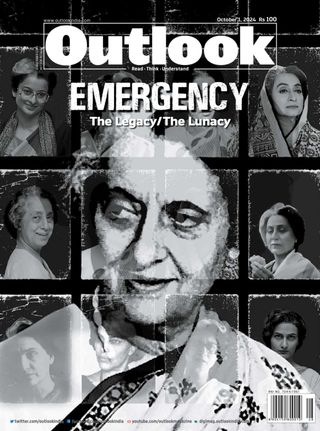

Denne historien er fra October 01, 2024-utgaven av Outlook.
Abonner på Magzter GOLD for å få tilgang til tusenvis av kuraterte premiumhistorier og over 9000 magasiner og aviser.
Allerede abonnent? Logg på
FLERE HISTORIER FRA Outlook

Outlook
Joy Words Club
Lit fests are defined by their audience. Organisers, speakers, curators are all replaceable but not the readers, not the audience

4 mins
February 01, 2026

Outlook
The Sting of the Bar
India today has more than 4.3 lakh undertrial prisoners. A significant number of them are linked to political cases
8 mins
February 01, 2026
Outlook
The Dispossessed
The systematic creation of criminal and security legislations view Adivasis as an inherently suspect class of criminals and terrorists
8 mins
February 01, 2026

Outlook
The Hypocrisy of Liberals
Favour of the self-proclaimed 'liberals' is lost the minute religion intervenes
5 mins
February 01, 2026
Outlook
Inside the Phansi Yard
Death row intensifies the structured brutalities of the penal system and reminds us why the struggle against the death penalty must also include the fact of prison violence
9 mins
February 01, 2026
Outlook
The Detention Legacy
Since Independence, a number of laws have been enacted that allow preventive detention which have been widely used by all regimes against their political opponents
7 mins
February 01, 2026
Outlook
“This Could Happen to You
The Bhima Koregaon case is not only about those who were imprisoned. It is also about the fate of democracy itself
8 mins
February 01, 2026

Outlook
"I Remember Swinging Between Hope and Despair"
HOPE and despair are basic human emotions and I believe that all human beings, now and then, swing between these two ends of the spectrum in life.
2 mins
February 01, 2026

Outlook
Think Ink
In 2026-the 'year of analog'-how will our relationship with literary festivals evolve?
6 mins
February 01, 2026
Outlook
Who Stole My Youth?
A Delhi district court granted Mohammad Iqbal bail in the riots case within three months. On March 18, 2025, he was discharged in the Babbu murder case, even as the riots trial continues
6 mins
February 01, 2026
Listen
Translate
Change font size