Prøve GULL - Gratis
Joseph Haydn
BBC Music Magazine
|September 2023
The father of the symphony and the string quartet deserves to be remembered for his still underappreciated operas too, says George Hall

When we think of Haydn, what comes to mind? Maybe the two late, great oratorios: The Creation and The Seasons. Or his vast number of symphonies, or his string quartets, or the masses. Not, perhaps, the baryton trios (of which there are more than 125); nor, for that matter, the operas, though again there are plenty. To a degree Haydn's operas - and those by a host of his late-18th-century contemporaries, successful in their day but obscure in ours - have been sidelined due to our understandable fascination with Mozart's and, to a lesser degree, our admiration of Gluck's. Many composers of the Classical period specialised in opera. Though in his enormous and comprehensive output, Haydn could be said - paradoxically-to have specialised in everything, he would have regarded his operas as representing an important strand of his work.
Haydn's life in professional music began, aged eight, as a treble at Vienna's St Stephen's Cathedral. He managed to escape 'il coltello' (the castrating knife) before his voice broke, so in his early teens he entered upon the career of a practical musician in the musically hyperactive city of Vienna itself. After meeting the leading composer Nicola Porpora (1686-1768) - also a vocal teacher of renown (the castrato Farinelli was one of his pupils) - Haydn became the Italian's musical assistant, and was able to familiarise himself with the world of opera at the highest level. He would also get to know Gluck and Pietro Metastasio, the most admired librettist of the day. When scarcely out of his teens, Haydn's own operatic debut came with the commissioning of Der krumme Teufel (The Limping Devil), a Singspiel (see panel, left) for the playwright and man-of-the-theatre Johann Felix von Kurz - known as Bernardon. Performed at the Kärntnertortheater in 1753 when Haydn was 21, its score has sadly disappeared, as is the case with many of his operas.
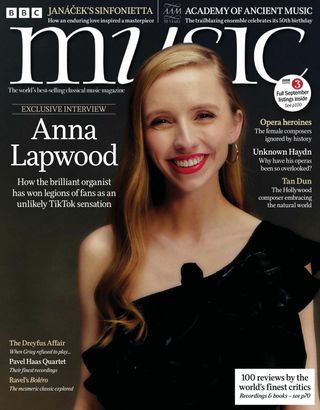

Denne historien er fra September 2023-utgaven av BBC Music Magazine.
Abonner på Magzter GOLD for å få tilgang til tusenvis av kuraterte premiumhistorier og over 9000 magasiner og aviser.
Allerede abonnent? Logg på
FLERE HISTORIER FRA BBC Music Magazine

BBC Music Magazine
Small screen BIG music
Television drama is getting ever more sophisticated, but why has it become such a draw for Hollywood composers?

7 mins
February 2026

BBC Music Magazine
All in the mind
Pianist Nicolas Namoradze is allowing audiences to peek into the depths of his brain as he performs
6 mins
February 2026

BBC Music Magazine
Heidelberg Germany
A visit to the home of Germany's oldest university and a sparkling spring music festival gives Jeremy Pound plenty of food for thought
3 mins
February 2026

BBC Music Magazine
Boulanger's buried opera has its day in the sun
Four magnificent leads bring a passionate work back to life, writes Christopher Cook
1 mins
February 2026

BBC Music Magazine
Portable cassette and CD players to rewind with
When I recently showed a cassette tape to my 11-year-old daughter, she looked genuinely baffled. 'What is it?' she asked.
3 mins
February 2026

BBC Music Magazine
Grace Williams
For long neglected outside her own nation, the Welsh composer is starting to enjoy her time in the sun again, explains Geraint Lewis
6 mins
February 2026

BBC Music Magazine
Halle's comet
As the Hallé's vibrant new principal conductor, Kahchun Wong is looking to blaze a trail across Manchester's music scene, writes Clive Paget
7 mins
February 2026

BBC Music Magazine
Leonard Slatkin
US conductor Leonard Slatkin has been music director of orchestras including the Detroit, St Louis and National symphonies, Orchestre National de Lyon and the BBC Symphony Orchestra.
3 mins
February 2026

BBC Music Magazine
The Reichtrack
As he approaches 90, the US composer Steve Reich tells Tom Service about his pride in playing an important part in bringing tonality and pulse back to music
9 mins
February 2026
BBC Music Magazine
Music to die for
Did legendary crime novelist Agatha Christie once harbour ambitions to become an opera singer? Andrew Green follows the clues...
6 mins
February 2026
Translate
Change font size