Prøve GULL - Gratis
John Locke & Personal Identity
Philosophy Now
|August/September 2023
Nurana Rajabova considers why, according to John Locke, you continue to be you.
-

Does the self reside in the soul, in the body, or in some combination of both? It’s a question philosophers have long debated. However, one philosopher, John Locke (1632-1704), argued that the self resides in memory. In what follows I will give an overview of the arguments that led him to this conclusion, and consider some of the objections critics have raised against Locke’s account of the self, in particular his reducing the self to memory. I will conclude that Locke does not only reduce the self to memory, but to internal memory. In doing so, he puts himself on a slippery slope toward idealism, despite his general common-sense empiricism.
Identity Principles
Before delving into Locke’s position on personal identity, it will be helpful to consider his principles regarding the identity or sameness of things in general. In his Essay Concerning Human Understanding (1690), Locke offers us two main principles in determining the identity or unity of things. One is the time and location principle (p.297): at any given time, one thing can exist at one place only. The same thing cannot possibly exist in two or more places at the same time. Suppose you see a chair in the front yard right at the moment. At the same time, you also see an identical chair five meters away. Despite looking identical, these two items being in different locations at the same time make you conclude that these are separate things. However, if you happened to see only one chair in the front yard in the morning, and two hours later you saw an identical chair in the backyard, you could easily assume that it’s the same chair you’d seen in the front yard in the morning. Someone possibly moved it. Locke concludes:
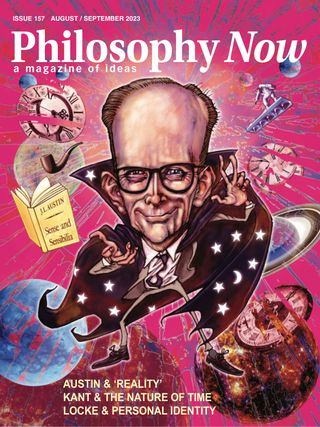

Denne historien er fra August/September 2023-utgaven av Philosophy Now.
Abonner på Magzter GOLD for å få tilgang til tusenvis av kuraterte premiumhistorier og over 9000 magasiner og aviser.
Allerede abonnent? Logg på
FLERE HISTORIER FRA Philosophy Now
Philosophy Now
Bilbo Theorizes About Wellbeing
Eric Comerford overhears Bilbo and Gandalf discussing happiness.

9 mins
December 2025 / January 2026

Philosophy Now
What Women?
Marcia Yudkin remembers almost choking at Cornell
11 mins
December 2025 / January 2026
Philosophy Now
Islamic Philosophers On Tyranny
Amir Ali Maleki looks at tyranny from an Islamic perspective.
4 mins
December 2025 / January 2026

Philosophy Now
Peter Singer
The controversial Australian philosopher defends the right to choose to die on utilitarian grounds
5 mins
December 2025 / January 2026

Philosophy Now
Another Conversation with Martin Heidegger?
Raymond Tallis talks about communication problems.
7 mins
December 2025 / January 2026

Philosophy Now
Letters
When inspiration strikes, don't bottle it up. Email me at rick.lewis@philosophynow.org Keep them short and keep them coming!
17 mins
December 2025 / January 2026
Philosophy Now
The Philosophy of William Blake
Mark Vernon looks at the imaginative thinking of an imaginative artist.
9 mins
December 2025 / January 2026
Philosophy Now
Philosophical Haiku
Peering through life’s lens God in nature is deduced: The joy of being.
1 mins
December 2025 / January 2026

Philosophy Now
Philosophy Shorts
More songs about Buildings and Food' was the title of a 1978 album by the rock band Talking Heads. It was about all the things rock stars normally don't sing about. Pop songs are usually about variations on the theme of love; tracks like Rose Royce's 1976 hit 'Car Wash' are the exception. Philosophers, likewise, tend to have a narrow focus on epistemology, metaphysics and trifles like the meaning of life. But occasionally great minds stray from their turf and write about other matters, for example buildings (Martin Heidegger), food (Hobbes), tomato juice (Robert Nozick), and the weather (Lucretius and Aristotle). This series of Shorts is about these unfamiliar themes; about the things philosophers also write about.
2 mins
December 2025 / January 2026

Philosophy Now
Hedonic Treadmills in the Vale of Tears
Michael Gracey looks at how philosophers have pursued happiness.
8 mins
December 2025 / January 2026
Translate
Change font size