
Gå ubegrenset med Magzter GOLD
Få ubegrenset tilgang til over 9000 magasiner, aviser og premiumhistorier for bare
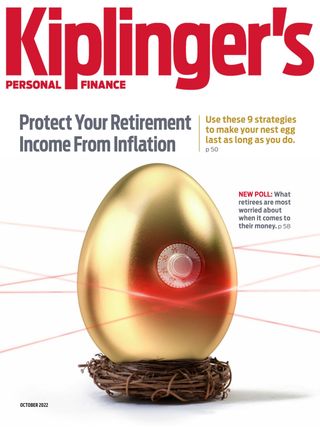
PROTECT YOUR RETIREMENT INCOME FROM INFLATION
Kiplinger's Personal Finance
|October 2022
Costs are rising, and the market is bearish, but that doesn't have to jeopardize your long-term security.

If you're a retiree (or near retiree) who isn't worried about inflation, you're either fabulously wealthy or not paying attention. Even for super savers, inflation is retirement kryptonite. To keep up with rising costs, you may be forced to take larger withdrawals from your portfolio, increasing the risk that you'll outlive your nest egg. And if inflation is accompanied by a bear market, as it is now, those withdrawals can leave a permanent hole in your portfolio.
More than 70% of individuals age 50 and older are concerned that inflation will cause serious economic hardship during their retirement, according to a recent national poll Kiplinger conducted with Athene, a retirement services company (for more results, see page 58). Although you can't control the inflation rate-or the stock market-you can take steps to protect your retirement security.
BE WILLING TO BREAK THE 4% RULE
One of the most perplexing questions facing retirees is this: How much can I withdraw from my savings each year without running out of money? For many, the answer has been to use the 4% rule, developed by William Bengen, an MIT graduate in aeronautics and astronautics who later became a certified financial planner.
Here's how it works: In the first year of retirement, withdraw 4% from your IRAS, 401(k)s and other tax-deferred accounts (which is where most workers hold their retirement savings). For every year after that, increase the dollar amount of your annual withdrawal by the previous year's inflation rate. For example, if you have a $1 million nest egg, you would withdraw $40,000 the first year of retirement. If inflation that year is 2%, in the second year of retirement you would boost your withdrawal to $40,800.

Denne historien er fra October 2022-utgaven av Kiplinger's Personal Finance.
Abonner på Magzter GOLD for å få tilgang til tusenvis av kuraterte premiumhistorier og over 9000 magasiner og aviser.
Allerede abonnent? Logg på
FLERE HISTORIER FRA Kiplinger's Personal Finance

Kiplinger's Personal Finance
A Helping Hand for the Homeless
This nonprofit offers shelters, job programs, support in finding a home and more.

2 mins
January 2026

Kiplinger's Personal Finance
Downsizing Advice, Part II
My column on downsizing (see “Living in Retirement,” Oct.) struck a chord with readers. I heard from many who offered advice on successfully culling clutter.
2 mins
January 2026
Kiplinger's Personal Finance
WHY COMPANY GUIDANCE MATTERS
Understanding how corporate profit forecasts affect analysts' estimates and stock ratings can help you make investment decisions.
4 mins
January 2026

Kiplinger's Personal Finance
WHAT SCIENCE REVEALS ABOUT MONEY AND A HAPPY RETIREMENT
Whether you're still planning or already retired, these research-based insights point the way to your best post-work life.
12 mins
January 2026

Kiplinger's Personal Finance
WHAT TO KNOW ABOUT FLOOD INSURANCE
Even if your home is outside a high-risk area, you may want to purchase coverage.
2 mins
January 2026

Kiplinger's Personal Finance
My Retirement Learning Curve
THE NEW WORLD OF RETIREMENT
2 mins
January 2026
Kiplinger's Personal Finance
CREATE A FINANCIAL PLAN WITH THESE TOOLS
Online programs for do-it-yourselfers are better than ever-and they're affordable, too.
9 mins
January 2026

Kiplinger's Personal Finance
2026 MONEY CALENDAR
These key dates and tips will help you make the most of your money in the new year.
7 mins
January 2026
Kiplinger's Personal Finance
Should You Renew Your CD?
AFTER you put money in a certificate of deposit, you can sit back while it collects interest over its term. Once it reaches maturity, you'll face a decision: renew it or withdraw the funds.
1 mins
January 2026

Kiplinger's Personal Finance
GIVING THE BULL THE BENEFIT OF THE DOUBT
KIPLINGER: What do you see ahead for financial markets in 2026? Do you have a target price for the S&P 500?
5 mins
January 2026
Translate
Change font size