Prøve GULL - Gratis
What It Really Takes for a General-Purpose MCU to Function as a Complete AI SOC
Circuit Cellar
|April 2025
Innovative AI-enabled MCUs are transforming endpoint devices by integrating advanced AI capabilities while addressing critical challenges in power and space. This article explores the future of wearable technology and the engineering solutions that make it possible.

The application of AI to endpoint devices can transform their value. In the medical arena, wearable AI devices promise to take the detection and diagnosis of serious conditions such as atrial fibrillation out of the clinic and into the patient's everyday world for monitoring. And by applying AI algorithms, hearing aids can be transformed from a simple amplifier into an intelligent vocal discriminator, isolating the voice of the person of interest, while cancelling all other noise and voices, or muting them in the sonic background.
These AI capabilities could multiply the value of almost every type of wearable and portable battery-powered product. And at the endpoint, AI functions can often not be performed in the cloud for reasons of power, latency, privacy, wireless reach, security and cost. Such devices need local AI processing capability.
But the successful local deployment of AI in these products must find a way past the severe design constraints of space and power. Wearable devices such as earbuds, rings, smart glasses, and patient monitors have small enclosures which can accommodate few components and only a small battery.
Pre-AI, many of these types of products (although endowed with fewer features and physically larger) were based on general purpose microcontrollers or microprocessors which could integrate the main functions. Integration helps the designer meet their goals for space and power while reducing component count and board footprint.
In the AI era, integration of system functions into a general-purpose MCU remains a highly desirable way to save space and power. But an AI MCU must integrate even more functions than earlier conventional MCUs, while at the same time providing the ultra-low power consumption that enables devices with small batteries to run AI at the endpoint without sacrificing run-time between charges.
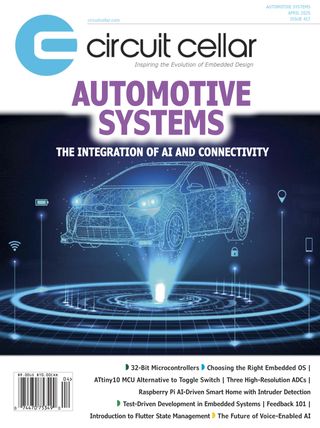

Denne historien er fra April 2025-utgaven av Circuit Cellar.
Abonner på Magzter GOLD for å få tilgang til tusenvis av kuraterte premiumhistorier og over 9000 magasiner og aviser.
Allerede abonnent? Logg på
FLERE HISTORIER FRA Circuit Cellar
Circuit Cellar
The Future of Sensors in Safety Systems Sensing the Stop
How Magnetic Sensors Are Enabling the Next Generation of Braking Systems

5 mins
December 2025

Circuit Cellar
Alif Semiconductor Elevates Generative AI at the Edge with New Support for ExecuTorch Runtime in Its Ensemble MCUs
Alif Semiconductor, the leading global supplier of secure, connected, power efficient Artificial Intelligence and Machine Learning (AI/ML) microcontrollers (MCUs) and fusion processors, announced that developers can now use the ExecuTorch Runtime, a quantization extension of the popular PyTorch ML framework, for AI applications built to run on its Ensemble E4/E6/E8 series of MCUs and fusion processors.
1 min
December 2025

Circuit Cellar
Encrypted MQTT Protocol for Critical Sectors
Mechanisms, Challenges, and Best Practices
3 mins
December 2025

Circuit Cellar
Datasheet: Small Size, Big Power
Smaller Microcontrollers Bring New Possibilities
9 mins
December 2025

Circuit Cellar
Analog Devices Launches ADI Power Studio and New Web-Based Tools
Analog Devices, Inc. (ADI), a global semiconductor leader, announced the launch of ADI Power Studio, a comprehensive family of products that offers advanced modeling, component recommendations, and efficiency analysis with simulation.
1 mins
December 2025
Circuit Cellar
Compact IBR300 2.5" SBC Powered by NXP i.MX 93 from IBASE
IBASE Technology, Inc., a leading provider of rugged embedded computing platforms, announced the release of the IBR300, a 2.5\" RISC-based single board computer (SBC) powered by the NXP i.MX 93 processor with dualcore ARM Cortex-A55 (up to 1.7GHz) and a Cortex-M33 MCU.
1 min
December 2025

Circuit Cellar
Sensors in the Spotlight
The Next Decade of Embedded Sensor Systems
12 mins
December 2025

Circuit Cellar
Bob's Wrap Up
In Bob's last article with Circuit Cellar, he attempts to wrap up a career of more than 50 years as an embedded systems engineer and 14 years with Circuit Cellar. He looks at each of his 58 articles by category and provides some recommendations for his fellow engineers.
7 mins
December 2025

Circuit Cellar
Designing Embedded Software Architectures That Last
I've reviewed hundreds of firmware projects over the years, and one thing always stands out: the most successful projects have a clear, deliberate architecture.
10 mins
December 2025

Circuit Cellar
Broadcom Introduces Industry's First Wi-Fi 8 Silicon Ecosystem Powering the AI Era
Broadcom, Inc. unveiled the first Wi-Fi 8 silicon solutions for broadband wireless, targeting residential gateways, enterprise access points, and smart mobile clients.
1 mins
December 2025
Listen
Translate
Change font size