
Gå ubegrenset med Magzter GOLD
Få ubegrenset tilgang til over 9000 magasiner, aviser og premiumhistorier for bare
Power Analysis Over JTAG Ports: Hidden Debug Dangers - Block Side-Channel Analysis Attacks
Circuit Cellar
|September 2024
Small changes in the phase of clock signals can encode power leakages. An attacker can use standard interfaces such as the JTAG port to drive clocks across targets, using them as measurement techniques for sidechannel analysis attacks despite limited physical access. This article demonstrates how you can test devices for vulnerability and how to modify devices to prevent attacks.

When I've presented side-channel power analysis attacks, I always use an oscilloscope or ADC that measures analog voltage variations. This is logical because side-channel power analysis attacks exploit the small changes in device power when it executes different instructions or even processes different data. This made it seem like a purely analog attack. Attackers need measurement access, such as a shunt resistor or electromagnetic probe. But what if attackers could use a purely digital interface, one that is already on your board, like the JTAG interface?
Things you always thought were safe might have hidden dangers. In this case, I will show you how a a side-channel power analysis attack occurs through the JTAG interface. But first, the background.
Back in the March 2024 issue of Circuit Cellar (Issue 404, "It's About Time: When Timing Attacks Reveal Power Usage), I recreated the work of a paper presented at CHES 2023 titled "JitSCA: Jitter-based Side-Channel Analysis in Picoscale Resolution", by Kai Schoos, Sergej Meschkov, Mehdi B. Tahoori, and Dennis R. E. Gnad.[1] In this article, I will present an extension of my talk at CHES 2024. If you want to see the full article entitled "Phase Modulation Side Channels: Jittery JTAG for On-Chip Voltage Measurements"[2] use a link to both the original paper and my extension available in article resources.
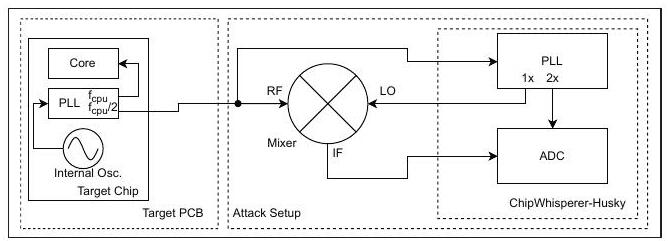 PHASE MODULATION LEAKAGE
 In my March 2024 column, I recreated the JitSCA paper to demonstrate how small changes in the phase of a clock directly leak a power trace. In the previous column, I used a basic voltage divider; here, I'm using an RF mixer component. While RF mixers are normally used to create a signal based on frequency differences, they will also give an output related to a phase difference of two signals.


Denne historien er fra September 2024-utgaven av Circuit Cellar.
Abonner på Magzter GOLD for å få tilgang til tusenvis av kuraterte premiumhistorier og over 9000 magasiner og aviser.
Allerede abonnent? Logg på
FLERE HISTORIER FRA Circuit Cellar
Circuit Cellar
The Future of Sensors in Safety Systems Sensing the Stop
How Magnetic Sensors Are Enabling the Next Generation of Braking Systems

5 mins
December 2025

Circuit Cellar
Alif Semiconductor Elevates Generative AI at the Edge with New Support for ExecuTorch Runtime in Its Ensemble MCUs
Alif Semiconductor, the leading global supplier of secure, connected, power efficient Artificial Intelligence and Machine Learning (AI/ML) microcontrollers (MCUs) and fusion processors, announced that developers can now use the ExecuTorch Runtime, a quantization extension of the popular PyTorch ML framework, for AI applications built to run on its Ensemble E4/E6/E8 series of MCUs and fusion processors.
1 min
December 2025

Circuit Cellar
Encrypted MQTT Protocol for Critical Sectors
Mechanisms, Challenges, and Best Practices
3 mins
December 2025

Circuit Cellar
Datasheet: Small Size, Big Power
Smaller Microcontrollers Bring New Possibilities
9 mins
December 2025

Circuit Cellar
Analog Devices Launches ADI Power Studio and New Web-Based Tools
Analog Devices, Inc. (ADI), a global semiconductor leader, announced the launch of ADI Power Studio, a comprehensive family of products that offers advanced modeling, component recommendations, and efficiency analysis with simulation.
1 mins
December 2025
Circuit Cellar
Compact IBR300 2.5" SBC Powered by NXP i.MX 93 from IBASE
IBASE Technology, Inc., a leading provider of rugged embedded computing platforms, announced the release of the IBR300, a 2.5\" RISC-based single board computer (SBC) powered by the NXP i.MX 93 processor with dualcore ARM Cortex-A55 (up to 1.7GHz) and a Cortex-M33 MCU.
1 min
December 2025

Circuit Cellar
Sensors in the Spotlight
The Next Decade of Embedded Sensor Systems
12 mins
December 2025

Circuit Cellar
Bob's Wrap Up
In Bob's last article with Circuit Cellar, he attempts to wrap up a career of more than 50 years as an embedded systems engineer and 14 years with Circuit Cellar. He looks at each of his 58 articles by category and provides some recommendations for his fellow engineers.
7 mins
December 2025

Circuit Cellar
Designing Embedded Software Architectures That Last
I've reviewed hundreds of firmware projects over the years, and one thing always stands out: the most successful projects have a clear, deliberate architecture.
10 mins
December 2025

Circuit Cellar
Broadcom Introduces Industry's First Wi-Fi 8 Silicon Ecosystem Powering the AI Era
Broadcom, Inc. unveiled the first Wi-Fi 8 silicon solutions for broadband wireless, targeting residential gateways, enterprise access points, and smart mobile clients.
1 mins
December 2025
Listen
Translate
Change font size