Prøve GULL - Gratis
The Puppet Masters - Compulsion, complicity, and the art of Bunraku.
The New Yorker
|November 04, 2024
The National Bunraku Theatre, in New York recently for the first time in more than thirty years, presented an evening of suicides. The performance, at the Japan Society, consisted of excerpts from two of the company’s most celebrated productions. In the Fire Watchtower scene from “The Greengrocer’s Daughter,” by Suga Sensuke and Matsuda Wakichi, from 1773, the titular character sacrifices herself to save a temple page boy she loves. In a scene from “The Love Suicides at Sonezaki,” by Chikamatsu Monzaemon, from 1703, two lovers are driven to take their own lives. Both plays were inspired by real events, and Chikamatsu’s was followed by a wave of double suicides that led to a ban on further performances. This mirroring of life and art is all the more astonishing given the fact that the actors are not people but puppets.

The National Bunraku Theatre, in New York recently for the first time in more than thirty years, presented an evening of suicides. The performance, at the Japan Society, consisted of excerpts from two of the company’s most celebrated productions. In the Fire Watchtower scene from “The Greengrocer’s Daughter,” by Suga Sensuke and Matsuda Wakichi, from 1773, the titular character sacrifices herself to save a temple page boy she loves. In a scene from “The Love Suicides at Sonezaki,” by Chikamatsu Monzaemon, from 1703, two lovers are driven to take their own lives. Both plays were inspired by real events, and Chikamatsu’s was followed by a wave of double suicides that led to a ban on further performances. This mirroring of life and art is all the more astonishing given the fact that the actors are not people but puppets.
Bunraku, named for Uemura Bunrakuken, the owner of an Osaka puppet theatre, has its roots in the seventeenth century, and especially in the plays of Chikamatsu. Writing often for puppets rather than actors, he was interested in the clash between duty and passion in the lives of a rising merchant class. Bunraku was a kind of people’s theatre, but it wasn’t light entertainment, showing fascination with tragedy and ritual violence in ordinary lives.
The Fire Watchtower scene has a cast of one: Oshichi, whose beloved will have to commit ritual suicide if she cannot help him recover a lost sword. To do this, she must sound a false alarm on the fire drum, opening the city gates—an offense that, in a city of largely wooden buildings, is punishable by death. As Oshichi enters, she is convulsed with fear and determination, and her puppet body, half the size of a person, flings violently forward at the waist as she makes her way to the watchtower, escorted by three puppeteers, two shrouded head to toe in black, the other unmasked.
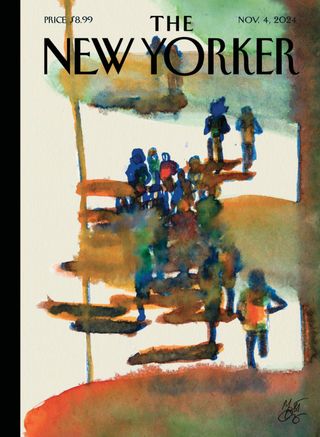

Denne historien er fra November 04, 2024-utgaven av The New Yorker.
Abonner på Magzter GOLD for å få tilgang til tusenvis av kuraterte premiumhistorier og over 9000 magasiner og aviser.
Allerede abonnent? Logg på
FLERE HISTORIER FRA The New Yorker

The New Yorker
AND YOUR LITTLE DOG, TOO
When animals attack.

8 mins
December 15, 2025
The New Yorker
Katy Waldman on Mary McCarthy's "One Touch of Nature"
I first encountered Mary McCarthy not through her novels or criticism but through her political reporting. A former editor recommended that I read “The Mask of State: Watergate Portraits” before covering Paul Manafort’s arraignment in 2017. (Were we ever so young?) I loved McCarthy’s witty cameos of malefactors—behold Maurice Stans, Nixon’s erstwhile Secretary of Commerce, “a silver-haired, sideburned super-accountant and magic fundraiser, who gave a day-and-a-half-long demonstration of the athletics of evasion, showing himself very fit for a man of his age.” McCarthy’s sentences were like mousetraps, snapping shut on both visual information and something deeper, the kind of quintessence that fictional characters possess and that we often long for real people to have, too.
2 mins
December 15, 2025

The New Yorker
KILLING BORROWED TIME
Will Geese redeem noisy, lawless rock and roll?
5 mins
December 15, 2025
The New Yorker
PRISON BREAKS
A new study illuminates the origins of incarceration
13 mins
December 15, 2025
The New Yorker
UNDERSTANDING THE SCIENCE
“Everyone thinks they're on this big journey now,” Debbie said, refilling her glass.
22 mins
December 15, 2025

The New Yorker
ALL RISE
A new Afghan bakery, in New York's golden age of bread.
7 mins
December 15, 2025

The New Yorker
HOW TO LEAVE THE U.S.A.
Why fed-up Americans are going Dutch.
26 mins
December 15, 2025

The New Yorker
TRADING PLACES
The ex-bankers behind HBO's \"Industry\" are the latest British élites to dramatize their own kind.
26 mins
December 15, 2025

The New Yorker
BRIGHT LIGHTS, BIG CITY
The new Studio Museum in Harlem shows that Black art matters.
10 mins
December 15, 2025

The New Yorker
MIND OVER MATTER
Did the celebrated neurologist Oliver Sacks write his patients into case studies of his own psyche?
36 mins
December 15, 2025
Listen
Translate
Change font size