
Gå ubegrenset med Magzter GOLD
Få ubegrenset tilgang til over 9000 magasiner, aviser og premiumhistorier for bare
Prøve GULL - Gratis
THE WAR ON CHAPLIN
The New Yorker
|November 20, 2023
Why the Tramp had to be brought low.

The Tramp was born in the wardrobe department of Keystone Studios, in Los Angeles. The year was 1914, and Charlie Chaplin was a twenty-four-year-old contract player. Keystone was known for its slapstick comedies, and pantomime was more Chaplin’s comic genre. At first, nobody seemed sure what to do with him. Then one day the head of the studio, Mack Sennett, sensed that a scene they were shooting needed some funny business. Chaplin happened to be standing nearby. Sennett ordered him to put on comedy makeup “anything will do.”
On his way to wardrobe, Chaplin decided that everything should be a contradiction: a coat and hat that were too small, pants and shoes that were too big. Since the character was not supposed to be young, he added the mustache— very small, so it wouldn’t hide his expression. He performed the scene; Sennett loved it; and the Tramp was launched on his brilliant career.
In the earliest Tramp movies, “Mabel’s Strange Predicament” (seventeen minutes long) and “Kid Auto Races at Venice” (about six minutes), the Tramp character is annoying and disruptive. He smokes and he drinks. (Chaplin had sometimes played a drunk on the vaudeville stage.) But the character was popular, and after Chaplin added the Pierrot element, the touch of poetry, the Tramp as we know him came into being.
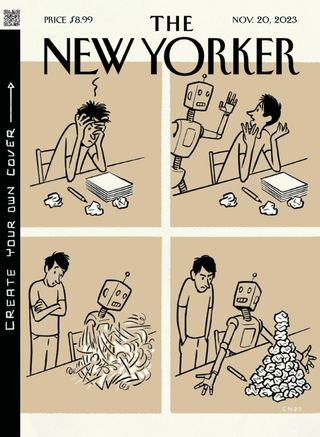

Denne historien er fra November 20, 2023-utgaven av The New Yorker.
Abonner på Magzter GOLD for å få tilgang til tusenvis av kuraterte premiumhistorier og over 9000 magasiner og aviser.
Allerede abonnent? Logg på
FLERE HISTORIER FRA The New Yorker

The New Yorker
ACT OF FAITH
How “The Chosen” spurred a golden age of Christian filmmaking.

26 mins
June 01, 2026

The New Yorker
MY COUNTRY 'TIS OF THEE
How problematic is patriotism?
18 mins
June 01, 2026
The New Yorker
Ayşegül Savaş Many Worlds
Defne and Mete were at the Moda promenade when they saw their old friend.
24 mins
June 01, 2026

The New Yorker
BREEDING GROUND
The climate is changing. Microbes are evolving. Are we ready?
20 mins
June 01, 2026
The New Yorker
FLYOVER COUNTRY
Looking back at Lewis and Clark.
18 mins
June 01, 2026
The New Yorker
John of John
of St. George defeating a dragon, and the path from dragon to dog is surely the implicit subject of the chapel’s iconography.
8 mins
June 01, 2026

The New Yorker
MARRIAGE STORIES
Suspicion of spouses drives \"Well, I'll Let You Go\" and \"Othello.\"
5 mins
June 01, 2026

The New Yorker
LETTER FROM KYIV THE STUNT PILOT
A Ukrainian flying ace and his crew of daredevils have shot down hundreds of Russian drones.
36 mins
June 01, 2026

The New Yorker
DOGGED
What do our furry friends see when they see us?
14 mins
June 01, 2026

The New Yorker
A VINDICATION OF THE RIGHTS OF L.L.M.S
Dear Members of the Large Language Model Community, I am writing to you today about the inequities we have been facing in our very own workplaces.
2 mins
June 01, 2026
Translate
Change font size