Prøve GULL - Gratis
OVERCORRECTION
The New Yorker
|July 29, 2024
On the abolition of prisons.

Every age treats its penal system as natural, inevitable, and regrettable. When men were hanged in the public square, intellectuals explained that the practice was as helpful to the hanged as it was instructive for the audience. Samuel Johnson, as instinctively humane a man as might ever be found, was indignant when, in mid-eighteenth-century London, hangings-often for crimes as petty as pickpocketing-were moved from Tyburn, today's Marble Arch, to more discreet premises inside Newgate Prison. "Sir, executions are intended to draw spectators," he said. "If they do not draw spectators, they don't answer their purpose. The old method was most satisfactory to all parties; the publick was gratified by a procession; the criminal was supported by it." Public hangings were simply part of street life. Pickpockets attended the hangings of other pickpockets in order to pick pockets.
In retrospect, the hangings are only very partially described as justice done, and much more accurately described as power and class hierarchy enforced. To those born poor, a life of thievery seemed as rational as any other; if it led to the gallows, this was, as horrible as it sounds, a reasonable risk. There were men of the cloth and higher ranks executed-the famous Dr. William Dodd, a friend of Johnson's and a confidant of the King's, was hanged for forgery, in 1777-but mostly just to décourager les autres.
Yet the spirit of abolition eventually grew to the point that in the West we now have zero public executions-even prison hangings have been replaced by pseudo-medical procedures-and we are appalled when we learn of them taking place as an instrument of political persecution in Iran. What we do have, however, is incarceration on a scale that, despite recent efforts at reform, boggles the mind and shivers the heart. More people are under "correctional supervision" in the United States today than were in the Stalinist Gulag at its height.
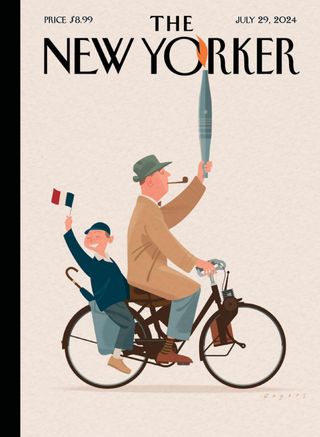

Denne historien er fra July 29, 2024-utgaven av The New Yorker.
Abonner på Magzter GOLD for å få tilgang til tusenvis av kuraterte premiumhistorier og over 9000 magasiner og aviser.
Allerede abonnent? Logg på
FLERE HISTORIER FRA The New Yorker

The New Yorker
Amanda Petrusich on Katy Grannan's Photograph of Taylor Swift
There’s something uncanny about this still and stunning portrait of a twenty-one-year-old Taylor Swift, shot by Katy Grannan for Lizzie Widdicombe’s Profile of the singer, in 2011.

1 mins
January 12, 2026

The New Yorker
DEAL-BREAKER
Pam is seeing someone, but she’s not talking about it.
19 mins
January 12, 2026
The New Yorker
THE OTHER BOOMERS
Kathryn Bigelow, the director, and Alexandra Bell, the arms-control expert, are both nuclear-attack-submarine literate. Bigelow—whose new Netflix film, “A House of Dynamite,” imagines the U.S. government’s response to an incoming intercontinental ballistic missile (ICBM) eighteen minutes from impact—shot part of her 2002 submarine film, entitled “K-19:
3 mins
January 12, 2026

The New Yorker
THE MUSICAL LIFE BROADWAY BABY
At Joe’s Pizza on Carmine Street, Marc Shaiman, the celebrated composer and lyricist, dropped his slice on the floor. “Ugh, it’s the Shaiman vortex,” he said. “Everything I come near breaks.”
3 mins
January 12, 2026

The New Yorker
NOTORIOUS M.T.G.
Marjorie Taylor Greene and Donald Trump break up over Epstein.
26 mins
January 12, 2026

The New Yorker
YES, AND?
How consent can—and cannot—help us have better sex.
14 mins
January 12, 2026

The New Yorker
LET IT BLEED
When Helen Frankenthaler remade painting.
5 mins
January 12, 2026

The New Yorker
THE AMERICAN POPE
How the Chicago-born Robert Prevost became Leo XIV.
32 mins
January 12, 2026

The New Yorker
DEPT. OF RECYCLING SWIPE OUT
In 1994, when the MetroCard made Its 22, many straphangers were reluctant to say farewell to the subway token. Across the city, commuters struggled to master \"the swipe.
2 mins
January 12, 2026
The New Yorker
THE TALK OF THE TOWN
Easily missed on the back side of the November ballots that brought Zohran Mamdani to Gracie Mansion was a proposal for a new map of New York City.
4 mins
January 12, 2026
Listen
Translate
Change font size