
Gå ubegrenset med Magzter GOLD
Få ubegrenset tilgang til over 9000 magasiner, aviser og premiumhistorier for bare
Prøve GULL - Gratis
LINE OF FIRE
The New Yorker
|February 03, 2025
The fight to contain an inferno in Los Angeles.
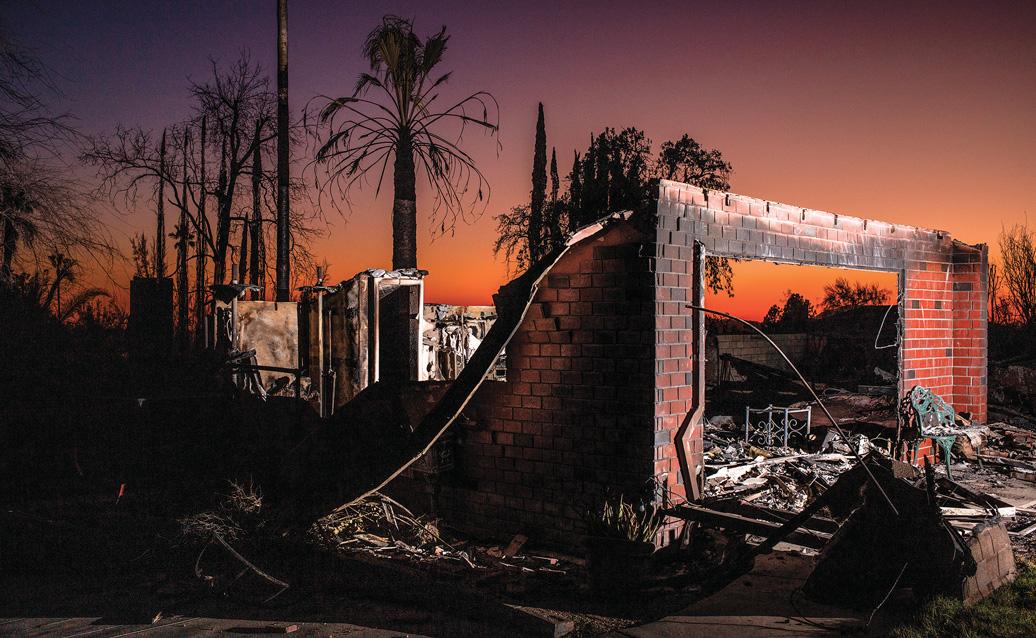
The Eaton Fire, which burned thousands of homes in Altadena (above), was one of the deadliest blazes in California history.
On the seventh day of the Eaton Fire, the most lethal of several wildfires burning in Southern California, I woke up in a tent at the Rose Bowl, which had become a staging area for first responders, called “fire camp.” At 7 A.M., an emergency-management team known as incident command gave a briefing at the stadium entrance. We were told that the blaze now encompassed fourteen thousand acres and was only fifteen per cent contained. It had risen into the San Gabriel Mountains to the north and spread into the suburbs to the south. “It does not get much worse than it’s going to be the next few days,” an expert on fire behavior warned us. “We could have rapid fire spread in basically any direction.”
At eight o’clock, I climbed into one of several white pickup trucks as part of a twenty-person handcrew, a team of wildland firefighters who dig lines around fires to contain and control them. (If fire engines are the artillery of firefighting and airtankers and helicopters are the air force, handcrews are the infantry.) Our caravan drove east to Sierra Madre, a community of about eleven thousand in the foothills of the mountains. Police officers, parked on the streets to enforce mandatory evacuation orders, waved us through, and we unloaded at the eerily vacant Eaton Canyon Golf Course. Behind us, the houses were untouched, but we knew that in front of us hundreds of homes had been reduced to rubble. Nearly everyone in the crew carried hand tools, and two people, designated sawyers, carried chainsaws. We shrugged on our backpacks—which included silver, cocoonlike fire shelters that we could deploy if we were overtaken by flames—and lined up. “Assume you’re not coming back to the trucks till tonight,” our captain instructed. “Stay vigilant! Stay alert!”


Denne historien er fra February 03, 2025-utgaven av The New Yorker.
Abonner på Magzter GOLD for å få tilgang til tusenvis av kuraterte premiumhistorier og over 9000 magasiner og aviser.
Allerede abonnent? Logg på
FLERE HISTORIER FRA The New Yorker

The New Yorker
ACT OF FAITH
How “The Chosen” spurred a golden age of Christian filmmaking.

26 mins
June 01, 2026

The New Yorker
MY COUNTRY 'TIS OF THEE
How problematic is patriotism?
18 mins
June 01, 2026

The New Yorker
Ayşegül Savaş Many Worlds
Defne and Mete were at the Moda promenade when they saw their old friend.
24 mins
June 01, 2026

The New Yorker
BREEDING GROUND
The climate is changing. Microbes are evolving. Are we ready?
20 mins
June 01, 2026

The New Yorker
FLYOVER COUNTRY
Looking back at Lewis and Clark.
18 mins
June 01, 2026

The New Yorker
John of John
of St. George defeating a dragon, and the path from dragon to dog is surely the implicit subject of the chapel’s iconography.
8 mins
June 01, 2026

The New Yorker
MARRIAGE STORIES
Suspicion of spouses drives \"Well, I'll Let You Go\" and \"Othello.\"
5 mins
June 01, 2026

The New Yorker
LETTER FROM KYIV THE STUNT PILOT
A Ukrainian flying ace and his crew of daredevils have shot down hundreds of Russian drones.
36 mins
June 01, 2026

The New Yorker
DOGGED
What do our furry friends see when they see us?
14 mins
June 01, 2026

The New Yorker
A VINDICATION OF THE RIGHTS OF L.L.M.S
Dear Members of the Large Language Model Community, I am writing to you today about the inequities we have been facing in our very own workplaces.
2 mins
June 01, 2026
Listen
Translate
Change font size