
Gå ubegrenset med Magzter GOLD
Få ubegrenset tilgang til over 9000 magasiner, aviser og premiumhistorier for bare
WWI TAKING ON THE FIRST TANKS
History of War
|Issue 111
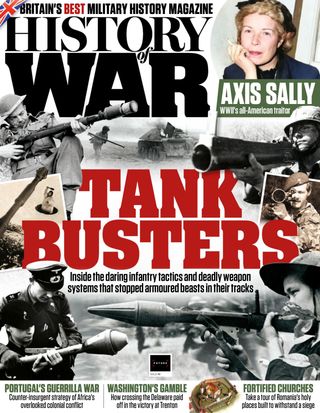
On the morning of 15 September 1916 the British Army altered the course of land warfare forever, deploying 49 Mark I tanks into the Battle of the Somme. This new technology quickly necessitated strong counter-measures
-

When they first encountered the tank in battle, German soldiers fled in panic. However, they quickly realised that these armoured behemoths, although fearsome, possessed weaknesses. Unwieldy, they often fell into shell holes or encountered obstacles that rendered them immobile. Furthermore, they were susceptible to existing weapons to varying degrees.
While machine gun and rifle bullets often glanced off their iron hulls, plunging artillery fire could destroy a tank with relative ease. The flamethrower was another nemesis, provided the infantryman could get close enough to spew the deadly stream inside the vehicle or set fire to a vital area such as its exhaust system. Along with these readily available defences, deep anti-tank ditches were dug to impede the progress of armour, and extensive minefields proved effective as well.
The German Army rapidly devised new weapons and tactics to defeat the tank in the field. Chief among these were three primary initiatives: the use of artillery with special emphasis on tank killing, the deployment of anti-tank rifles of calibre large enough to penetrate the tank's armour, and an innovative use of bundled hand grenades called the geballte ladung - bundled charge - that could be hurled toward the enemy tank and disable it with the weapon's detonation.

Denne historien er fra Issue 111-utgaven av History of War.
Abonner på Magzter GOLD for å få tilgang til tusenvis av kuraterte premiumhistorier og over 9000 magasiner og aviser.
Allerede abonnent? Logg på
FLERE HISTORIER FRA History of War

History of War
MORE MISS MONEYPENNY THAN MATA HARI WOMEN SPIES THROUGHOUT THE DECADES
THEY LOOKED LIKE ORDINARY HOUSEWIVES, MOTHERS AND SECRETARIES IN SENSIBLE CLOTHES AND STURDY SHOES. BUT THESE INNOCUOUS WOMEN WERE EMBARKED ON COURAGEOUS AND OFTEN TREACHEROUS MISSIONS AS SECRET AGENTS

4 mins
Issue 153
History of War
THE END OF GREAT POWERS
Full-spectrum analysis of a state's economy, technology, leadership, society and alliances could be a superior way of predicting battlefield performance
3 mins
Issue 153
History of War
THE BATTLE OF JERUSALEM 9 JANUARY - 11 DECEMBER 1917
During a campaign that lasted nearly a year, British and Arab forces defeated the Ottoman Turks and entered the ancient city
7 mins
Issue 153
History of War
QUEEN ELIZABETH CLASS BATTLESHIP
These five super-dreadnoughts set the standard for early 20th century warship design in speed, firepower and protection and were the first fast battleships of the age
4 mins
Issue 153
History of War
THE MASSACRE AT WOUNDED KNEE
In 1890, US troops killed more than 250 Lakota, at a location that remains the focus of resistance and dark controversy
10 mins
Issue 153
History of War
BORN IN NORTH AFRICA
HOW THE TUNISIA CAMPAIGN FORGED THE 'SPECIAL RELATIONSHIP'
3 mins
Issue 153

History of War
ANTI-TANK MINE
This lightweight General Service Mk V device could immobilise Hitler's heavy tanks and was used during fighting in Northwest Europe
1 mins
Issue 153
History of War
HEROES OF THE MEDAL OF HONOR BALDOMERO LOPEZ
During the daring landings at Inchon in 1950, this first lieutenant sacrificed his life to save his US Marine comrades
6 mins
Issue 153
History of War
NORTH KOREA'S ROCKET REVOLUTION
After the peninsula was divided by a long-term ceasefire, Pyongyang and Seoul raced to build weapons that could obliterate each other
4 mins
Issue 153
History of War
THE GREAT TRAIN RAID THE MOST DARING SAS MISSION OF WWII
DAMIEN LEWIS' LATEST SAS ADVENTURE IS CHARACTERISTICALLY FAST-PACED AND ACTION-PACKED
2 mins
Issue 153
Translate
Change font size