Prøve GULL - Gratis
The Evolving Value of the Polyester Value Chain
Textile Value Chain
|September 2025
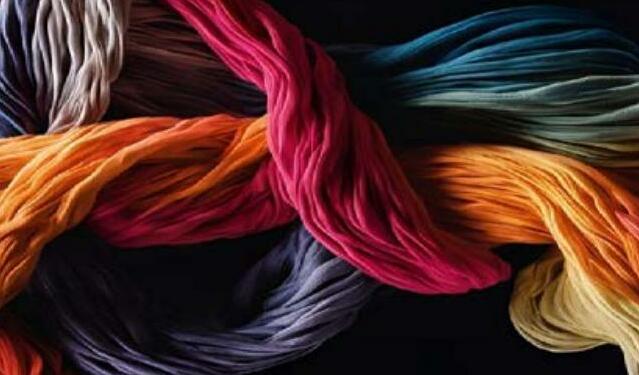
The global textile industry is at a transformative juncture. As consumer demands shift towards performance, sustainability, and affordability, Polyester Filament yarn- already the world's most widely used fibre-continues to play a pivotal role in shaping the future of textiles. The polyester value chain, from upstream petrochemicals to downstream fashion and technical applications, is poised for accelerated growth, driven by evolving end-use sectors, innovation, and global policy shifts.
Polyester's Expanding Dominance
Polyester accounts for nearly 54% of global fibre production, making it the most dominant fibre in the textile landscape. Its growth is propelled by advantages like durability, versatility, cost efficiency and adaptability to technological innovation such as moisture wicking, stretch, and flame-retardant finishes.
Future Market Insights projects that India's polyester fibre market will expand at a CAGR of around 5.6% from 2025 onward. Driven by the country's growing preference for synthetics and blended fabrics - particularly in activewear, home textiles, and technical textiles - the entire value chain is witnessing strong upward momentum across segments.
The Value Chain Dynamics
Purified Terephthalic Acid (PTA) and Monoethylene Glycol (MEG) are polymerised through a continuous polymerisation (CP) process to form polyester chips. These chips are further processed into polyester staple fibre (PSF), polyester filament yarn (PFY) through spinning, drawing, and texturising operations.
India's recent policy interventions, such as Production Linked Incentives (PLI) schemes and support for Mega Integrated Textile Regions and Apparel (MITRA) parks, are helping strengthen domestic capacities across the value chain. With players investing in integration, India is becoming more self-reliant in PTA and MEG production, thereby de-risking supply chains and improving cost competitiveness.
 Growth Driver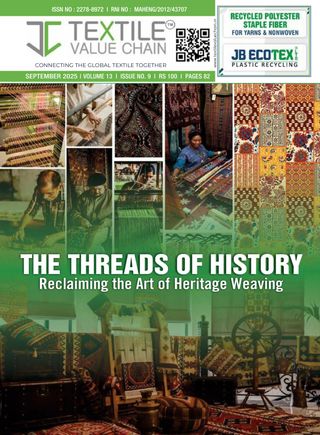

Denne historien er fra September 2025-utgaven av Textile Value Chain.
Abonner på Magzter GOLD for å få tilgang til tusenvis av kuraterte premiumhistorier og over 9000 magasiner og aviser.
Allerede abonnent? Logg på
FLERE HISTORIER FRA Textile Value Chain

Textile Value Chain
TMMA's 65th Annual General Meeting: Charting the Future of India's Textile Machinery Sector
The Textile Machinery Manufacturers' Association (India) successfully organised its 65th Annual General Meeting (AGM), Export and R&D Awards Function, and a high-level stakeholder consultation at the India ITME Centre, Mumbai. The event brought together industry leaders, policymakers, and innovators to reflect on the current state of the textile machinery sector and chart the path forward.

6 mins
October 2025

Textile Value Chain
Textile Circularity - A Decade of Experiments and Experiences at Meemansa
The textile industry is a paradox: it is a generator of beauty, culture, and livelihoods - yet also one of the most resource-intensive and waste-producing sectors in the world.
6 mins
October 2025

Textile Value Chain
Your Next Big Buyer Won't Ask for Price - They'll Ask for Your Scope 3
Every time we make a piece of clothing — from buying cotton to spinning yarn, weaving fabric, stitching garments, transporting, and even the way the customer washes it — we leave behind a footprint.
3 mins
October 2025

Textile Value Chain
Textile Automation Impact
We explore how automation is redefining the textile and apparel industries not just in technology, but in the very foundation of production, sustainability, and competitiveness.
4 mins
October 2025

Textile Value Chain
India Gets its First: Liva Reviva TM M Marks a New Milestone in Recycled Cellulosic Fibre
Redefining fashion's environmental future, Birla Cellulose has introduced Liva Reviva™ M: India's first next-generation circular fibre.
1 mins
October 2025

Textile Value Chain
NIT Jalandhar Signs MoU with Tynor Orthotics, Mohali
The Department of Textile Technology at Dr B. R. Ambedkar National Institute of Technology (NIT), Jalandhar, has signed a Memorandum of Understanding (MoU) with Tynor Orthotics Pvt. Ltd., a leading Indian manufacturer of orthopaedic and healthcare products.
1 min
October 2025

Textile Value Chain
It's the Machine Era...Upgrade to Safeguard & Magnify Textiles!!!
Our world is surrounded by automated systems; we wake up to the chirping sounds of alarms, and with another touch, the coffee maker starts brewing.
7 mins
October 2025

Textile Value Chain
Recycled Polyester Fabric: From Plastic Bottles to Your Wardrobe
Every day, millions of plastic bottles end up in trash bins around the world.
4 mins
October 2025

Textile Value Chain
Geopolitical Risks and the Future of Indian Textile Exports: Navigating an Uncertain World
The global textile trade, once anchored in predictable economic cycles and established trade corridors, now finds itself navigating one of the most volatile geopolitical landscapes in decades. From the Russia x Ukraine war to the conflict in West Asia, from U.S. x China, U.S. x India tariff hostilities to fragmented global trade alliances, uncertainty has become the new constant.
4 mins
October 2025

Textile Value Chain
The Impact of Textile Automation: Transforming an Industry Thread by Thread
Walk into any modern textile factory today, and you'll witness something remarkable. Machines that once needed constant human guidance now hum along independently, making split-second decisions. Robots handle delicate fabrics with precision that would make veteran seamstresses nod in approval. This isn't science fiction; it's the reality reshaping the $31 billion textile machinery market right now.
6 mins
October 2025
Listen
Translate
Change font size