Prøve GULL - Gratis
The Chevron Doctrine Is Dead. What Are the Implications for Business?
MIT Sloan Management Review
|Fall 2024
A recent U.S. Supreme Court ruling gives companies more opportunities to challenge regulations, but they may face more regulatory uncertainty as well.

In June 2024, the U.S. Supreme Court overturned the long-standing Chevron doctrine, fundamentally altering how businesses interact with federal regulations. The decision will almost certainly make it easier for companies to challenge agency regulations and other agency action interpreting federal statutes (that is, federal laws passed by Congress). However, it could also introduce new uncertainties in the regulatory landscape that will pose new challenges for business. Here, I will provide some "before and after" context about the doctrine and then highlight some of the most important takeaways for businesses operating in a post-Chevron environment.
What Was Chevron?
The 1984 Supreme Court decision in Chevron U.S.A., Inc. v. Natural Resources Defense Council, Inc. established a crucial legal doctrine that required federal courts to defer to administrative agencies' reasonable interpretations of ambiguous federal statutes. The doctrine gave agencies significant power to interpret laws. For example, a provision in the Clean Air Act required that a permit system be established to regulate "new or modified major stationary sources" of air pollution. The Environmental Protection Agency (EPA) regarded an entire plant with multiple pollution-emitting devices as a single stationary source rather than treating each device as a separate source. That interpretation allowed plants to modify or add devices without having to obtain new permits, as long as overall emissions did not increase. The Supreme Court upheld this interpretation, finding the statute ambiguous and the EPA's view reasonable.
How and Why Was the Chevron Doctrine Overturned?
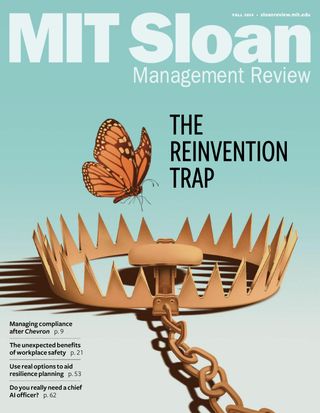

Denne historien er fra Fall 2024-utgaven av MIT Sloan Management Review.
Abonner på Magzter GOLD for å få tilgang til tusenvis av kuraterte premiumhistorier og over 9000 magasiner og aviser.
Allerede abonnent? Logg på
FLERE HISTORIER FRA MIT Sloan Management Review

MIT Sloan Management Review
Resolve the Conflict Between Efficiency and Resilience
Rethinking performance metrics and buffers can reduce disruption even in highly streamlined operations.

10 mins
Summer 2026

MIT Sloan Management Review
Why Can’t They See That I’m Visionary?
I’ve been trying to move up to the next level and want to be considered a candidate for senior leadership roles.
2 mins
Summer 2026

MIT Sloan Management Review
The Trap That Skilled Negotiators Miss
A simple reminder can help you avoid anchoring to the first offer and set deals on your own terms.
8 mins
Summer 2026

MIT Sloan Management Review
Scaling AI With Adaptive Governance
Maximize the value of AI investments and manage emerging risks by embedding flexible oversight processes.
17 mins
Summer 2026

MIT Sloan Management Review
Rethink Responsibility in the Age of AI
As AI systems take on more decision-making, leaders need to build shared narratives instead of assigning blame.
6 mins
Summer 2026

MIT Sloan Management Review
A Three-Minute Protocol to Reduce AI Manipulation Risk
OF THE POTENTIAL WEAKNESSES OF ANY SECURITY SYSTEM, THE HUMAN layer has always posed a key risk.
1 mins
Summer 2026

MIT Sloan Management Review
Gain Consumer Insight With Generative AI
Large language models are compressing research timelines with synthetic consumers, AI-moderated interviews, and qualitative research at scale.
14 mins
Summer 2026

MIT Sloan Management Review
Does Cultural Training Help Expats Succeed?
EVERY YEAR, MULTINATIONAL CORPORATIONS invest billions in global mobility programs.
1 mins
Summer 2026

MIT Sloan Management Review
Assessing Customer Reviews
HOW SHOULD COMPANIES EFFECTIVELY use or respond to an unwieldy array of customer opinions?
2 mins
Summer 2026

MIT Sloan Management Review
How Nespresso Builds Sustainability Into Its Business Model
Jean-Christophe Jaunin became CEO of Nespresso North America, the Nestlé unit that sells coffee brewing machines and capsules, on Jan. 1, 2026, after having served as global chief customer and technology officer.
2 mins
Summer 2026
Listen
Translate
Change font size