Prøve GULL - Gratis
Beating 'Not Invented Here' Syndrome
MIT Sloan Management Review
|Fall 2024
Resistance to external ideas hinders innovation. The right incentives can open minds.

When I was managing director of the German subsidiary of U.S.-headquartered SC Johnson, I witnessed "not invented here" (NIH) syndrome in action. The larger company paid scant attention to an innovative air freshener product successfully launched by an Asian subsidiary, apparently due in part to bias toward innovations originating from the United States. By chance, the Asian product came to the attention of the German subsidiary. We launched the product, now called Brise One Touch, with minor adaptations. It was a big success, taking a leadership position in the local market for that category with a 50% share and going on to do well in other markets.
NIH syndrome is a bias against ideas perceived as coming from outsiders. This bias can affect anyone in an organization. While there are rational reasons to reject some external knowledge - say, for intellectual property concerns or technical incompatibilities - this bias is often the driver, and it can be economically damaging when it leads to missed opportunities and fewer innovations. One research study surveyed 565 innovation projects from around the globe and found that only 16% of them remained entirely unaffected by NIH syndrome. This bias against outside ideas positively correlated with a reduced likelihood of project success.
My research into this phenomenon found that it can manifest at all levels of an organization and to different degrees but can be most entrenched among two types of individuals: doubters and resisters. Both lack motivation and hold strong negative attitudes toward external knowledge.
Incentivize the Doubters
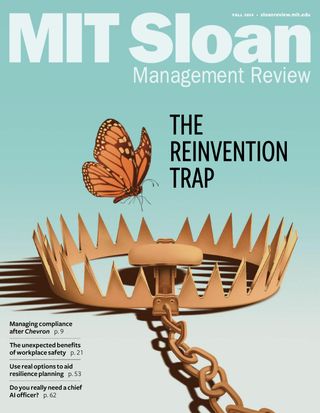

Denne historien er fra Fall 2024-utgaven av MIT Sloan Management Review.
Abonner på Magzter GOLD for å få tilgang til tusenvis av kuraterte premiumhistorier og over 9000 magasiner og aviser.
Allerede abonnent? Logg på
FLERE HISTORIER FRA MIT Sloan Management Review

MIT Sloan Management Review
Assess What Is Certain in a Sea of Unknowns
Understanding what won't change clarifies what might — and strengthens decision-making in volatile times.

13 mins
winter 2026

MIT Sloan Management Review
Ask Sanyin: Why Is It So Hard to Pull the Plug on a Project?
We're finding it difficult to wind down projects that no longer serve our priorities.
2 mins
winter 2026

MIT Sloan Management Review
Integrate Sustainability and Innovation to Find New Opportunities
Five common innovation practices can help leaders pursue sustainability as a growth strategy.
12 mins
winter 2026

MIT Sloan Management Review
The Case for Quiet Corporate Activism
Leaders concerned that they will be penalized for championing sustainability and diversity can still sustain their commitments.
11 mins
winter 2026

MIT Sloan Management Review
The Perils of Algorithmic Pricing
Some revenue management systems based on algorithms may lead to unintended collusion and antitrust violations.
9 mins
winter 2026

MIT Sloan Management Review
Broadening Future Perspectives at the Bank of England
Leaders at the U.K’s central bank sought to broaden their thinking about future risks and opportunities. Here’s how they built longer-term horizon-scanning capabilities and what they learned along the way.
9 mins
winter 2026

MIT Sloan Management Review
How Nesting Changes Platform Strategy
Should your platform host another platform — or be hosted by one? Here's how to think through the choices.
14 mins
winter 2026
MIT Sloan Management Review
Are You an Authentic Leader or an Authentic Jerk?
Leaders who are true to their values can inspire trust and respect, but not if \"being yourself\" becomes the problem.
13 mins
winter 2026

MIT Sloan Management Review
How to Make Scenario Planning Stick
Developing future scenarios can deepen leaders’ strategic insights. Establishing scenario planning as an ongoing capability and reaping its full benefits require linking it to other processes.
16 mins
winter 2026

MIT Sloan Management Review
A Faster Way to Build Future Scenarios
This streamlined approach to scenario planning incorporates AI and helps managers navigate future uncertainties more efficiently.
13 mins
winter 2026
Listen
Translate
Change font size