
Gå ubegrenset med Magzter GOLD
Få ubegrenset tilgang til over 9000 magasiner, aviser og premiumhistorier for bare
Prøve GULL - Gratis
What to consider when mixing your own feed
Farmer's Weekly
|September 01, 2023
Mixing your own feed can save you money in the short term, but can also cost you in the long term if you do not pay attention to sourcing the optimal ingredients.

Livestock farmers have had a tough time over the past few years due to the high price of commodities, such as maize. These have led to an increase in the price of feed. For most livestock operations, feed constitutes the largest percentage of all input costs, and an increase in the price of feed inevitably leads to a drop in a farmer’s profit margin. When a farmer buys animal feed, he or she is not only paying for the commodities used in the feed, but also for the cost of processing. As such, many farmers have turned to mixing their own on-farm rations to help lower their feeding costs.
While it may seem like a good way to manage input costs more effectively, farmers should be cautious when deciding on this approach. Mixing feed is not simply a matter of putting a few ingredients together, particularly as livestock operations exist to make a profit. Inferior feed will have a direct impact on the production efficiency of a farmer’s animals, and while a farmer may thus be saving money in the short term, mixing his or her own feed could end up costing him or her over the long term.
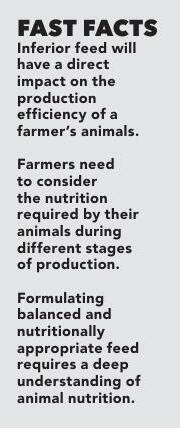
Formulating balanced and nutritionally appropriate feed requires a deep understanding of animal nutrition, as well as access to accurate nutritional information for various feed ingredients. Without proper knowledge and resources, it’s challenging to ensure that the feed meets the animals’ specific needs. It is also important to remember that animals’ feed requirements change depending on the stage of production they are in, and so it is also important for the farmer to fully understand what is required for each stage of production.

Denne historien er fra September 01, 2023-utgaven av Farmer's Weekly.
Abonner på Magzter GOLD for å få tilgang til tusenvis av kuraterte premiumhistorier og over 9000 magasiner og aviser.
Allerede abonnent? Logg på
FLERE HISTORIER FRA Farmer's Weekly

Farmer's Weekly
Pastry delights and cupcakes
The versatility of pastry in baking and cooking is best flaunted by two vastly different recipes appealing to the sweet and savoury tooth, while a novel way to bake those Christmas-themed cupcakes will also go down well.

4 mins
December 5-12, 2025

Farmer's Weekly
Specialised spider-hunting wasps
Wasps are apex predators of the insect world and have developed many survival strategies. One group of wasps focuses on hunting spiders to provide a source of food for their larval offspring
2 mins
December 5-12, 2025

Farmer's Weekly
From bulls to boardrooms: farming part-time as a professional
Maintaining a farm requires time, resources, and commitment. Farming part-time while being fully employed elsewhere can seem daunting and risky. Although it certainly presents unique challenges, it is feasible for some. Koot Klopper and Herman van Heerden spoke to Henning Naudé about how excellent time management and the delegation of resources, as part-time farmers, successfully keep their farms productive.
5 mins
December 5-12, 2025

Farmer's Weekly
Holy Shiitake: mastering the science of gourmet fungi
Mushroom production is inherently the practice of expanding mycelium. But since wanted and unwanted fungi flourish under the same circumstances, a mushroom farmer's biggest challenge is ensuring the right fungi prevails. Lindi Botha reports on Rory Brooks' learning curve.
9 mins
December 5-12, 2025
Farmer's Weekly
No more 'secret' price hikes?
'Secret' electricity price hikes in South Africa have been curbed in a game-changing court ruling, explains Felix Dube, lecturer in the Department of Law at the University of Venda.
4 mins
December 5-12, 2025

Farmer's Weekly
The cutworm scourge, and how to control it
The dominant cutworm, Agrotis segetum, is causing renewed, costly damage to South African maize, soya bean, and sunflower.
5 mins
December 5-12, 2025
Farmer's Weekly
Legislative gap requires a rethink on biosecurity controls
Since the dawn of democracy, the agriculture sector has cemented its place as one of the essential and trusted pillars for economic growth, job creation, and foreign earnings in South Africa.
2 mins
December 5-12, 2025

Farmer's Weekly
From kitchen experiments to a thriving meat empire
What started as an after-hours kitchen project in the Truter household has grown into the fully fledged meat empire Deli-Co. Brothers Pieter and Hendri Truter told Glenneis Kriel how they turned a local favourite into a multigenerational family business.
7 mins
December 5-12, 2025
Farmer's Weekly
Brushing up on your 'cow speak'
Experienced stockman and cattle judge Willie de Jager spoke to Sabrina Dean about some of the basics of reading cattle behaviour and how best to handle these animals.
8 mins
December 5-12, 2025

Farmer's Weekly
Corporate day job fuels farming dream
Marius Smit lives in the middle of Gauteng in Centurion and spends his workdays in the fast-paced high-stress corporate sector as a group forensic head for Discovery.
5 mins
December 5-12, 2025
Translate
Change font size