Prøve GULL - Gratis
Sovereign Data, Shared Responsibilities
DataQuest
|December 2024
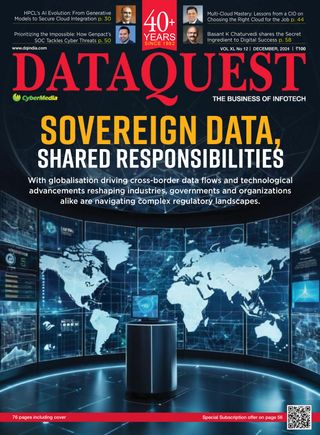
Data sovereignty-the principle that data is subject to the laws and governance of the country where it is generated-has become a defining issue of the digital age. With globalisation driving cross-border data flows and technological advancements reshaping industries, governments and organizations alike are navigating complex regulatory landscapes.

DATA WITHOUT BORDERS, SOVEREIGNTY WITHIN
Data sovereignty transforms how businesses manage, store, and secure information, from national security concerns to economic strategies and privacy advocacy.
This article dives deeper into the rise of data sovereignty, its implications, the challenges organisations face, and the strategies they employ to stay compliant while driving innovation.
THE RISE OF DATA SOVEREIGNTY
What Is Data Sovereignty?
At its core, data sovereignty reflects a nation’s effort to assert control over data generated within its borders. This control is not just about power—it’s tied to national security, economic independence, and the protection of citizen privacy. Countries enforce this through regulations requiring either:
• Data Localization: Storage and processing of data must occur within national boundaries.
• Regulated Data Transfers: Data can cross borders,but only under strict compliance frameworks.
Why Does Data Sovereignty Matter?
1. National Security
Governments seek control over data to safeguard sensitive information and reduce vulnerabilities to cyber espionage or external interference.
2. Economic Stability
Storing data locally promotes domestic IT ecosystems, creates jobs, and reduces reliance on foreign technology providers.
3. User Privacy and Trust
Localized data storage ensures compliance with domestic privacy regulations, fostering user trust in an era of widespread data breaches and surveillance concerns.
In the last decade, governments around the world have responded to cybersecurity threats, cross-border data flows, and user privacy concerns with stronger data regulations. Below is a snapshot of global data sovereignty trends:

Denne historien er fra December 2024-utgaven av DataQuest.
Abonner på Magzter GOLD for å få tilgang til tusenvis av kuraterte premiumhistorier og over 9000 magasiner og aviser.
Allerede abonnent? Logg på
FLERE HISTORIER FRA DataQuest

DataQuest
Cognizant CAIO Babak Hodjat explains how Agentic AI will transform enterprises
Cognizant CAIO Babak Hodjat discusses agentic AI, sovereign compute, multilingual models, and Green AI, outlining how India can translate its AI ambitions into scalable enterprise impact and ecosystem growth.

7 mins
March 2026

DataQuest
Are You Bleeding While Leading?
The stress is compounded because of global trade tensions and increased volatility in financial markets
6 mins
March 2026

DataQuest
FROM RANK TO READINESS: WHAT DEFINES INDIA'S BEST T-SCHOOLS IN 2026
Dataquest-CMR's 2026 survey shifts from scale to outcomes, measuring placements, research, industry integration, and governance to judge readiness.
5 mins
March 2026

DataQuest
India's test-drive, World's triathlon
Pushing the needle, by threading the AI needle- AWS' top honcho shares how partners matter in bridging the gap between what customers need and what technology solves. And why a pilot in India is as good as a production-scale deployment in any other country.
5 mins
March 2026

DataQuest
India's AI moment is not about models alone, but who gets access, trust, and control
At the AI Impact Summit, India’s AI story moved beyond hype to a harder question: can the country build AI that is trusted, inclusive, sovereign, and useful at scale?
5 mins
March 2026

DataQuest
Why India may need a middle-power AI alliance to secure digital sovereignty
India's IndiaAI Mission is bold, but experts argue a middle-power 'CERN for AI' could pool funds and data, to secure sovereign intelligence and public-good outcomes.
3 mins
March 2026

DataQuest
AI slop. Not AI spit. Yet
The shiny flavours of speed and scale with AI can silently burn away deeper and long-term issues like quality, credibility and traceability. AI slop is not just broccoli. It can easily turn into a death-cap mushroom.
8 mins
March 2026

DataQuest
The AI Crayon Box: Where's The Pink?
Bias, under-representation, stereo-types, gender-insensitive UI, Conspicuous gaps on solutions that females need- as we celebrate W-Day; it's a good time to ask, again - Has AI been cognizant of that age-old puzzle that has troubled the best of human brains for centuries: 'What Do Women Want?'
10 mins
March 2026

DataQuest
Engineering India's Al-First Data Centres at Hyperscale
Rohan Sheth explains how AI and HPC are reshaping India's data centres, from density and cooling to power economics, sustainability, and hyperscale decision criteria.
4 mins
February 2026

DataQuest
From copilots to colleagues: Why agentic AI is forcing enterprises to rethink control, trust, and culture
As AI agents shift from assisting to acting, enterprises must redesign governance, data controls, and security guardrails so autonomy stays auditable, reversible, and trusted.
2 mins
February 2026
Listen
Translate
Change font size