Prøve GULL - Gratis
Governments cannot accumulate capital
Business Brief
|BusinessBrief December/January 2025/26
Austrian economists argue that capital is more than just money, it is a living process in which private individuals set aside present consumption, conserve resources, and pour those resources into ventures they believe will yield increase later. That choice demands patience, sound judgment and - above all - ownership.
-

Since governments lack these ingredients, their so called capital formation is little more than political expenditure masked by economic jargon.
Understanding capital
To picture capital, imagine a farmer who buys better tools rather than spending his earnings on weekend trips. His decision channels effort from today into tomorrow.
Two forces make that leap possible:
Time preference
Some people happily defer gratification for a bigger future payoff, while others crave immediate satisfaction. Genuine capital accumulation on a nationwide scale thrives - not when the state spends on infrastructure, education or anything else - but when a large number of individuals are willing to defer consumption.
Entrepreneurial foresight
Waiting alone is useless unless the saver can foresee where demand will appear and steer resources accordingly.
Neither force can operate without private property. When you own an asset you can pledge it, improve it, or lose it. The possibility of profit - and the threat of loss - sharpens prudence and encourages long term thinking.
Why governments cannot accumulate capital
These fundamental constraints explain why government activity cannot produce authentic capital:
Lack of market feedback
Businesses live or die by the profit and loss statement. A surplus signals that resources are being arranged in ways customers value; a deficit warns of waste. Governments, financed by taxes rather than voluntary payments, feel no such sting. Votes, lobbying and jurisdictional turf fights - not consumer choice - guide their spending, so misallocation goes unpunished.
No authentic saving
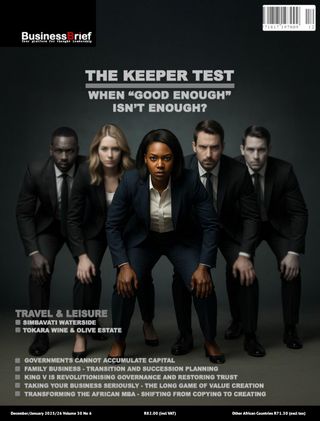

Denne historien er fra BusinessBrief December/January 2025/26-utgaven av Business Brief.
Abonner på Magzter GOLD for å få tilgang til tusenvis av kuraterte premiumhistorier og over 9000 magasiner og aviser.
Allerede abonnent? Logg på
FLERE HISTORIER FRA Business Brief
Business Brief
Carbon guidelines in context - aligning global practice for local construction
Could South Africa’s construction industry benefit from best-practice frameworks developed halfway around the world? And how well do international guidelines - such as the recently released Best Practice Guideline for Carbon Smart Construction Site[1] by the Hong Kong Construction Association - translate into local realities?

3 mins
BusinessBrief December/January 2025/26

Business Brief
Hospitality humans - the edge AI can't replace
While Al is projected to displace 300 million[1] jobs worldwide, the hospitality industry is making a contrarian bet: doubling down on people. This isn't sentimentality - it's survival. With 73%[2] of guests preferring human interaction, the sector runs on something technology can't replicate - genuine connection.
2 mins
BusinessBrief December/January 2025/26

Business Brief
Property investing - data, AI and disruption
Two decades ago, property investing relied on gut instinct and local gossip. The right address, a handshake, and a rough sense of what the neighbour's house sold for were often enough to close a deal. Today, the rules have changed. Technology, from machine learning models to satellite data and automated valuations, is rewriting how investors assess risk, spot opportunity and create long term wealth.
4 mins
BusinessBrief December/January 2025/26
Business Brief
AI in reporting readiness - what CFOs must get right
Finance leaders may be feeling the pressure to adopt AI into their reporting and planning environments, and it's understandable. CFOs are driven by board expectations, and many are of the opinion that staying ahead means adopting technology. At the same time, vendors are promoting it as the latest must-have, and these contribute to the wider narrative that its use in reporting is now unavoidable.
2 mins
BusinessBrief December/January 2025/26

Business Brief
Next-wave AI strategy from copilots to coordinated agents
For the better part of the last two years, the conversation around Artificial Intelligence (AI) has moved at breakneck speed. From the first Copilot demos to widespread experimentation across Microsoft 365, Power Platform, and Dynamics, we've watched a generation of users and businesses dip their toes into Al-powered productivity.
3 mins
BusinessBrief December/January 2025/26

Business Brief
Customer experience and loyalty - forging fulfilment from friction
Every small business owner wants happy, satisfied customers. But are those customers coming back? Loyalty is not only the holy grail of a sustainable business, it's also harder to achieve than most realise.
2 mins
BusinessBrief December/January 2025/26
Business Brief
AI infrastructure demands training vs inference at scale
The IT industry is undergoing one of its most defining shifts to date, driven by the explosive growth of generative AI. These powerful language models are pushing the limits of traditional data centre infrastructure. The upgrades operators prioritise will depend largely on whether they're handling Artificial Intelligence (AI) training or inference workloads.
3 mins
BusinessBrief December/January 2025/26
Business Brief
Swift's blockchain pivot - reinvention or slow obsolescence?
For years, industry headlines have circled around the same narrative - blockchain will kill Swift. The Society for Worldwide Interbank Financial Telecommunication, founded in the 1970s, has been the invisible layer behind trillions of dollars in global payments. Yet it's very design, slow, costly, and dependent on intermediaries, has made it an easy target for critics and innovators alike.
3 mins
BusinessBrief December/January 2025/26
Business Brief
Indemnity trigger rules - no payment, no cover
In ISMIE Mutual Insurance Co v Pergament, an Illinois appellate court reaffirmed a core principle of professional liability insurance - indemnity is not triggered unless the insured becomes legally obligated to pay damages.
1 mins
BusinessBrief December/January 2025/26
Business Brief
Taking your business seriously the long game of value creation
Consider this scenario. You have invested ten years into building your business. It has supported your lifestyle, paid salaries, funded personal expenses and allowed you to draw dividends.
4 mins
BusinessBrief December/January 2025/26
Listen
Translate
Change font size