
Gå ubegrenset med Magzter GOLD
Få ubegrenset tilgang til over 9000 magasiner, aviser og premiumhistorier for bare
Prøve GULL - Gratis
"We anticipate India will adopt decentralised models for managing CGTs, ensuring closer proximity between patients and treatment facilities"
BioSpectrum Asia
|BioSpectrum Asia April 2024
Cell and gene therapy (CGT) expert from Germany, Miltenyi Biotec has recently announced its entry into the Indian market to provide researchers, scientists and clinicians easier access to expertise, research, and manufacturing solutions.

The company is well poised to enable local development and manufacturing in India to drive affordable and accessible CGTs by academia and industry for Indian as well as global patients. In conversation with BioSpectrum Asia, Dr Boris Stoffel, Chief Executive Officer and Managing Director of Miltenyi Biotec, talks about the real challenges associated with the use of CGT, and the way forward.
Could you elaborate on the narrative behind Miltenyi Biotec’s invention of the groundbreaking technology that has led to the development of new procedures for treating diseases through Cell and Gene Therapy? How was this achieved?
Miltenyi Biotec, being a private entity, stands as the pioneer in next-generation technology within the field of Cell and Gene Therapy (CGT). The significance of this technology persists even after 35 years, as it emerged in 1989 at a time when the concept of disruptive technology was still nascent. Looking back 35 years, it's evident that our innovation was disruptive because, at that time, only a handful of labs worldwide utilised large-scale cell sorters. Specialised operators were required to sort immune cells from blood, making it a cumbersome process.
The invention of MACS technology revolutionised this landscape by enabling every researcher to utilise a simple column and antibodies coupled with small microbeads in a magnetic field to separate cells within a short timeframe. This democratisation of technology meant that researchers were no longer reliant on expensive, specialised equipment available only in select labs. At that time, Germany, for instance, had only two such sorters, one of which was located at the Institute of Genetics of Immunology, where Stefan Miltenyi, the founder, was a student.
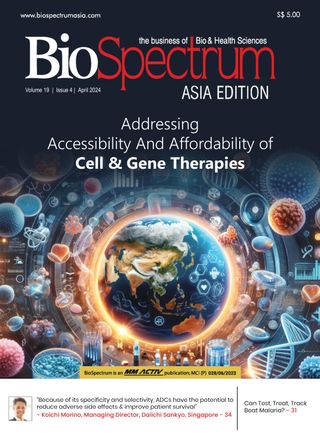

Denne historien er fra BioSpectrum Asia April 2024-utgaven av BioSpectrum Asia.
Abonner på Magzter GOLD for å få tilgang til tusenvis av kuraterte premiumhistorier og over 9000 magasiner og aviser.
Allerede abonnent? Logg på
FLERE HISTORIER FRA BioSpectrum Asia

BioSpectrum Asia
India Health Fund supports D-Nome to bolster molecular TB screening in India
India Health Fund (IHF), a Tata Trusts initiative, is poised to transform tuberculosis (TB) screening at scale by enabling the development of the world's most affordable molecular screening tool for TB.

1 min
BioSpectrum Asia May 2026

BioSpectrum Asia
BioOra and Octane Biotech sign LoI to expand cell therapy manufacturing using Cocoon Platform
BioOra, a commercialstage cell therapy company advancing CAR-T therapies for cancer patients, & Canadabased Octane Biotech Inc., an Octane Medical Group Company, has announced the signing of a Letter of Intent (LOI) to collaborate on the co-development & deployment of advanced cell therapies using the Cocoon automated cell therapy manufacturing platform.
1 min
BioSpectrum Asia May 2026

BioSpectrum Asia
NTU and NHG Health partner to advance healthcare education in Singapore
NHG Health's inaugural E3 (Educate, Elevate, Evolve) conference, held recently, was marked by a new partnership with Nanyang Technological University (NTU) Singapore, signalling a significant step in advancing healthcare education through interdisciplinary collaboration.
1 min
BioSpectrum Asia May 2026
BioSpectrum Asia
Gene Solutions introduces non-invasive prenatal screening technology triSure in Taiwan
Singapore-based startup Gene Solutions has introduced triSure, a revolutionary non-invasive prenatal screening technology.
1 min
BioSpectrum Asia May 2026
BioSpectrum Asia
How FemTech Spurt in APAC is Redefining Healthcare
Despite representing half the global population, women's health has historically received only a fraction of healthcare innovation and investment.
4 mins
BioSpectrum Asia May 2026
BioSpectrum Asia
China's Colossal Ageing Population and Low Birth Rate Challenge
China's recent policy initiatives pertaining to long-term care insurance, maternity insurance expansion, and primary healthcare reform reflect a coordinated attempt to address deep structural demographic challenges—most notably 'rapid population ageing' and declining birth rates.
2 mins
BioSpectrum Asia May 2026
BioSpectrum Asia
"We need to prioritise research as several common AYA cancers are significantly under-studied in Asian populations"
At the SingHealth Presidents' Scientific and Partners in Social-care (SPSOC) Conference, Assistant Professor Eileen Poon, Senior Consultant in Medical Oncology at the National Cancer Centre Singapore (NCCS) delivered an enlightening presentation.
7 mins
BioSpectrum Asia May 2026
BioSpectrum Asia
Shimadzu Scientific Instruments opens laboratory in San Francisco Bay Area
Shimadzu Scientific Instruments (SSI) has opened its new research and development (R&D) facility in South San Francisco, California, US.
1 min
BioSpectrum Asia May 2026
BioSpectrum Asia
"Building a lean team with deep operational expertise increases likelihood of success in rare disease drug development"
More than 300 million people worldwide are impacted by over 10,000 rare diseases, i.e. more than cancer and AIDS combined.
5 mins
BioSpectrum Asia May 2026

BioSpectrum Asia
Qiagen expands into bloodstream infection syndromic testing with new rapid QIAstat-Dx panel
Qiagen N.V. has announced its expansion into syndromic testing for bloodstream infections with the launch of the CE-IVDR-certified QIAstat-Dx BCID GPF Plus AMR Panel.
1 min
BioSpectrum Asia May 2026
Listen
Translate
Change font size