
Gå ubegrenset med Magzter GOLD
Få ubegrenset tilgang til over 9000 magasiner, aviser og premiumhistorier for bare
Prøve GULL - Gratis
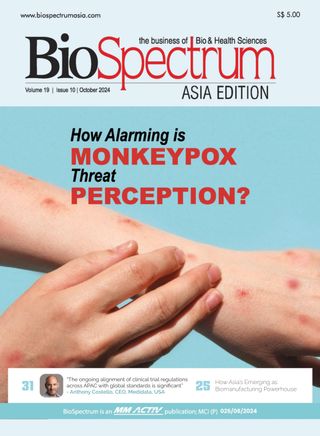
How alarming Is Monkeypox Threat Perception?
BioSpectrum Asia
|October 2024
As the world finally emerges from the grip of COVID-19, a new threat looms: Mpox (formerly known as Monkeypox).

In August 2024, the World Health Organisation (WHO) declared Mpox a global health emergency due to the rising cases of the new strain, clade I Mpox in Africa and Sweden, underscoring the urgent need for coordinated global action to monitor and contain the virus. As of September 2024, 2082 confirmed Mpox cases were reported globally, marking the highest number of monthly cases globally since November 2022. Nearly 400 cases have been reported in Asia Pacific this year.How are Asia Pacific countries stepping up surveillance measures and preparing their healthcare systems to combat Mpox? And just how significant is the threat posed by this outbreak? Let’s explore.
Two years after the World Health Organization (WHO) declared a global health emergency over an Mpox outbreak, a deadlier strain, clade 1b, emerged in the Democratic Republic of the Congo (DRC) in September 2023. This came just months after the WHO had ended the 2022 global health emergency in May 2023. By August 2024, the new outbreak, largely concentrated in the DRC and its African neighbours, was declared a Public Health Emergency of International Concern (PHEIC), sparking concerns of a wider spread similar to the 2022 outbreak, which affected 122 countries.
There are two clades of Mpox: clade I and clade II. Endemic to Central Africa, clade 1 is the most deadly, causing a severe illness and – in past outbreaks – killing up to 10 per cent of those who become unwell. Clade II, on the other hand, which had spread globally in 2022, has a survival rate of over 99.9 per cent and is endemic to West Africa. Five countries in Africa (Burundi, DRC, Kenya, Rwanda and Uganda) and three countries outside of Africa (Sweden, Thailand, India) have reported clade Ib monkeypox virus (MPXV) as of September 22, 2024.

Denne historien er fra October 2024-utgaven av BioSpectrum Asia.
Abonner på Magzter GOLD for å få tilgang til tusenvis av kuraterte premiumhistorier og over 9000 magasiner og aviser.
Allerede abonnent? Logg på
FLERE HISTORIER FRA BioSpectrum Asia
BioSpectrum Asia
India–EU FTA Paves Way for Expanded Healthcare Trade
On January 27, 2026, after years of negotiations, India and the European Union announced a landmark Free Trade Agreement.

4 mins
BioSpectrum Asia March 2026
BioSpectrum Asia
PreferCo and Glatt to open CoE for precision fermentation bioprocess scale-up in India
In a major boost to Government of India's BioE3 push, German major Glatt and India-based startup PreferCo have announced the launch of \"PreferCo-Glatt Centre of Excellence (CoE) for Bioprocess Scale-Up\" in Hyderabad's Genome Valley.
1 min
BioSpectrum Asia March 2026

BioSpectrum Asia
Women's Health Surge in APAC
The rising burden of diseases such as ovarian cancer, breast cancer, cervical cancer, infertility, etc. is emerging as the key driver of the women's healthcare market across the globe. While North America led the women healthcare market in 2025, Asia Pacific (APAC) is expected to witness the fastest growth this year onwards. As a result, governments across the APAC region, are recognising the importance of women's health and are launching initiatives, particularly under female leaders, to improve access to healthcare services. Moreover, a number of women-led startups are now developing new solutions to address this growing burden of women-associated diseases in the APAC region. Let's take a closer look.
6 mins
BioSpectrum Asia March 2026

BioSpectrum Asia
Hanchor Bio receives US FDA Orphan Drug Designation for HCB101 in gastric cancer
Taiwan-based biotech startup HanchorBio, Inc. has announced that the US Food and Drug Administration (FDA) has granted Orphan Drug Designation (ODD) to HCB101 for the treatment of gastric cancer.
1 min
BioSpectrum Asia March 2026

BioSpectrum Asia
Daiichi Sankyo names Dr John Tsai as Global Head of R&D
Japan-based Daiichi Sankyo Company has appointed Dr John Tsai to succeed Dr Ken Takeshita, who is stepping down as Global Head of R&D, effective April 1, 2026.
1 min
BioSpectrum Asia March 2026

BioSpectrum Asia
"The global trend is moving beyond centralised hubs toward distributed networks and domestic capability"
King Faisal Specialist Hospital & Research Centre (KFSHRC) and US-based Germfree Laboratories have announced a strategic partnership to develop Saudi Arabia's first fully integrated, modular Advanced Therapy Medicinal Product (ATMP) Manufacturing Campus.
4 mins
BioSpectrum Asia March 2026

BioSpectrum Asia
SEOUL'S RISKY DRUG PRICING RESET
Drug pricing has once again moved to the centre of policy debate in South Korea, with the government recently stepping back from its proposed generic drug pricing reform.
2 mins
BioSpectrum Asia March 2026

BioSpectrum Asia
Takeda and Iambic sign $1.7 B deal to advance AI driven design of small molecules
Iambic, a US-based clinical-stage life science and technology company developing novel medicines using its artificial intelligence (AI)-driven discovery and development platform, has announced a multi-year technology and discovery collaboration agreement with Japan-based Takeda Pharma that will use Iambic's industry leading AI drug discovery models to advance a select set of high-priority small molecule programmes, initially in Takeda's Oncology and Gastrointestinal and Inflammation therapeutic areas.
1 min
BioSpectrum Asia March 2026

BioSpectrum Asia
S.Biomedics announces partnership with Catalent to develop and manufacture TED-A9
US-based Catalent and South Korea-based S.Biomedics have announced a strategic partnership to support the development and manufacturing of TED-A9, S.Biomedics' allogeneic pluripotent stem-cell-derived ventral midbrain-specific dopaminergic precursor cell therapy being developed for the treatment of Parkinson's disease.
1 min
BioSpectrum Asia March 2026
BioSpectrum Asia
China revises drug administration regulations to spur innovation
China has revised regulations concerning drug administration in a bid to promote drug innovation, strengthen management of online sales of medicines and reinforce drug safety supervision.
1 min
BioSpectrum Asia March 2026
Listen
Translate
Change font size