Prøve GULL - Gratis
Strengthening the Draft Seed Act, 2025
AgroSpectrum
|January 2026
The Draft Seeds Bill, 2025, released by the Department of Agriculture & Farmers Welfare, marks a significant step towards modernising India's seed regulatory framework. Aimed at replacing the Seeds Act, 1966 and the Seeds (Control) Order, 1983, the proposed legislation seeks to ensure the availability of high-quality seeds, promote innovation, strengthen transparency in the seed supply chain, and protect farmers' interests, while also improving ease of doing business. The draft has elicited varied responses from industry, farmers' organisations, and other stakeholders, reflecting both opportunities and concerns associated with the proposed reforms.
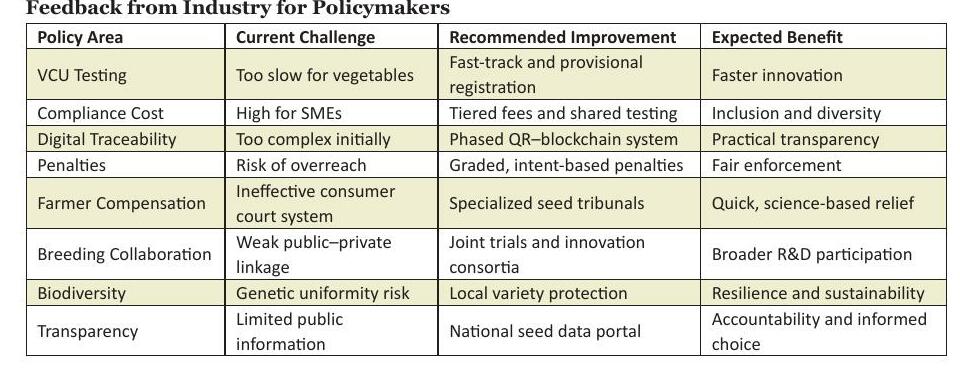
The Draft Seed Act, 2025 represents an important step toward modernising India’s seed regulation framework. However, the vegetable seed sector requires special consideration owing to its unique dynamics, short varietal life cycles, rapid innovation, diverse agro-climatic adaptability, and high private-sector participation. To ensure balanced growth and inclusivity, the Act can be further strengthened through targeted interventions that promote innovation, accountability, and farmer protection.
Vegetable crops typically have short commercial lifespans of three to five years, yet the current Value for Cultivation and Use (VCU) testing process extends over multiple seasons, delaying the market introduction of improved hybrids. A fast-track VCU protocol specifically designed for vegetables and other short-duration crops should be introduced, allowing multi-location private trials validated by accredited public laboratories. Private R&D data generated under NABL-accredited facilities must be formally recognised to avoid redundancy. Provisional registration for one season, based on preliminary VCU results, followed by post-release performance review, can help balance innovation with accountability. Developing crop-specific timelines, with single-season VCU testing for short-duration vegetables, will further accelerate innovation and availability.

Denne historien er fra January 2026-utgaven av AgroSpectrum.
Abonner på Magzter GOLD for å få tilgang til tusenvis av kuraterte premiumhistorier og over 9000 magasiner og aviser.
Allerede abonnent? Logg på
FLERE HISTORIER FRA AgroSpectrum
AgroSpectrum
Baramati, Agrovision and NBSSLUP seal landmark MoU to drive AI-enabled agriculture across Vidarbha
In a move that could redefine the technological architecture of Indian agriculture, Baramati-based institutions, Agrovision Foundation and the National Bureau of Soil Survey and Land Use Planning (NBSSLUP) have signed a landmark Memorandum of Understanding to accelerate the deployment of artificial intelligence across Vidarbha's farming systems.

1 min
January 2026
AgroSpectrum
AI driven orange farming: a key to increased yield and export opportunities for Vidarbha
“Use of AI driven orange farming methods, new high-yield orange varieties and use of latest post-harvest technologies will help make orange farming profitable in Vidarbha region,” said the experts in the special workshop “Citrus production and Processing technologies” held as a part of the Agrovision recently.
1 mins
January 2026

AgroSpectrum
Feed Is the New Battleground in India's Blue Revolution
Aquaculture isn't just another allied sector in India. It is increasingly becoming important for food security because of the protein requirements of the nation. Fishes and shrimp are being cultivated not just to meet domestic demand, but also being sought after globally as capture fisheries hit ecological limits.
4 mins
January 2026
AgroSpectrum
Agrovision to conduct activities for farmers throughout the year: Nitin Gadkari
Agrovision, an annual agricultural exhibition filled with knowledge sessions, conferences, and panel discussions, will now conduct activities for farmers throughout the year”, said Nitin Gadkari, Chief Patron, Agrovision Foundation and Union Minister Road Transport and Highways. He was addressing the valedictory session of 16th edition of Agrovision event in Nagpur.
3 mins
January 2026
AgroSpectrum
Building Climate Resilience from Seed to Shelf
At a time when climate volatility, water stress, nutritional insecurity, and biodiversity loss are converging into a systemic food crisis, agrobiodiversity is no longer a peripheral concern—it is rapidly becoming a strategic imperative. This was the central message that emerged from “Mainstreaming Agrobiodiversity in Global Value Chains,” an AgroSpectrum webinar organised in partnership with GFAIR – The Global Forum on Agricultural Research and Innovation, bringing together leading voices from international research, plant breeding, policy, and state-level implementation.
5 mins
January 2026
AgroSpectrum
How Al Is Solving India's Farm Labour Crisis: A Bottom-Up Model Led by Farmers Themselves
Ask any farmer today what their biggest challenge is, and the answer will invariably be the same: labour shortage. This problem becomes particularly acute in horticulture, where time-sensitive operations—from fruit care to harvesting and grading—demand both skilled and unskilled workers at precise intervals.
4 mins
January 2026
AgroSpectrum
“Agriculture will become the primary source of income in many parts of the world by 2030"
AgriPilot.ai is a global real-time agricultural intelligence platform created to enhance crop productivity, livestock management, and promote an efficient and sustainable future. This paradigm encompasses Al innovation in open and controlled environment agriculture, livestock management, offering a sustainable path forward. It empowers growers to make data-driven decisions, enhancing productivity and profitability while conserving vital resources such as water, energy, and land. In an exclusive interview with AgroSpectrum, Prashant Mishra,CEO & Founder, AgriPilot.ai shared his insights about Al driven agriculture and how it will bring transformation in the global agriculture sector. Edited excerpts;
5 mins
January 2026
AgroSpectrum
Scale, Structure, and India's Path to 2030
After years of disruption caused by the pandemic, geopolitical tensions, and supply-chain volatility, the global agrochemical industry is entering a new phase of structural growth. Demand is being reshaped not just by scale, but by sustainability, regulatory rigor, and technology integration. For India, this transition presents a strategic opportunity. With strong manufacturing capabilities, supportive policy frameworks, and rising global demand for reliable crop protection solutions, India is well positioned to emerge as a key export and innovation hub as the industry moves toward 2030.
3 mins
January 2026

AgroSpectrum
How We Can Tackle Counterfeiting and Raise Agricultural Integrity
Agriculture remains the backbone of India's economy, underpinning food security, farmer livelihoods, and rural growth. Yet the rapid spread of counterfeit agrochemicals—particularly pesticides—has emerged as a serious and largely invisible threat. Estimates suggest that fake products may account for up to 30–40 per cent of the market, eroding crop yields, degrading soil health and undermining farmer confidence. Beyond economic losses, counterfeiting weakens trust across agricultural value chains and threatens India's credibility as a reliable food producer, making urgent action on authentication and traceability essential.
6 mins
January 2026

AgroSpectrum
From AI to Orbit: Rewriting Indian Agriculture
Google, through its philanthropic arm, has committed $8 million to support four Centres of Excellence in Artificial Intelligence (AI) in India, one of which will focus on agriculture.
3 mins
January 2026
Listen
Translate
Change font size