Prøve GULL - Gratis
THE WIND CRIES MARTY
Stereophile
|November 2020
Composer Sasha Matson talks to veteran reedist Marty Krystall about film music, studio work, recording, and working with musicians from Serkin to Zappa.

MARTY KRYSTALL IS A MUSICIAN’S MUSICIAN, HIGHLY REGARDED AND KNOWN TO HIS PEERS IN THE LA MUSIC WORLD AS A TRIPLE-THREAT WIND PLAYER EQUALLY ADEPT AT JAZZ, CLASSICAL, AND IN THE STUDIO. HE IS ALSO AN AUDIOPHILE, A RECORDING ENGINEER, AND A RECORD COMPANY OWNER, HAVING CREATED THE K2B2 LABEL WITH BASSIST AND COLLEAGUE BUELL NEIDLINGER IN 1979.
Krystall is a veteran of hundreds of recording sessions, in all music genres and media types. You have heard his playing even if you don’t know it; in this respect, he’s typical of other world-class musicians you may not have heard of: remarkable, individual talents who have been making music for decades in the musical vineyards of La La Land.
A native son of Los Angeles who came of age in the 1960s, Krystall has musical roots that take eclecticism to the extreme. Early on, he was hooked on progressive jazz. He committed himself to performing the most challenging of that music. He became a ferociously adept player on his primary axes, tenor sax and the clarinets. As a leader, Krystall has chaired combos whose repertoire focuses on the compositions of Thelonious Monk and Herbie Nichols. He has played and recorded classical music with some of the best musicians of recent decades.
Krystall is also a composer himself. The personnel in his bands have included a who’s who of Los Angeles– based jazz virtuosi.
I first met Marty in Los Angeles in the late 1980s, when he played for me on a number of film-scoring sessions. Some were done in actual studios, others in my garage, where he would come in and enrich the synthesizer scores I had generated on my 8-track Otari tape deck. We knew many of the same players and composers and even did similar music-proofreading work, looking for mistakes in the handwritten parts copyists prepared for sessions, back before computers took over that job.
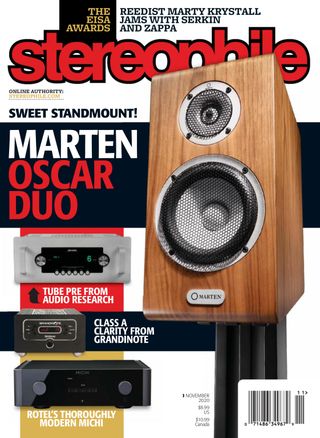

Denne historien er fra November 2020-utgaven av Stereophile.
Abonner på Magzter GOLD for å få tilgang til tusenvis av kuraterte premiumhistorier og over 9000 magasiner og aviser.
Allerede abonnent? Logg på
FLERE HISTORIER FRA Stereophile

Stereophile
Life in the emerald beyond
If you find yourself in Monaco on a Sunday night, make your way to La Note Bleue, a cozy restaurant and music bar on the beach by the Avenue Princesse Grace. There, you're likely to find a legendary world/fusion guitarist sitting in with a group of young jazz musicians eager to cut heads with the acknowledged maestro of inner awareness and otherworldly spirits. Forever known to some as “Mahavishnu,” you can call him by his birth name, John McLaughlin.

3 mins
December 2025

Stereophile
36 sides of late Bowie
I Can't Give Everything Away is the sixth and last of the Bowie box sets that survey specific periods in the artist's career. The first was Five Years 1969–1973, released in September 2015. That was followed by Who Can I Be Now? (1974–1976), A New Career in a New Town (1977–1982), Loving the Alien (1983–1988), Brilliant Adventure (1992–2001), and finally the new set. Together, the six sets are an impressive testament to a musical giant—a heavyweight tribute figuratively and literally. You could use this last installment to pump up your biceps.
3 mins
December 2025
Stereophile
Is this the ultimate old-school analog move?
Dedicated readers know that lately in this space I’ve been on something of an analog kick. Two months ago, in the October issue,¹ I wrote about refurbishing and modding my old McIntosh FM tuner. Last month’s column (November) was on the much-discussed but little-understood topic of the skating force on a phono cartridge stylus.²
4 mins
December 2025
Stereophile
STEREOPHILE'S 34TH ANNUAL PRODUCT OF THE YEAR 2025 AWARDS
Stereophile's Product of the Year Awards were first published in 1992.1 I decided at that time that, in contrast to other publications' awards schemes, we would keep the number of categories to a minimum.
21 mins
December 2025
Stereophile
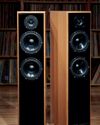
DeVore Gibbon Super Nine
LOUDSPEAKER
11 mins
December 2025
Stereophile
Some marketing claims are true
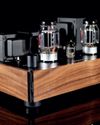
None of the amps I build are better than the others,” Justin Weber of Ampsandsound told me not long after we met. “They are just different.” I may have smirked inwardly. According to his company’s website, Weber makes no fewer than 23 amplifier models, many capable of driving both headphones and speakers, ranging from the $2700 Kenzie OG to the $38,000 Arch Monos. Are they really all equally good?, I wondered. Surely this was just a clever Buddhist ploy to distract us from some of his amps’ high prices. Doesn't the extra $35k spent on the Arch Monos buy you something more desirable than the performance offered by the little Kenzie? Writing for an audio magazine means I hear a lot of marketing claims, some more risible than others, and I have learned to take them with an entire seabed worth of salt.
11 mins
December 2025

Stereophile
Lotti Golden
Her life became a whirlwind. Taking the train in from Brooklyn to Manhattan to pitch songs and experience the East Village scene, she landed a song-publishing deal at age 14. In 1968, at 18, after a chance meeting in an elevator, a legendary songwriter/record producer was interested in assisting her in making her debut album. Released on Atlantic Records in 1969, Lotti Golden's Motor-Cycle was wildly experimental and ahead of its time. Seemingly poised for success, the album and her career suddenly vanished.
4 mins
December 2025

Stereophile
Baby you can drive my car(tridge)
While I was coming to grips with this month's review subject, the idler drive Garrard 301 Advanced, I began to think about the various methods that have been used to spin turntable platters over the years. Since the transition a century ago from windup clockwork to electric motors, there have basically been three ways to spin a turntable platter: idler drive, belt drive, and direct drive. True, there have also been a few designs that go their own unique ways, such as the rare, water-driven Oasis made by David Gillespie of Saturn Audio in the late 1970s and the gear-driven H.H. Scott 710 I once owned and foolishly sold. But almost everything made since the 1950s uses one of the three main drive systems. Even the Omega Drive system, which was used by Wilson Benesch on their extraordinary GMT One turntable, is at its core a direct drive design.
10 mins
December 2025

Stereophile
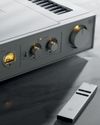
Audio Research Reference 330M
MONOBLOCK POWER AMPLIFIER
19 mins
December 2025
Stereophile
MANUFACTURERS' COMMENTS
MoFi Distribution would like to thank both Ken Micallef and John Atkinson for their time and effort reviewing the HiFi Rose RA280 integrated amplifier (November 2025, p.93).
2 mins
December 2025
Translate
Change font size