Prøve GULL - Gratis
Will Google's Alphabet Pay Off?
Fast Company
|April 2016
When Google became Alphabet, the rationale seemed simple: that a company of companies can innovate faster than a single large beast. But that's only the start.
-

"It’s kind of counterintuitive,” Google co-founder Larry Page remarked a couple of years ago. “Normally in a business, you think about, ‘What’s the adjacent thing that I can do?’ But maybe you can actually do more projects that are less related to each other.”
Back then, Page was explaining why his company—whose mission, officially, is to organize the world’s information and make it universally accessible and useful—had expanded to address everything from teaching automobiles to drive to researching ways to extend the human life span. At the time, the insight seemed classic Page, a heartfelt defense of unconventional thinking. Today it feels like something more: a premonition of perhaps the most radical, labyrinthine corporate restructuring of the digital era.
Page released a letter last August announcing the reconfiguring of Google into a conglomerate called Alphabet. It described Alphabet as a new holding company that would be composed of independent operating units. The Google search engine and related businesses—including Android, Gmail, and YouTube, to name a few—would be just one of them, and although it wasn’t initially clear, Alphabet would be home to nine other companies, including Calico (the health care company whose goal is to lengthen life expectancy), Verily (the home of the company’s “smart” contact lens), X (its R&D arm), Deep Mind (artificial intelligence), and Access (all of the company’s high-speed Internet initiatives). In February, Alphabet added its 11th unit when it elevated the think tank/tech incubator formerly known as Google Ideas into its own entity called Jigsaw.
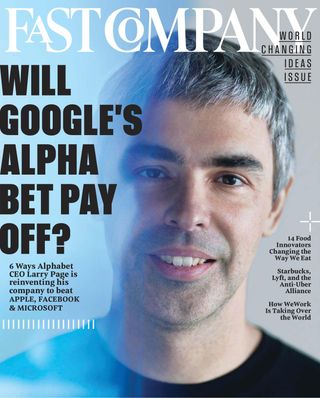

Denne historien er fra April 2016-utgaven av Fast Company.
Abonner på Magzter GOLD for å få tilgang til tusenvis av kuraterte premiumhistorier og over 9000 magasiner og aviser.
Allerede abonnent? Logg på
FLERE HISTORIER FRA Fast Company

Fast Company
EMAIL IS BACK! IT NEVER REALLY WENT AWAY.
FIFTY YEARS IN, EMAIL HAS BECOME MORE ESSENTIAL THAN EVER—AND THE KEY TO UNLOCKING PERSONALIZED AI.

7 mins
Winter 2025 - 2026

Fast Company
RED WHITE & DENIM
LEVI STRAUSS & CO., THE MOST QUINTESSENTIAL AMERICAN BRAND, IS SUDDENLY HOLDING THE TORCH FOR AMERICA ITSELF.
13 mins
Winter 2025 - 2026

Fast Company
WHO'LL START THE RAIN?
RAINMAKER FOUNDER AND CEO AUGUSTUS DORICKO WANTS TO HELP DROUGHT-PRONE AREAS BY USING DRONES TO NUDGE CLOUDS INTO PRODUCING SNOW AND RAIN. HE'S GENERATING A STORM OF CONTROVERSY IN THE PROCESS.
16 mins
Winter 2025 - 2026

Fast Company
DEATH TO BORING CORPORATE GATHERINGS!
WANT A STRONG RETURN ON YOUR EVENT BUDGET? START FOCUSING ON VIBES.
2 mins
Winter 2025 - 2026

Fast Company
HOW ONE BIG IDEA CAN CHANGE EVERYTHING
SANDISK'S INNOVATION CULTURE IS MAKING AI MORE COST AND ENERGY EFFICIENT
2 mins
Winter 2025 - 2026
Fast Company
REAL INTEL ABOUT AI
NO, YOU'RE NOT HALLUCINATING: THIS ISSUE IS packed with fresh reporting about AI.
2 mins
Winter 2025 - 2026

Fast Company
CELEBRATING DIRT WHILE CHALLENGING TABOOS
DIRT IS GOOD FINDS NEW MEANING IN STAINS TO DRIVE BRAND ENGAGEMENT
2 mins
Winter 2025 - 2026

Fast Company
Untainted Love
Hinge is winning the dating game. Can it stay on top?
8 mins
Winter 2025 - 2026

Fast Company
CENTURIES OLD, FUTURE FOCUSED
LLOYDS BANKING GROUP'S BRAND REINVENTION PROVES THAT LEGACY CAN BE A LAUNCHPAD
2 mins
Winter 2025 - 2026

Fast Company
AI 20
These 20 technologists, entrepreneurs, corporate leaders, and creative thinkers are pushing artificial intelligence in unexpected directions.
20 mins
Winter 2025 - 2026
Translate
Change font size