Prøve GULL - Gratis
Science For Just Solutions
Down To Earth
|May 16, 2022
If science-policy interfaces are to deliver just and effective solutions to climate change, they must involve indigenous peoples and local communities

When presenting my research on global institutions established to guide policy-making on environmental challenges, my (mostly North American and European) audiences will often wonder at the need to scrutinise these science-policy interfaces. Isn’t the only thing that matters, someone will inevitably ask, is that we have asked the best scientists on the planet to guide us?
This is typically when I draw from Anil Agarwal and Sunita Narain’s seminal 1991 piece, “Global warming in an unequal world”. Agarwal and Narain called out the environmental colonialism evident in a 1990 report by the US-based World Resources Institute purporting to measure a country’s greenhouse gas emissions. I invite my interlocutors to consider the distinction Agarwal and Narain draw between “luxury” and “survival” emissions. We then consider what gets erased when we take up the now commonplace unit: the metric tonne of CO2 (or of CO2 equivalent). From there, it is easier to understand how the assumptions stemming from Eurocentric knowledge have gone on to constrain not only the output of science-policy interfaces but also the climate negotiations and policies that followed.


Denne historien er fra May 16, 2022-utgaven av Down To Earth.
Abonner på Magzter GOLD for å få tilgang til tusenvis av kuraterte premiumhistorier og over 9000 magasiner og aviser.
Allerede abonnent? Logg på
FLERE HISTORIER FRA Down To Earth

Down To Earth
Bitter pill
THE WEB SERIES PHARMA EXPOSES HARSH TRUTHS OF THE PHARMACEUTICAL INDUSTRY, WHERE PROFIT OFTEN BECOMES MORE IMPORTANT THAN HUMAN HEALTH

3 mins
January 16, 2026
Down To Earth
CHAOS IN-DEFINITION
The Aravallis are perhaps India's most litigated hill range. More than 4,000 court cases have failed to arrest their destruction. The latest dispute concerns a narrow legal definition of this geological antiquity, much of which has been obliterated by mining and urban sprawl. While the Supreme Court has stayed its own judgement accepting that definition, it must see the underlying reality and help reconcile development and national security with conservation.
19 mins
January 16, 2026

Down To Earth
BITS: INDIA
Indore has recorded 16 deaths and more than 1,600 hospitalisations between December 24 and January 6.
1 min
January 16, 2026

Down To Earth
GUARANTEE EXPIRES
India's rural employment guarantee law is replaced with a centrally controlled, budget-capped scheme. Is this an attack on the right to work?
3 mins
January 16, 2026
Down To Earth
BLOOM OR BANE
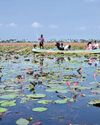
Surge of vibrant pink water lilies in Kuttanad, Kerala, provides socio-economic benefits, but the plant's ecological impacts must be understood
4 mins
January 16, 2026
Down To Earth
INVISIBLE EMPLOYER
Field and academic evidence shows sharp falls in casual agricultural employment at places where groundwater access declines
3 mins
January 16, 2026

Down To Earth
Schemed for erasure
Does the VB-G RAMG Act address structural weaknesses long observed in MGNREGA's implementation?
10 mins
January 16, 2026

Down To Earth
School of change
An open school in Panagar, Madhya Pradesh, aims to protect children of tribal settlements from falling into the trap of addiction
2 mins
January 16, 2026

Down To Earth
PULSE OF RESILIENCE
As a climate-ready crop, cowpea shows potential for widespread use in India
3 mins
January 16, 2026
Down To Earth
BITS GLOBAL
Britain recorded its hottest and sunniest year ever in 2025, the country's meteorological office said on January 2.
1 min
January 16, 2026
Translate
Change font size