Prøve GULL - Gratis
Quash The Dogma
Down To Earth
|September 01, 2019
Most policies to tackle desertification are bound to fail. The problem will get solved as soon as they become holistic

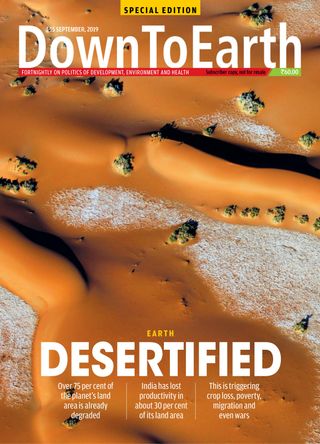
I ONCE heard evolutionary biologist Elisabet Sahtouris say, “If we had viewed Earth from space for thousands of years, we would describe humans as a dessert-making species.” Over that time, we would have watched the few natural deserts that receive almost no rainfall, expanding into regions that receive rainfall as high as 1,000 mm, or more. Such environmental degradation caused by one species is terrifying and it is entirely due to humans. This desertification is occurring in regions that experience seasonal rainfall with long dry periods and is the greatest visible sign of human presence.
Before I go any further, let’s look at the symptoms of desertification, which include increased frequency and severity of droughts and floods, poverty, social breakdown, mass emigration, violence, war, and climate change. I do not include biodiversity loss as a symptom because desertification itself is a symptom of biodiversity loss, starting with the loss of vital soil-covering plant material. Exposed soil between plants results in the available rainfall becoming less effective as water runs off the soil surface or evaporates out of soil, which is why droughts and floods increase.
Over millennia, desertification has led to the failure of many civilizations. During my lifetime (and I’m 84), trillions of dollars have been spent and millions of lives lost because we continuously address only the symptoms. We all know that to be successful, we must address the cause of a problem.

Denne historien er fra September 01, 2019-utgaven av Down To Earth.
Abonner på Magzter GOLD for å få tilgang til tusenvis av kuraterte premiumhistorier og over 9000 magasiner og aviser.
Allerede abonnent? Logg på
FLERE HISTORIER FRA Down To Earth
Down To Earth
Popular distrust
THE WORLD seems to be going through a period of stasis despite facing an unfathomable polycrisis.

2 mins
February 01, 2026
Down To Earth
CONSERVE OR PERISH
Periyar Tiger Reserve has rewritten Indian conservation by turning poachers into protectors and conflict into coexistence
5 mins
February 01, 2026

Down To Earth
'Rivers need to run free'
From Tibet to West Bengal, the Brahmaputra is the pulse of communities and ecosystems along its course. But what are the risks the river faces through human interventions, particularly dams, discusses journalist, author and filmmaker SANJOY HAZARIKA in his new book, River Traveller.
4 mins
February 01, 2026
Down To Earth
India is facing up to its innovation lag
There are signs now that India is acknowledging the superior strides made by China in a frontier technology like Al
4 mins
February 01, 2026

Down To Earth
Competing concerns
What are the repercussions of the EU-Mercosur pact that have made European farmers protest against the free trade agreement?
4 mins
February 01, 2026

Down To Earth
From fryer to flight
Sustainable fuel made from used cooking oil can play a pivotal role in helping India achieve its aviation emission reduction goals. Measures to collect this oil must be revamped
4 mins
February 01, 2026
Down To Earth
ACCESS OPEN
An amendment to India's nodal forest conservation law opens up forests across India to commercial exploitation by the paper industry
6 mins
February 01, 2026
Down To Earth
DRINK FROM TAP CAN BE A REALITY
As cities across India struggle to supply safe piped water, Odisha offers a success story
2 mins
February 01, 2026

Down To Earth
GREAT DRYING
The Earth is hotter than at any point in the past 100,000 years, with 2023-25 becoming the warmest three-year period on record and also breaching the 1.5°C threshold for the first time. One fallout is dwindling freshwater.
22 mins
February 01, 2026

Down To Earth
Green redemption
Restoration of grasslands of Kerala's Pampadum Shola National Park, once dominated by invasive Australian wattles, see a return of streams and native species
1 mins
February 01, 2026
Translate
Change font size